

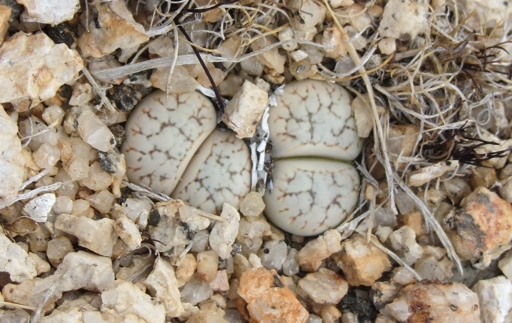
In a small area of Namibia’s Erongo Mountains, a tiny, pebble-like plant grows on a very thin layer of gravel. This succulent, Lithops werneri, is found in just one tiny 4 square-kilometer (1.5 square-mile) area, according to the IUCN, the global wildlife conservation authority. With more than an 80% decline in its population since 1981 and fewer than 200 plants remaining in the wild, the species was listed as critically endangered on the IUCN Red List in February 2026. Sonja Loots, manager of the Threatened Plants Programme at Namibia’s National Botanical Research Institute, told Mongabay by email that the plant “has always had a restricted range”. After it was first scientifically described in the 1950s, the succulent was “heavily harvested for the horticulture market in Europe”, she said. “Since then it was searched for numerous times by several succulent enthusiasts, but additional populations were never discovered.” The plant was even once thought to be extinct, but was found again in the original location in 2012, Soots said. A census in 2012 recorded 659 plants, according to the IUCN, but subsequent surveys found only 118 plants in 2019 and 163 in 2020. Lithops are a group of dwarf succulents, commonly called living stones or pebble plants, found across South Africa, Namibia and Botswana. These plants only grow on certain rocky outcrops and typically have just a single pair of water-storing succulent leaves attached to some roots, Loots said. L. werneri grows in a very thin layer of gravel, approximately 2 centimeters…This article was originally published on Mongabay
From Conservation news via This RSS Feed.
Really interesting. I see these occasionally (once a year) in big sales displays in garden centres in Australia, where we have a similar climate to Namibia. I presume large cultivated populations survive beyond the original distribution.
Not defending their over-harvest, just stating personal experience seeing lots of their cultivars available.
