

Government restores damaged power capacity while launching measures to prepare for a forecast super-El Niño.
Venezuela’s acting President Delcy Rodríguez on Sunday announced a nationwide plan to strengthen the country’s electricity system following damage caused by the June 24 earthquakes, while unveiling preventive measures to mitigate the expected impact of a forecast super-El Niño climate event.
Power Recovery Underway
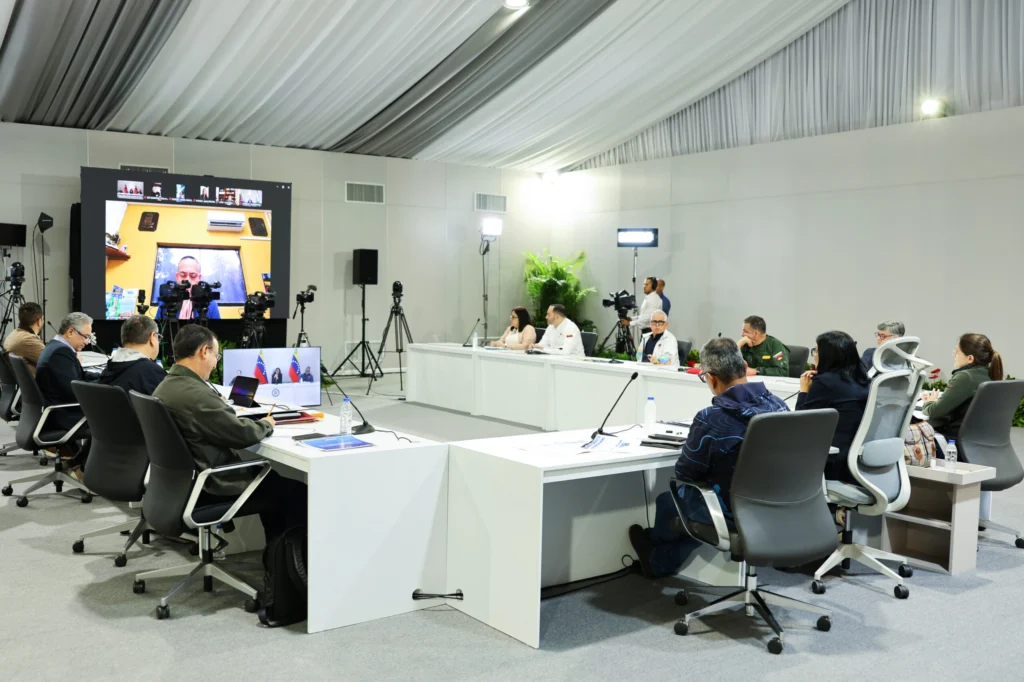
Speaking by videoconference with governors, government officials and the National Electric System (SEN) leadership, Rodríguez said 300 megawatts of generation had been restored at the TermoCarabobo thermoelectric plant, recovering half of the 600 MW the facility was producing before the earthquakes. She said full restoration is expected in the coming weeks.
Rodríguez attributed recent instability and fluctuations in the national grid to damage sustained at TermoCarabobo.
“Thermoelectric plants not only generate electricity, but also serve as a power regulator for the entire system, particularly the connection between the central and western regions of the country,” she said.
The June 24 earthquakes also damaged transmission towers and power lines between Planta Centro and Yaracuy. Rodríguez praised the Ministry of Electric Energy for the speed of its restoration work.
To reinforce the country’s electricity supply, she announced a recovery plan aimed at adding 4,800 megawatts of thermoelectric generation capacity before the end of 2026 through international agreements with companies including General Electric.
“While we are addressing the contingency caused by the double earthquake, we are preparing to face the potential consequences of a climate emergency expressed through a super-El Niño,” Rodríguez said.
Preparing for Super-El Niño
Rodríguez warned that South America is expected to experience the effects of a super-El Niño between August and October, with impacts extending into early 2027. She said the phenomenon is expected to bring prolonged drought, significantly higher temperatures and reduced rainfall.
“Super-El Niño refers to climatological periods of severe drought, in which temperatures increase significantly, rainfall periods are reduced and water sources decline,” she said.
She also pointed to what she described as a broader global climate emergency marked by severe rainfall, flooding, landslides, heatwaves and wildfires. Rodríguez said ocean temperatures had risen from 1.25°C to 1.94°C, exceeding the threshold discussed under the Paris Agreement.
Water, Fire Prevention and Food Production
Rodríguez instructed Environment Minister Nelson Rodríguez and Vice President Isabel Iturria to activate wildfire prevention measures, monitor reservoirs and protect water basins.
She also called for a nationwide campaign to reduce electricity and water consumption, urging households and workplaces to conserve both resources.
In addition, Rodríguez directed the National Economic Council and Venezuela’s agro-industrial sector to coordinate a special production plan to safeguard food output against temperature fluctuations and electrical discharges, supported by police deployments to help protect the population and the environment.
The measures announced by the government combine the continued recovery of infrastructure damaged by the June earthquakes with preparations to reduce the potential impact of prolonged drought and higher temperatures on Venezuela’s electricity, water and food systems.
From teleSUR English via This RSS Feed.