

Chicago, IL – On Thursday morning, July 30, the Chicago Board of Education passed an amended budget to avoid over 1000 layoffs of workers in Chicago Public Schools (CPS). The revised budget counts on the state of Illinois to allocate an additional $150 million to CPS for the 2026-2027 school year. The amount is a fraction of the funding Illinois committed to provide to school districts under the Evidence-Based Funding (EBF) for Student Success Act, passed back in 2017. Unions, community organizations and other stakeholders are pressuring the general assembly and Governor J.B. Pritzker to follow through on these commitments.
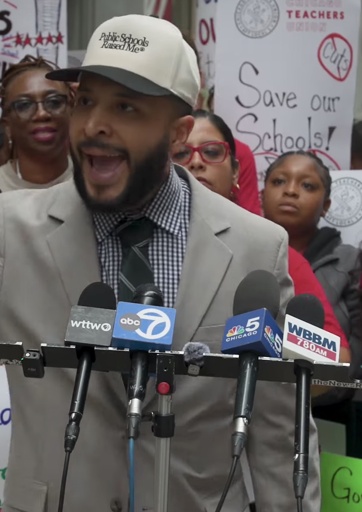
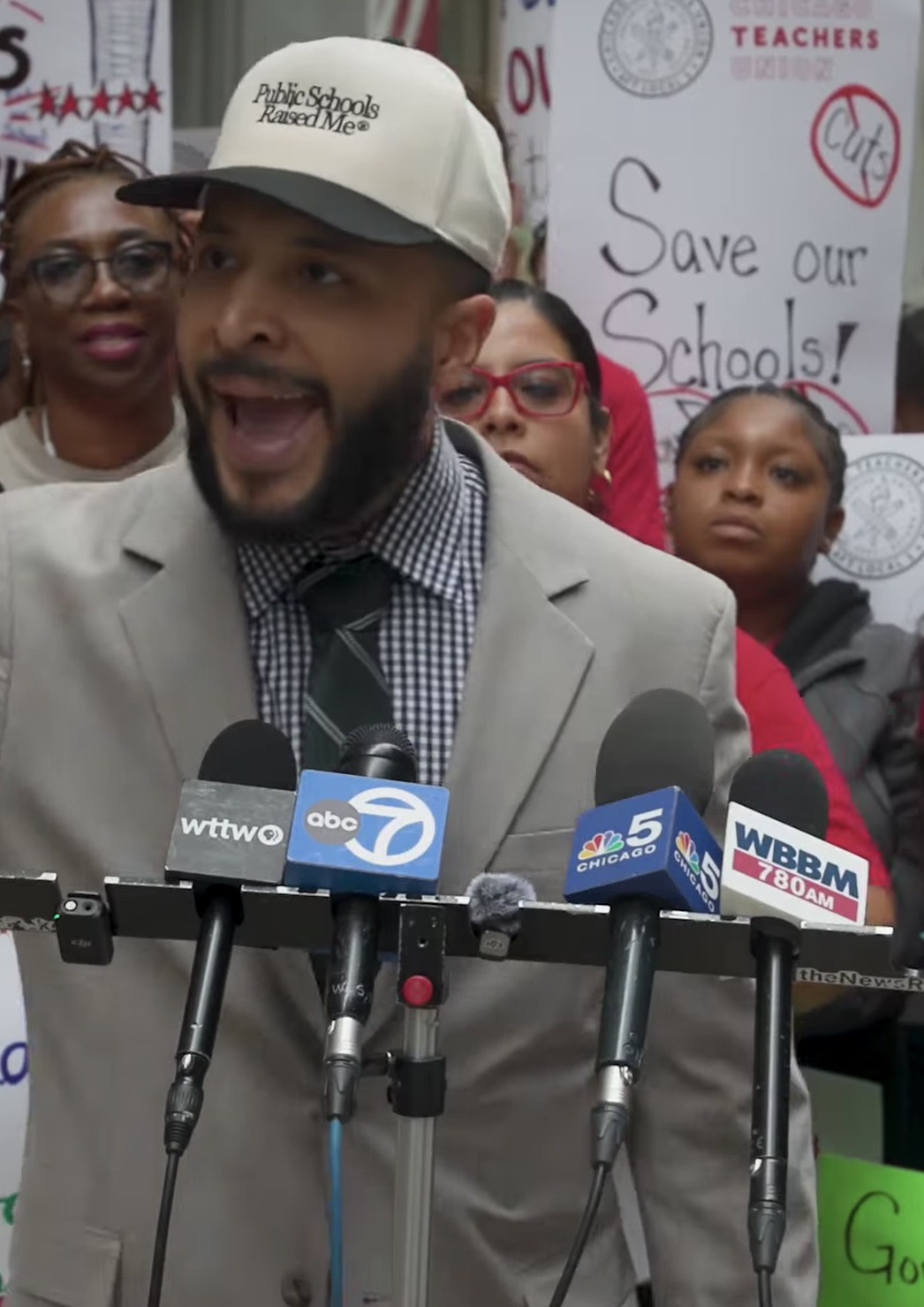
Hundreds of students, teachers and other school workers gathered before the board meeting in downtown Chicago. CPS students in youth organizations demanded more mental health programming and staff. Chicago Teachers Union (CTU) members wore red and carried signs reading “Budget incomplete” and “Protect our students.” Lunchroom workers, organized with Unite Here Local 1, demanded a contract from CPS after a year of stalled negotiations.
Inside the board meeting, CPS Chief Executive Officer Macquline King urged the board to accept CPS’s budget proposal unamended. The proposal featured layoffs of over 700 teachers, 800 school support personnel, and 100 central office and citywide staff. She emphasized the need to close a $732 million budget deficit amidst declining student enrollment.
During public comment, however, board members heard from many CTU members about the negative impacts that the proposed layoffs would have on the students and the school communities in the coming school year. Libby Lundeen, a second-grade teacher in the Austin neighborhood, said the layoffs will leave her school with only one fourth-grade teacher for a classroom of 45 students, a size that is “untenable.”
“These layoffs may be numbers to you, but to the schools they serve, they are instrumental in keeping our schools running and our students learning,” Lundeen said. “Join us to demand that the state pay its share and save our educators. Do not accept this current budget without exhausting all options.”
Many speakers united around the call to start the school year with the staff in place, then fight for the state funding required to maintain them through the end of the school year.
In response to such community pressure, school board member Michilla Blaise introduced the amendment to increase anticipated state revenue by $150 million and to use this money to “avoid” making the layoffs permanent. She emphasized that “over 75% of the staff laid off are people of color” and that the state is “the only path to long-term structural solutions.”
In 2017, the Evidence-Based Funding (EBF) for Student Success Act committed the Illinois legislature to fund schools at 90% of adequacy by 2027. With the deadline upon us, Chicago Public Schools is funded at only 73% of what it needs to provide students with an adequate education. An estimated $985 million would be required to meet the state’s initial commitment. Even with the $150 million in additional revenue that the amendment assumes from the state, the district would continue to be funded at less than 77% of adequacy.
Board member Jitu Brown gave further context to the relative shortcomings and inequities of state funding. “For three decades, Illinois was 49th in public education due to an overreliance on property taxes, despite the fact of having an international city within its midst. This was foundational to creating an apartheid school system. The schools in Streeterville and Lincoln Park, by design, were far more resourced than schools in Austin and Altgeld Gardens. The state has caused harm, and they owe us.”
Brown continued to emphasize the need for long-term structural solutions to the deficit. “If you look at other large urban districts, Los Angeles funds between 58% and 70% of their schools from the state of California; New York, 40% to 48%; Chicago, 29%.”
The amendment to assume increased state funding passed by a vote of 11-7 with one abstention. CTU representatives praised the decision. In an interview with Fox 32 Chicago, CTU Vice President Jackson Potter emphasized the evidence of political will in Springfield, with Speaker Emanuel “Chris” Welch pledging to push for more funding in the November veto session.
In contrast to King’s focus on the negative outcomes of the 2017 budget process, Potter pointed out the positive outcomes from the same time period. “When we had a similar crisis the last time the Board of Education included state money that hadn’t yet manifested in the budget in 2017, we won the biggest increase in school funding in the state’s history. Ten years later, now we have to win them fully funding the formula that is part of the state statute that is legally required.”
In the meantime, Jackson does expect a “restoration” of critical positions as a result of the budget amendment. “So those class sizes that were 45 can come down to under 30 where they are more manageable and students can get a much more beneficial, holistic experience that they deserve.”
Despite optimism and will to fight for additional funding from labor leaders, CEO King responded to the budget vote with an email to parents and school workers threatening furloughs and interruptions to the school year after the vote.
“CPS needs to stop placing the burden of broken promises and bad financial decisions on the backs of students and teachers,” said CTU member Jake Hanawalt, who received a layoff letter from Englewood STEM High School. “Instead, they need to join us in Springfield this year and demand that the state fully fund our schools.”
#ChicagoIL #IL #Labor #PeoplesStruggles #CTU #Teachers
From Fight Back! News via This RSS Feed.