


By JAMES MARKIN
As elections rapidly approach in Israel, the Zionist regime is continuing its unchecked rampage through a significant portion of the Middle East. Israel has killed over 1200 people in Gaza since the supposed “ceasefire” was announced in October 2025. As of late, there has been a renewed offensive by Israeli settlers in the West Bank, setting the Palestinian territory on fire.
Then there is Lebanon. Israel has continued to hold on to the southern part of the country with an iron grip, building a Gaza-style “yellow line” and demolishing homes. Israel also has invaded Syria, expanding beyond the part of the country it has illegally occupied since the 1960s and demolishing civilian homes.
Israeli elections
Israel will head to the polls in October to decide the fate of the current Netanyahu-run government. The election is largely being contested around the personal ruling style of Netanyahu and whether ultra-orthodox Jews in Israel should continue to enjoy an exemption from the draft, and not the future of Israeli militarism, which is broadly popular with the Jewish Israeli public. For example, a poll of Jewish Israelis in April showed that 80% supported Netanyahu’s war in Lebanon.
Polls suggest that, while the margins in the Israeli Knesset (parliament) will be thin, Gadi Eisenkot, the former Israeli Defense Forces (IDF) chief of staff, is currently the favorite to defeat Netanyahu and become prime minister. On his heels are former Prime Minister Naftali Bennet and his new Together party. Neither man would represent a fundamental change in Israeli policy, with both being firm supporters of Israeli militarism. Nonetheless, the looming election has colored Israel’s recent actions across its many fronts.
West Bank
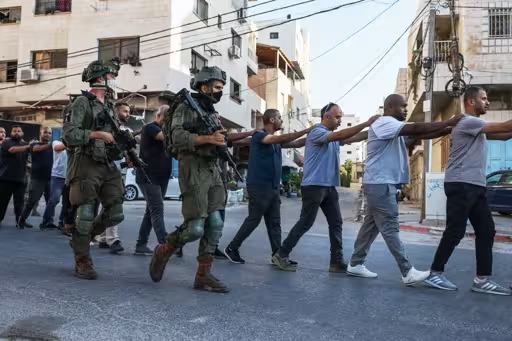
The situation in the West Bank has continued to deteriorate in 2026, with attacks by groups of Israeli settlers, backed by Israeli military, continuing to escalate. This summer things really kicked off when a group of 20 armed Israeli settlers attacked the West Bank town of Tal, leading to a shoot out that left four Palestinians and two Israelis dead. This led to waves of reprisals by both armed settler groups and the IDF, with the two often acting in concert.
These attacks should be seen as part of a broader Israeli plan to expand Jewish settlements in the West Bank at the expense of the Palestinian population. Their goal has been to terrorize Palestinians, forcing them from their homes and farms, which will open the way for settlement expansion. Indeed, the fascist Israeli Minister Ben-Gvir has been foaming at the mouth, calling for the depopulation of the Palestinian population of the area in retaliation for the spilt Israeli blood.
While Gadi Eisenkot criticized Netanyahu’s government for not “tak[ing] administrative steps to remove elements of Jewish terror and violence” in the West Bank, Naftali Bennet instead blamed Palestinian “terrorists” for the violence. Even if Eisenkot comes to power in the next elections, he is unlikely to realistically do anything to limit settler attacks, as these attacks are central to how Israel maintains control over the Palestinian majority population of the West Bank. Indeed, Eisenkot will certainly need the support of Bennet, who has backed the attacks, alleging that Palestinians are trained from birth to want to kill Jews.
Lebanon
In Lebanon, a new era was supposed to have dawned with the signing of a ceasefire between the Lebanese state and Israel. Notably, the Lebanese political movement Hezbollah, which has been fighting Israel’s invasion of Lebanon, was not party to the ceasefire and rejected it as invalid. Even worse, the ceasefire agreement was always of questionable utility, with carve-outs that allowed Israel to “preserve its right to take all necessary measures in self-defense, at any time, against planned, imminent, or ongoing attacks,” and did not require Israel to withdraw from Lebanon, making the deal not worth the paper it was printed on. Instead, the deal focused on the creation of “pilot zones” where the Lebanese state would take over anti-Hezbollah operations. Even this has been slow to emerge, with Israel only giving Lebanon back control of one village in July, even as Israeli troops fired “warning shots” at their Lebanese counterparts from the next village.
Israeli troops still maintain military occupation over around 70 villages, according to Reuters, and the Israeli flag still flies from the battlements of the symbolic medieval crusader fortress of Beaufort Castle. Israel has said that they are waiting to withdraw until they are sure that Hezbollah will disarm, an impossibility, and has continued demolishing homes behind their “yellow line.”
As we said when the Israeli invasion began, negotiations in Washington will not solve the problem of the Israeli invasion of Lebanon. Lebanon cannot have peace and security while Israel continues to butcher the Palestinian people next door. Ultimately, the cause of Palestine is the cause of the working people of the whole region, Lebanon cannot stand to the side, even if it wants to.
Syria
Since the overthrow of the al-Assad regime in 2024, Israel has taken actions intended to weaken and divide Syria, out of fear that any democratic government in Damascus would be hostile to Israel’s continued genocide and abuse of the Palestinian people. This included not just the largest ever bombing campaign carried out by the IAF, targeting Syrian military bases and stockpiles, but also an incursion by Israel beyond its existing occupation zone in the Golan Heights, including seizure of the symbolic Mount Harmon.
Then in 2025, Israel once again took advantage of divisions within Syria, this time sectarian divisions between Druze and Bedouins in the Syrian governate of Suwayda, with the IAF once again bombing Damascus and Israeli Druze paramilitaries crossing into Syria. Since this last flare-up, Israel has continued to operate in southern Syria despite facing intensifying resistance from the local population. The new government in Damascus has denounced the Israeli attacks on Syrian civilians but claimed that they are too weak now to do anything about them.
Disturbingly, a movement has emerged within Israel called the “Pioneers of Bashan,” which has been caught by the IDF attempting to sneak into the Israeli occupation zone in Syria in order to begin Israeli settlement of the area. Supporters of the movement even published an article in the Jerusalem Post calling for Israel to annex what they declare is a biblical “Bashan region,” expelling the current Syrian inhabitants and replacing them with Jewish settlers. This would then link Israel directly to Suwayda, opening the door for an Israeli-backed Druze breakaway state. While currently this is a fringe movement opposed by the government and the IDF, so too was the West Bank settlement movement at one time.
The only way to guarantee that an Israeli “Bashan province” will never emerge, is for the Syrian people to continue their resistance against IDF interventions. A mass movement is needed opposed to the government’s inaction, both for the sake of Syria and Palestine.
Gaza
The tragic farce of the ceasefire has continued in Gaza, now with potentially explosive ramifications. With Israeli bombs continuing to rain down, including the recent deaths of children, Hamas has come to an agreement with the “Board of Peace,” agreeing to disarm in exchange for Israel’s withdrawal and the National Committee for the Administration of Gaza (NCAG) taking governorship over the strip.
While the NCAG is on paper an unelected committee of technocrats tasked with rebuilding the Gaza Strip, its true nature is revealed by even a cursory glance at its ministers, who are drawn from the civil service of the Fatah-led Palestinian Authority in the West Bank. Indeed, potentially the most important member of the committee is Sami Nasman, a former Palestinian Authority intelligence chief who was involved in the failed U.S.-backed Fatah takeover of the Gaza Strip, following Hamas’ victory in the 2006 Palestinian elections.
The NCAG is nothing more than a puppet regime, intended to turn the Gaza Strip into a U.S. colony under the political leadership of its preferred faction, Mahmoud Abbas’s Fatah party.
Whether Hamas will actually disarm and hand the strip over to the NCAG regime is ultimately up to whether Israel agrees to withdraw. Either way, it is hard to see this as anything other than a massive defeat for the Palestinian people, with the strip ultimately coming under the control of Washington. It is hard to imagine that Israel would respect the NCAG enough to end its campaigns of violence and devastation against the people of Gaza.
Indeed, both opposition groups and the fascist minister Ben Gvir have criticized it. Ben Gvir stated on social media that he would prefer that the strip be depopulated and resettled by Israelis. While Netanyahu is likely to at least pretend to support the deal, given his long-standing desire to keep Trump happy, we have seen many times before his playbook of pretending to accept peace deals and then dismantling them.
Conclusion
No matter the results of the next Israeli elections—whether Netanyahu, Eisenkot, Bennet, or anyone else becomes prime minister—it will not change the facts on the ground across the country’s many armed fronts. Israel continues to be a danger to the whole of the Middle East, not merely to Palestinians. Today Israel is invading Lebanon and Syria, but tomorrow it could be Jordan or Egypt or Iran.
The threat of the IDF is a threat that can only be eliminated if the working masses of the whole region come together to stop it. This would entail overthrowing the corrupt and authoritarian Arab regimes that continue to attempt to “make peace work” with Israel even as IDF bulldozers destroy the homes of their citizens.
It is incumbent upon us as workers in the United States to aid the struggle of Middle Eastern people against Israel by fighting to end U.S. military and diplomatic support for Israel, without which it could not fight on all these fronts.
Photo: Israeli soldiers detain Palestinian men in the occupied West Bank city of Tulkarm in September 2025. (Jaafar Ashtiyeh / AFP – Getty Images)
The post Despite the ‘ceasefire,’ Israel continues to devastate and occupy its Middle Eastern neighbors first appeared on Workers’ Voice/La Voz de los Trabajadores.
From Workers’ Voice/La Voz de los Trabajadores via This RSS Feed.