

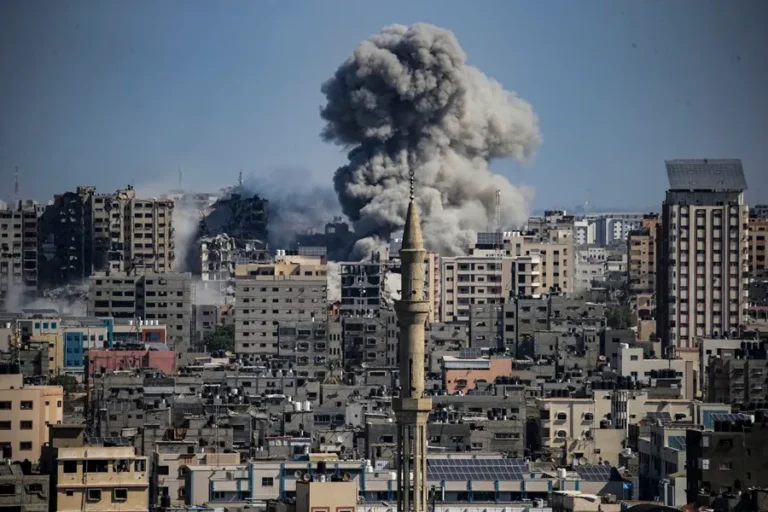
Gaza ceasefire violation deepens after Israeli strikes kill 18 Palestinians in residential areas, raising doubts over the Sharm el-Sheij peace roadmap.
Related: Israeli Strikes Kill Eight as Gaza Peace Plan Stalls
Gaza Ceasefire Violation as Israel Kills 18
Gaza ceasefire violation has intensified after Israeli forces killed 18 Palestinians in a series of airstrikes that hit residential areas across the enclave, undermining the commitments reached under internationally mediated talks in Sharm el-Sheikh. The attacks struck homes, vehicles, and areas near medical facilities, deepening fears that the fragile truce may be collapsing.
Medical sources at Shifa Hospital confirmed that an entire family was killed in a strike on a building near Gaza City’s port. Among the dead were a man, his pregnant wife, and their three-year-old daughter, in one of the most devastating incidents reported during the latest wave of attacks.
Gaza ceasefire violation and the latest strikes
The latest Gaza ceasefire violation unfolded as Israeli airstrikes targeted densely populated zones in the Gaza Strip despite the ceasefire framework announced in recent days. In central Gaza, a helicopter attack hit Deir al-Balah, killing Hamas local leader Kamal Abu Mueileq and his wife, according to local reports.
Further south, in the coastal area of Al Mawasi, three members of the same family were killed, including the well-known writer Mahmoud Zaki al Hams. Residents also reported vehicle strikes in the Rimal neighborhood and ground incursions in Al Saftawi, signaling that military activity remained active even under the supposed truce.
The Gaza ceasefire violation also extended to the Jabalia refugee camp, where explosions were reported near hospital facilities. That move increased panic among civilians already displaced and exhausted by months of war, hunger, and repeated bombardment.
The continued shelling has raised concerns among humanitarian organizations that the ceasefire may exist only on paper. The attacks appear to contradict the understanding reached in Sharm el-Sheikh, where international mediators pushed for a pause in hostilities and steps toward broader de-escalation.
Gaza: 8 muertos y 76 heridos en las últimas 48 horas. Desde el alto el fuego del 11 de octubre se registran 1.222 fallecidos. La ocupación israelí mantiene ataques pese al acuerdo. #teleSUR #Gaza #Palestina #1Ago pic.twitter.com/O7sZ1OX7KV
— teleSUR TV (@teleSURtv) August 1, 2026
Sharm el-Sheikh agreement under pressure
The Gaza ceasefire violation is especially serious because it came just days after U.S. President Donald Trump announced a roadmap aimed at ending the fighting and securing the “total disarmament” of Hamas. Under that plan, Israel was expected to comply with the Sharm el-Sheikh protocol and observe the terms of the pause.
Instead, the new strikes have put the peace track in doubt. Hamas accused Benjamin Netanyahu’s government of deliberately seeking escalation and said the attacks were intended to sabotage the ceasefire understandings.
The movement urged the mediators to intervene immediately to stop the bombing and prevent the talks from collapsing. According to Hamas, the Gaza ceasefire violation shows that Israel is not respecting the commitments it accepted during negotiations.
For Palestinians in Gaza, the result is yet another cycle of uncertainty. Families who had hoped for a temporary lull now face more air raids, more displacement, and a renewed sense that no safe area exists in the enclave.
The attack pattern also suggests that the truce mechanism is weak and vulnerable to unilateral military action. If the bombardments continue, the diplomatic framework built at Sharm el-Sheikh may quickly lose credibility.
Geopolitical context
The Gaza ceasefire violation has wider implications far beyond the enclave itself. It threatens to weaken the role of international mediation, especially when agreements brokered by major powers are followed almost immediately by renewed military action.
For the United States, the situation complicates efforts to present itself as a stabilizing actor in the region. For Arab mediators and regional governments, the bombing raises the question of whether any ceasefire can hold without enforcement mechanisms and real pressure on the parties involved.
At the global level, the Gaza ceasefire violation adds to mounting concern over civilian protection in modern warfare. The repeated targeting of residential areas, along with attacks near hospitals, intensifies scrutiny of international humanitarian law and the ability of the international community to prevent further loss of life.
The conflict also remains tied to broader regional instability, including tensions involving neighboring states, shifting alliances, and the continuing political isolation of Gaza. A collapse of the truce could trigger new waves of displacement and deepen the humanitarian emergency across the Palestinian territories.
What happens next
The immediate question is whether the mediators can reestablish contact and stop further escalation. Hamas has called for urgent action, while Israeli forces have not signaled that operations will cease.
If the bombing continues, the Gaza ceasefire violation may mark the beginning of another prolonged cycle of violence. If diplomatic pressure succeeds, the Sharm el-Sheikh process could still be revived, but only if the parties commit to verifiable restraint.
For now, Gaza remains under attack, civilians continue to die, and the ceasefire that was meant to protect them is increasingly in doubt.
Defensa Civil palestina recuperó 112 cuerpos entre escombros en Sabra, sur de Gaza. Cerca de 200 miembros de la familia Al-Hasayna murieron en bombardeos israelíes. Excavan con las manos. Israel prohíbe la maquinaria pesada. #Palestina #Gaza #teleSUR
QudsNews pic.twitter.com/eYSFYEVYNx
— teleSUR TV (@teleSURtv) August 1, 2026
From teleSUR English via This RSS Feed.