

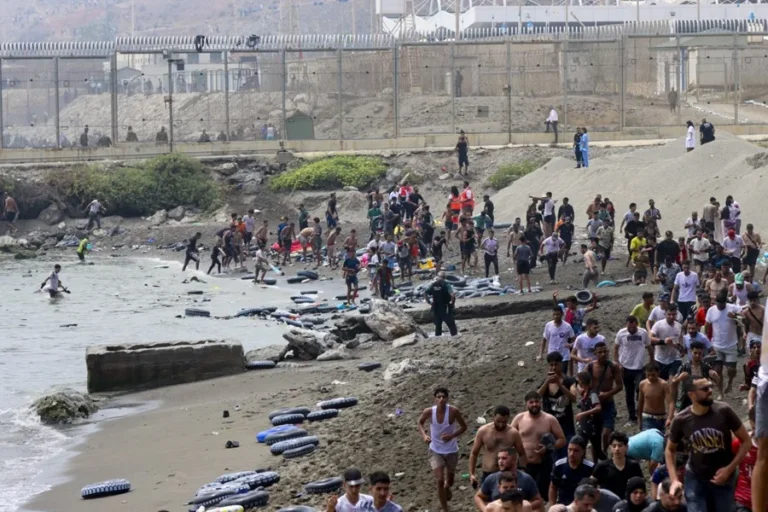
Ceuta migration crisis deepens after 72 deaths and tens of thousands crossings from Morocco, triggering EU alarm, border reinforcements, and tension.
Related: Leo XIV Calls for Solutions of Peace, Stability and Justice to the Crisis in Ceuta
Ceuta migration crisis deepened sharply on Sunday after Spain’s government delegation in the autonomous city confirmed the deaths of 72 undocumented migrants who crossed from Morocco on July 30. The announcement underscored the scale of one of the most severe border emergencies the enclave has faced in years.
Spanish authorities said most of the roughly 50,000 people who entered irregularly over the previous hours were later returned to Moroccan territory after intense diplomatic tension between Madrid and Rabat. The situation placed Ceuta at the center of a wider confrontation over border control, migration management, and responsibility for the lives of people moving across the southern edge of the European Union.
Ceuta migration crisis and the border response
The Ceuta migration crisis forced Spain to deploy nearly 3,000 soldiers and police officers to the Tarajal area in an effort to restore stability and secure the border. The presence of the military and security forces reflected the seriousness of the wave of arrivals, which officials described as one of the largest mobility crises ever recorded in the enclave.
Spanish authorities compared the emergency to the historic events of 2021, when around 8,000 people crossed into Ceuta after Morocco relaxed border controls. This new episode, however, was far larger and more abrupt, highlighting the fragile humanitarian and security conditions along the EU’s southern frontier.
The Ceuta migration crisis also exposed the limits of current border arrangements. Ceuta, a Spanish autonomous city on the North African coast, remains a strategic crossing point and a constant pressure zone for both Spanish and European migration policy.
Prime Minister Pedro Sánchez said the events amounted to a blatant violation of Spain’s national sovereignty and called for an emergency meeting of EU interior ministers in Brussels. He asked for coordinated border control measures and urgent financial support to manage the situation.
Sánchez also stressed that European security depends on close cooperation with countries of origin and transit. He urged Moroccan authorities to respect existing bilateral treaties, which require both sides to jointly manage the shared border in North Africa.
Ceuta migration crisis and political fallout
The Ceuta migration crisis quickly became a domestic political issue in Spain. The conservative Popular Party and the far-right Vox party blamed the central government for failing to prevent the crisis and demanded the immediate expulsion of everyone who entered irregularly.
By contrast, the progressive Sumar coalition called for the intervention of the United Nations Special Rapporteur on the Human Rights of Migrants. The group said the UN should assess the alleged role of Moroccan security forces in facilitating the flow.
Spanish civil society organizations also urged authorities to prioritize the right to life and human dignity for people fleeing complex humanitarian emergencies. Their position reflected the growing tension between border enforcement and human rights obligations at a moment of extreme pressure.
The Ceuta migration crisis triggered sharp diplomatic reactions abroad as well. The United States and Italy criticized aspects of Spain’s handling of the emergency, while Germany, France, and the United Kingdom publicly backed Madrid’s efforts to contain the crossings and defend Europe’s borders.
That split highlights the broader challenge facing the European Union: how to manage migration in a way that is both effective and lawful. The new EU Pact on Migration and Asylum, which entered into application in June 2026, aims to streamline border procedures and create a solidarity mechanism among member states, but crises like Ceuta show that practical implementation remains difficult.
@mpereztriano : “A lo largo de su historia, nuestra ciudad ha superado grandes desafíos, y este no será la excepción. Estoy convencido de que, con la unidad de todos, vamos a salir adelante”. pic.twitter.com/fWsFC0Iaar
— Delegación del Gobierno en Ceuta (@DelegGobCEU) August 1, 2026
Geopolitical context
The Ceuta migration crisis is not only a local emergency. It reflects the persistent instability along Europe’s southern border, where migration, diplomacy, and regional power dynamics collide. Any breakdown in cooperation between Spain and Morocco has immediate consequences for the EU as a whole.
For Brussels, the crisis raises renewed questions about the balance between deterrence, humanitarian protection, and shared responsibility among member states. For North Africa, it shows how border management can become a tool of political pressure in moments of bilateral tension.
At a global level, the Ceuta migration crisis also mirrors wider patterns of forced displacement driven by inequality, conflict, and climate stress. The response in Ceuta will likely influence future debates on asylum reform, external border control, and cooperation with transit countries across the Mediterranean.
What happens next
The immediate focus is now on stabilizing the border and addressing the humanitarian needs of people affected by the crossings. Spanish authorities say the city is gradually recovering normality, but the death toll and the scale of the movement mean the consequences will continue to unfold.
The Ceuta migration crisis is likely to remain a major issue in Spanish domestic politics and EU institutions alike. Whether the answer comes through stronger bilateral cooperation, emergency humanitarian action, or broader reform of the European asylum system, the pressure on Ceuta is far from over.
For now, the crisis stands as a reminder that the southern border of Europe is one of the continent’s most exposed and politically sensitive frontiers.
— Delegación del Gobierno en Ceuta (@DelegGobCEU) August 2, 2026
From teleSUR English via This RSS Feed.