

Lula candidacy Brazil is official as PT backs a fourth run, while polls favor him and tensions grow over foreign influence and regional far-right alliances.
Related: U.S. Consulate in Brazil Recruits Far-right Influencers to Attack Lula da Silva
Lula Candidacy Brazil Is Stirring Hope and Tension
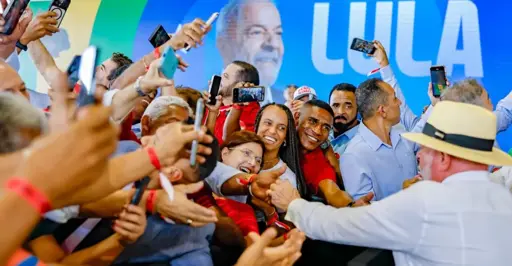
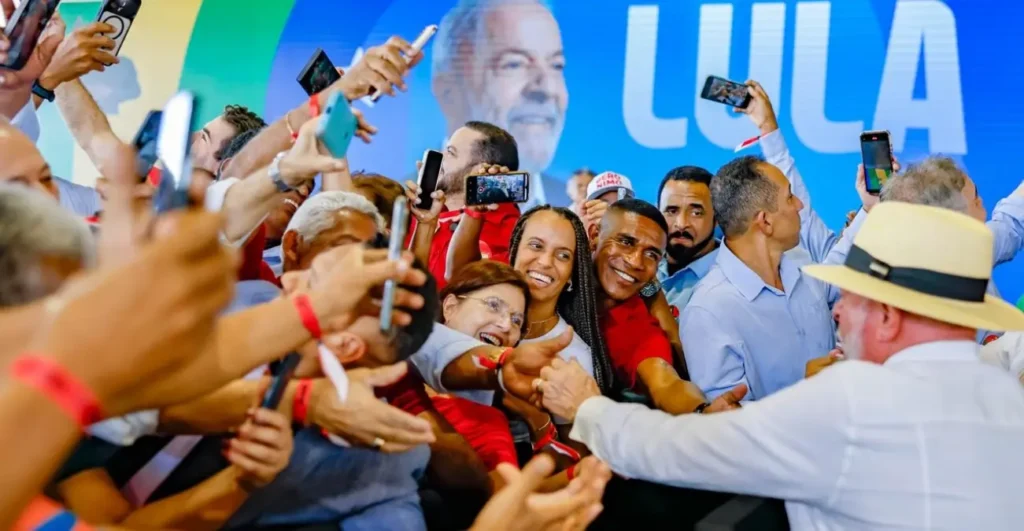
Lula candidacy Brazil was made official on Sunday as the Workers’ Party, or PT, formally launched President Luiz Inácio Lula da Silva’s bid for the October election, seeking a fourth term at the Planalto Palace. The convention, held at Expocenter Norte in São Paulo, came as Lula leads recent polls and positions himself once again as the main figure of Brazil’s progressive camp.
The announcement also reaffirmed Lula’s running mate, Vice President Geraldo Alckmin, repeating the ticket that won in 2022. PT leaders framed the moment as a broad democratic front, while Lula himself cast the campaign as a fight for development, sovereignty, and social inclusion.
PT launches Lula candidacy Brazil
The Lula candidacy Brazil campaign is being presented by the PT as a historic alliance. The party said that, for the first time since Brazil returned to direct presidential elections in 1989, seven progressive parties have rallied behind the same name from the first round.
Alongside the PT, the Brazilian Federation of Hope — made up of PCdoB, PV, and the PT itself — the coalition includes PSOL, Rede, PSB, and PDT. PT president Edinho Silva called the moment historic and said the coalition aims to deepen economic growth while reducing inequality, expanding opportunity, and defending democracy.
Éden Valadares, the PT’s national communication secretary, said the convention represented not only left-wing unity, but also a broader democratic convergence around sovereignty and social justice. He described the event as a political celebration of a Brazil that grows without abandoning inclusion.
Several political allies were present, including governors Elmano de Freitas of Ceará, Jerônimo Rodrigues of Bahia, Rafael Fonteles of Piauí, and Fátima Bezerra of Rio Grande do Norte. Former finance minister Fernando Haddad, now a candidate for São Paulo’s state government, was also among the invited figures.
The Lula candidacy Brazil event was broadcast live through the official social media channels of Lula and the PT, widening its reach beyond the convention hall. The party presented the launch not simply as an electoral formality, but as the opening of a campaign centered on the defense of the current administration’s economic and social agenda.
Lula candidacy Brazil and the 2026 race
The Lula candidacy Brazil race enters the campaign season with Lula favored in several recent polls. One of the most recent surveys, from AtlasIntel/Bloomberg, published last week, placed Lula ahead in a second-round matchup with 49.2 percent against 42.9 percent for far-right Senator Flávio Bolsonaro.
The same poll, conducted between July 22 and July 27 among 5,000 respondents nationwide, showed Lula leading the first round with 44.9 percent. Flávio Bolsonaro followed with 35.8 percent, while other contenders remained far behind, including businessman Renan Santos at 7.8 percent, Ronaldo Caiado at 3.1 percent, and Romeu Zema at 2.8 percent.
The Lula candidacy Brazil numbers suggest that the incumbent remains the central figure in the country’s polarized political landscape. His supporters point to economic recovery, job creation, and renewed social policy as the basis for his advantage, while opponents seek to mobilize anti-incumbent sentiment and the broader right-wing base.
Lula has also used the campaign moment to warn against external interference. Speaking at a PT convention in Ceará, he said that far-right forces would not return to power in Brazil and rejected what he framed as attempts by foreign leaders to influence the race.
He referred to public expressions of support from U.S. President Donald Trump and Argentine President Javier Milei for Flávio Bolsonaro, the candidate of the Liberal Party and son of former president Jair Bolsonaro. Lula said Brazil’s election must be decided by Brazilians alone.
The Lula candidacy Brazil contest is therefore shaping up not only as a domestic race but also as a test of how far regional and global political alignments can influence Latin America’s largest democracy.
Sovereignty at the center
The Lula candidacy Brazil campaign is being framed by the PT as a defense of sovereignty, independence, and social rights. Party leaders insist that the government’s record since 2023 shows a country recovering its economic footing while restoring the role of the state in social policy.
That message fits Lula’s long political trajectory. Born in Garanhuns, Pernambuco, in 1945, he rose from poverty, worked as a metalworker from childhood, became a union leader, and helped found the PT. He first won the presidency in 2002 and served two terms, then returned to office in 2023 after his earlier convictions were annulled by the Supreme Court.
The Lula candidacy Brazil narrative also draws on his legacy of social programs. His governments are associated with Bolsa Família, Fome Zero, ProUni, Minha Casa, Minha Vida, and Farmácia Popular, along with broader efforts to reduce poverty, expand access to higher education, and improve health care through initiatives such as Mais Médicos.
Supporters say those policies helped millions of Brazilians leave poverty and strengthened the country’s international standing. Lula’s first two governments were also marked by economic growth, lower unemployment, and a stronger global profile for Brazil in multilateral forums and trade negotiations.
At the same time, the current campaign is unfolding in a difficult external environment. Brazil continues to face pressure from Washington over trade and geopolitical disagreements, while the broader region has seen an intensification of far-right alliances that could affect elections and governance across Latin America.
Geopolitical context
The Lula candidacy Brazil race matters well beyond Brazil’s borders because the country is a central power in South America, a founding member of BRICS, and a major voice in debates over trade, climate, food security, and financial sovereignty. A Lula victory would likely reinforce Brazil’s current emphasis on multilateralism and South-South cooperation.
The contest also has implications for the wider ideological balance in Latin America. A strong progressive government in Brasília would act as a counterweight to the regional far-right bloc and to efforts to deepen political coordination around the Trump-Milei axis. For investors, neighboring governments, and international institutions, Brazil’s election is therefore a strategic turning point.
If Lula wins again, his government is likely to continue defending social spending, state-led development, and a more independent foreign policy. If the opposition gains ground, Brazil could move toward a more market-driven and geopolitically aligned model, with consequences for labor rights, environmental policy, and regional diplomacy.
What Lula is betting on
The Lula candidacy Brazil campaign is set to begin its first major popular event on August 16 in São Bernardo do Campo, at Vila Euclides Stadium, a symbolic place in Lula’s political history. It was there, in the industrial ABC region of São Paulo, that he rose as a union leader during the late 1970s, when major strikes helped fuel Brazil’s democratization process.
The PT wants that symbolism to resonate again. By returning to the place where Lula’s political identity was forged, the campaign is linking his present bid to the labor movement, social justice, and the memory of democratic struggle.
For now, Lula enters the race with the advantage of incumbency, a loyal party base, and favorable polling. But the Lula candidacy Brazil campaign will also have to confront polarization, disinformation, foreign meddling claims, and the effort by the right to unify behind a Bolsonaro name.
The question is no longer whether Lula can dominate the debate. It is whether he can convert that advantage into another victory while keeping together the broad coalition that brought him back to power in 2022.
From teleSUR English via This RSS Feed.