

By Aaron Ernest Cruz
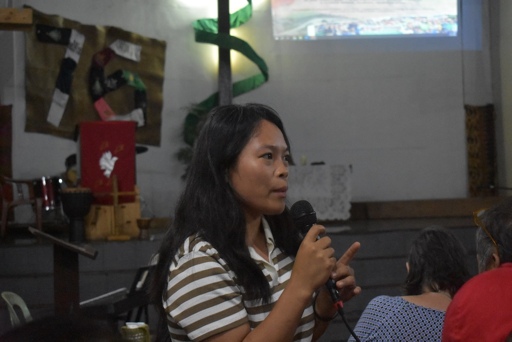
MANILA – Zesirie Enggo, 26, from Bugkalot tribe and convenor of Kasibu Inter-Tribal Response towards Ecological Development (KIRED) is in the frontline of struggle against the North Luzon Mineral Resource Center (NLMRC) operations in Kasibu, Nueva Vizcaya .
In an interview with Bulatlat, Enggo talked about the impacts of mining on the environment and their community. “When I was a child, the river was wide, but now it has become just a channel of water that came from the mine,” Enggo said.
For Enggo, life was peaceful back then. The family’s livelihood is farming, which she said, supported her and her siblings’ needs. She is the second child in a brood of four.
She earned a degree in criminology from a private university. However, job opportunities are rare so she decided to go back to farming. “I’ve tried looking for a job many times but still haven’t found one. I have become more knowledgeable and have seen the value of farming, so this has become my livelihood,” she told Bulatlat in an interview.
This is why when they discovered that an exploration permit was granted by the Mines and Geoscience Bureau (MGB) to NLMRC, they stood against it.
Last July 10, Enggo, along with other delegates from Nueva Vizcaya, went to Manila to tell their story at the State of the Philippine Environment organized by various groups.
Deception
According to Enggo, the exploration permit was granted in June 2025 but the community came to know about it in October 2025. They later learned that their attendance during the mushroom activity conducted by the barangay was used as proof of their consent for the mining company to operate.
“The barangay captain and IPMR [Indigenous People Mandatory Representative] are the ones coordinating there [with the NLMRC]. Then, that became their entry point for their activity, so now we have seven barricades to block mining equipment,” Enggo shared.
The community felt deceived with what happened so they set up the people’s barricade on May 8 this year at barangay Pao. Later, seven more barricades were set up across Kasibu.
The MGB granted the NLMRC 4,456 hectares covering eight barangays which are Pao, Dine, Kakiduguen, Biyoy, Catarawan, Sigwen, Pacquet, and Muta. There is also ancestral land situated in the area and will be affected by the mining operation.
Despite this, the National Commission of Indigenous Peoples (NCIP) approved NLMRC’s application for the certificate of non-overlap. It is a document issued by the NCIP attesting to the fact that the area where the particular plan, program, project or activity that will be conducted does not overlap with, or affect, any ancestral domain.
“It seemed that the NLMRC erased the ancestral land from the map, which they then gave to the NCIP. This has made our tribe angry,” Enggo said.
According to a map from the NCIP, the area falls within Conwap Valley which was identified as a resettlement site. However, the map also indicates that both the proposed exploration area and Conwap Valley are within the ancestral land covered by the Certificate of the Ancestral Domain Title (CADT).
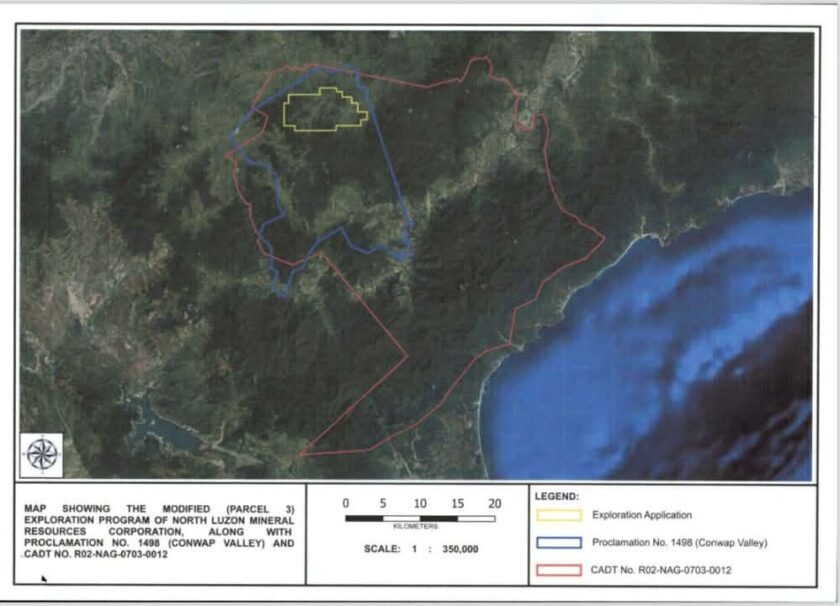
Screengrab from the response letter to the complaint filed by Zesirie Enggo.
Labor issues in the mining company
When a barangay counselor offered Enggo a job in the mining company, she agreed because she planned to get more information about the mining operations.
In her three months of working at the mining firm, Enggo found out that workers lacked personal protective equipment (PPE) amid harsh working conditions. She also said that their daily wage is only P700 ($11.3212), which Enggo said, is lower compared to what they earn from farming.
Many mine workers were recruited when the mining company started drilling in January. “They have so much work to do, from trenching and drilling. They earned more as farmers than being mine workers,” Enggo said.
At one point, Enggo was injured while working at the site after a pipe struck her on the head. She was not wearing a helmet at that time. Instead of attending to her medical needs, the contractor only let her rest for a few moments then they ordered her again to go back to work.
“Many others suffer from overfatigue. Some would have injuries, but they just let them rest for a bit and then work continues,” Enggo complained.
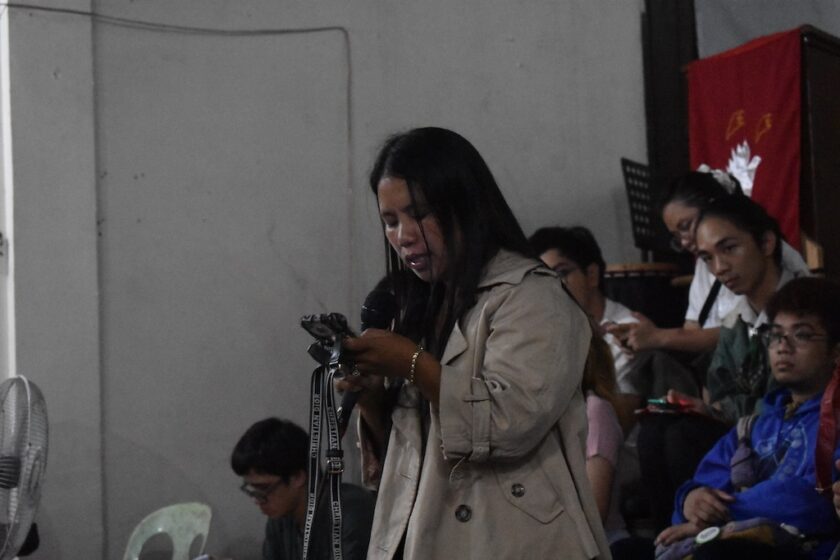
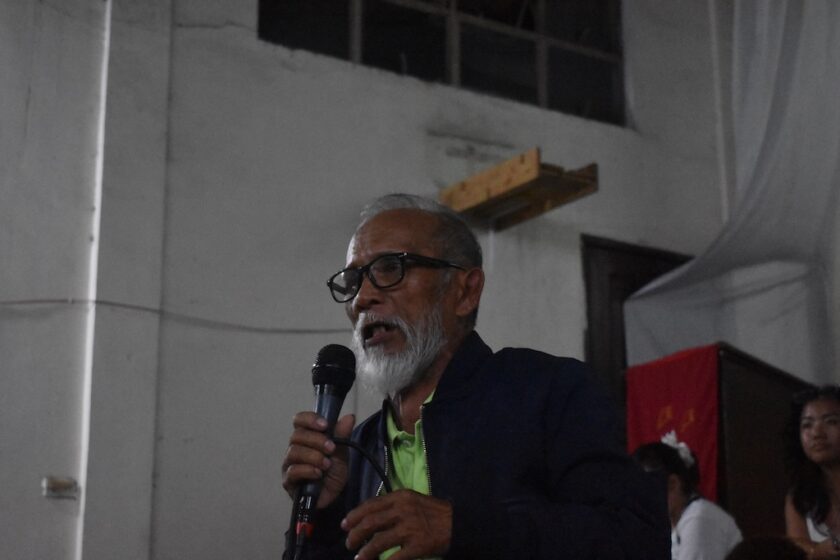
Mariano Maddela (right) and Lei Jin Dugay shared their experience at the barricade on July 13. Photo by Aaron Ernest Cruz/Bulatlat
Effects of NLMRC mining
Meanwhile, the community noticed the effects on the environment after the NLRMC started its drilling operations in January this year.
The water they used for farming was contaminated due to drilling operations. “It was supposed to be planting season, but there hasn’t been any rain yet. The water near the site of the drilling activities is already contaminated,” she shared.
She added that crops were also declining. “In terms of rice grains, there used to be 27 in one stalk, but now there are only 15. Out of those 15, not all of them are filled,” she added.
They also noticed the change in the temperature in their community. The normal temperature before the mining operation is 26 degree celsius compared to now when it reaches 30 and above.
On July 14, delegates from Nueva Vizcaya visited Manila to share their firsthand experience and knowledge on strengthening the community’s opposition to mining through barricades.
Mariano Maddela and Leijin Dugay shared their experience at the barricade on July 14. Photo by Aaron Ernest Cruz/Bulatlat
Mariano Maddela, an elder from the Bungkalot tribe, joined multiple people’s barricades in 2001, a year where the community at Nueva Vizcaya started to stand against large-scale mining operations.
“Whenever a mining corporation is about to enter, they always say it’s just exploration. To be honest, exploration is the ‘official’ operation of mining. So it really needs to be fought early on,” Maddela said.
Maddela also stated that as their place is known for being a major watershed in the Philippines, he pleaded that it should be taken care of instead of being exploited by foreign mining companies.
“I don’t know where we will end up if there is no land to till. We cannot live without fresh air and water if they are contaminated due to mining,” he said.
Meanwhile, for Lei Jin Dugay, the mining operations have become a burden on their daily lives. Instead of spending time with their families or tending to their livelihoods, she said they have to remain at the barricade to defend their rights, ancestral lands, and means of living.
“The hardship and sacrifice we endure at the barricade are immense. This cannot be measured by any material thing because what we are fighting for is far more important,” she stated.
Dugay also pleaded to the local government unit of Kasibu to join them in defending their rights and land.
Legal threats and harassment
Not only the people of Kasibu are facing environmental effects of the mining operation, they also experience harassment and threats due to the presence of private armed personnel.
Community leaders, elders and lawyers also face legal harassment.
Based on Enggo’s estimates, there are 20 private armed personnel stationed only two kilometers away from the barricade. This has caused intimidation to those who are on duty at the barricade.
The elders also experienced verbal threats which has contributed to their stress and anxiety. “One time, we heard a gunshot in the middle of the day. That is why we know that they are armed,” Enggo said.
Several anti-mining individuals including Enggo are facing cyberlibel charges and other civil cases filed by NLMRC. Two lawyers, Fidel Santos and Edgar Balgos representing the anti-mining community, have also been charged with cyberlibel.
Read: Mining firm files cyberlibel vs anti-mining residents’ lawyer
Other community leaders who face cyberlibel raps are pastor Florentino Daynos, known for previously opposing Woggle Corporation mining operation in Dupax Del Norte and now showing solidarity with the anti-mining community at Kasibu.
Community leader Anthony Glenn Guingayan Sr. faces cyberlibel charges filed by pro-mining faction residents. Meanwhile, the forcible entry case against Bayombong Bishop Jose Elmer Mangalinao and other anti-mining advocates was later dismissed.
Read: Court dismisses forcible entry case vs Bayombong bishop, anti-mining advocates
Despite the threats, Enggo still persists to defend their rights, livelihood, and the environment. Her motivation is her community who stand firm fighting for what is right and just.
“This case is just a small part of our struggle compared with what we are fighting for – not only for our community, but also to inspire other communities affected by large mining corporations,” Enggo said.
The community also pushed back against the mining operation as Enggo and other members of KIRED filed a petition with the MGB and NCIP to cancel the exploration permit and other certificates enabling NLMRC to conduct mining activities.
Read: Indigenous Peoples, environmentalists demand cancellation of Nueva Vizcaya mining permit
In recent development, two barangay captains exposed that the attendance for a training was misused as a proof of consent to the mining activities. This was a relief for Enggo.
For her, their journey to uphold their rights will take a long time, yet, for her, it does not matter.
Several mining corporations are eyeing Nueva Vizcaya’s natural resources such as gold, nickel, and copper. Recently, Ferdinand Marcos Jr. met with executives of Canadian-based mining corporation Didipio Gold-Copper Mine and secured a P1.9 billion ($30.73 million) investment for them to operate until 2037.
For Enggo, it is important to involve not just their community but also other Filipinos to stand with them as the harm caused by mining affects the whole country.
“Nueva Vizcaya is known for being a watershed that gives life to the community. If not taken care of, the production of fruits and vegetables will be scarce and it can’t supply to other places who depend on our products. That’s the consequence if we don’t do anything,” Enggo concluded. (AMU, RVO)
The post Indigenous community rising up against mining in Nueva Vizcaya appeared first on Bulatlat.
From Bulatlat via This RSS Feed.