


Nick Tūpara’s striking 2019 sculpture of Ngāti Oneone tipuna Te Maro sits at the Ruatanuika lookout, above Puhi Kai Iti Cook Landing National Historic Reserve, overlooking Tūranganui-a-Kiwa Gisborne. The location’s significance in voyaging traditions, the importance of gardening, and the value of mātauranga are all embodied in this site and artwork, which also suggests starting points for local history that don’t begin with the arrival of Captain Cook. (Photo: Julia Rae)
For many Pākehā, James Cook was a foundational figure for Aotearoa — an explorer, scientist, hero. For Māori, he was “one of the most potent symbols of empire and its bitter and enduring legacies.”
Here, historian Tony Ballantyne, the author of a new book, Captain Cook and the Unsettled Afterlives of Empire, looks at how Māori have always contested the notion of empire that Cook embodied.
Arguments have long swirled around Captain James Cook, who frequently returns to prominence in New Zealand life when questions about empire and colonisation flare up. Such issues generate considerable cultural and political heat before the finite fuel of media attention and public interest burns out, leaving behind smouldering tension, sadness, anger and anxiety.
Over the past two centuries, Māori have offered a range of assessments of Cook, and these have varied across time and space. A number of accounts looking back on Cook during the 19th century remembered the unusual nature of the Endeavour’s arrival, most notably Horetā Te Taniwha (Ngāti Whanaunga) who in the 1850s recalled meeting “Pene Kuku” (Captain Cook), Banks and their crew. Te Taniwha’s narrative stressed the strangeness of the Europeans: the way they rowed with their backs to shore, their blue eyes and white skin, their hissing language, their salty and fatty food.
Some narratives dwelt on the new things carried by the Europeans. The great Ngāti Porou leader Rāpata Wahawaha published an account of Cook’s visit to Ūawa that focused on Cook gifting a musket and powder to the local people. The Tūranganui rangatira Te Apaapa-o-te-rangi listed the gifts brought by Cook to Ūawa: two cats — “Puhi” (pussy) and “Kati” (cat) — along with two dogs, potatoes, corn, red blankets, hats, pots, an axe and iron hoops.
But the hapū and iwi that experienced the willingness of Cook and his men to use musket fire and kidnapping as tactics did not forget these experiences. On some occasions, such memories were shared publicly. Tāmati Hāpimana Te Rangituawaru told the Native Secretary Donald McLean at the Kohimarama Conference in 1860 that the “Pakehas behaved ill in the early times. I mean in the times of my forefathers. When Captain Cook’s ship came to anchor my forefathers went to look at her, and the Pakehas fired at them.”
Some Pākehā with close connections to hapū and iwi also recorded the effects of violence. In 1869, the centenary of Cook’s arrival, William Colenso, the politician and former missionary, documented the impact of the first collision at Te Kauwae-a-Māui Cape Kidnappers after Tupaia’s acolyte Taiata was seized by the crew of a waka, who perhaps thought Taiata was being held hostage by the British.
Colenso quoted the Endeavour’s records of the British opening fire on the waka with muskets and great guns, “killing several of them”, then followed this with a telling local recollection based on his conversation with the rangatira Hakaraia (Zechariah) Ngarangikamau: “In 1844, the writer saw at Waimarama an aged native who remembered this sad event; and also obtained from several natives, descendants of the sufferers on that occasion, their account of the affair, received from their forefathers; five it appeared, were killed, and several wounded; one of the poor fellows had received a ball in his knee joint which made him a helpless cripple during his long life.” Imperial violence left enduring scars.
Such critical perspectives, however, were overpowered in public life by the willingness of many Pākehā to see Cook as a benevolent explorer or an imperial hero. A host of memorials and statues to Cook were erected from the early 20th century, and his image featured on stamps, coins and cash. He was woven into the fabric of a developing national culture, and for many Pākehā he was a foundational figure.
The celebration of Cook reached its peak in the bicentennial of the Endeavour’s arrival in 1969. Although the 1969 memorial programme was subject to much debate as politicians, editors and community leaders argued about how best to remember Cook, pride in Cook and the nation were at the centre of proceedings. Hapū and iwi, however, were marginalised and their histories and perspectives on the Endeavour voyage and its consequences were given little space.
In the 1970s and 1980s, heroic visions of empire began to be punctured. The idea of New Zealand having exemplary race relations collapsed as a credible account of the past in the face of more critical historical writing and Māori frustration at the persistent legacies of colonisation, at the loss of land and language, and the corrosive effects of social and economic marginalisation.
Ranginui Walker (Whakatōhea) offered incisive indictments of colonialism and its legacies in the Listener and in his landmark history Ka Whawhai Tonu Matou. In a similar vein, Maori Sovereignty, by Donna Awatere (Ngāti Whakaue, Ngāti Porou, Ngāti Hine and Ngāpuhi), identified the “death machine” of colonial domination and Pākehā cultural imperialism as defining threads in New Zealand’s history, anticipating some recent ways in which Cook and the Endeavour have been represented.
Awatere also argued that New Zealand’s public culture, symbols and commemorations prioritised Pākehā, arguing that our “national shrines and memory are direct importations from Britain.”

This 1783 painting by English historical artist George Carter was created only a few years after Cook’s death in 1779. His demise is framed as a moment of imperial bravery, a collision between the light and the dark. Cook, dressed in white, confronts dark-skinned Hawaiians, faces contorted with rage. The oil painting shows how powerful ideas about racial difference were shaping British understandings of the Pacific and its peoples in the late Enlightenment. (Death of Captain James Cook, 1783, Wikipedia Commons.)
These powerful critiques, alongside the work of the Waitangi Tribunal, offered new ways of thinking about New Zealand’s past, and in the context of these critical reassessments, public understandings of Cook became more contentious, particularly as some Pākehā continued to see him as a great hero, an embodiment of benevolence, or founder of the nation.
The National government’s announcement in 2017 that it was planning a programme of commemoration to mark the 250th anniversary of the *Endeavour’*s arrival rekindled these debates. A host of activists, academics and iwi leaders expressed concern about the initial plans, foregrounding both the violence of Cook’s Pacific voyages and the profoundly negative impact of empire on Māori.
The commemorations were reshaped in response to these arguments, developing into Tuia 250, a programme that focused on a theme of “dual heritage, shared future”, but which also put considerable emphasis on Pacific voyaging traditions and mātauranga. Cook himself was to be much less prominent in the programme.
For some, this shift in emphasis did not resolve the fundamental problem: Cook and the Endeavour remained both agents and symbols of empire, violence, and the beginnings of disempowerment.
In September 2019, Ngāti Kahu banned the replica Endeavour from docking in Mangonui as part of the Tuia 250 programme. The iwi’s chief executive Anahera Herbert-Graves was deeply critical of Cook himself, arguing that wherever he went “there were murders, there were abductions, there were rapes, and just a lot of bad outcomes for the indigenous people.”
The academic Arama Rata (Ngāti Maniapoto, Taranaki, Ngāruahine) denounced the Endeavour as a “death ship” and criticised the Tuia 250 programme, suggesting it would “re-enact the invasion of Māori whenua”.
But perhaps the most prominent critic of Cook and Tuia 250 was Tina Ngata (Ngāti Porou). Her activism and deft use of social media powerfully shaped public discussions of the commemorations, which she dubbed a sequence of “invasion anniversary events”. Her arguments in 2019 were a kind of radical counter-memory, framing New Zealand history through empire, colonialism and the ongoing subjugation of Māori sovereignty.
Ngata criticised the Tuia 250 programme as a “celebration” of Cook that did not include “addressing the human rights abuse” which the arrival of the Endeavour set in train. Ngata asserted that the “roots of racism flourished in NZ after Cook’s arrival and his heroism is colonial fiction . . . His orders by the British Crown were to claim lands and that same imperial entitlement we see is present today as well.”
For some hapū and iwi that had met with Cook and his men on that first voyage, however, Tuia 250 was an important opportunity to articulate their historical narratives and challenge embedded local and national stories. In a series of videos, Rongowhakaata shared their “collision narratives”, highlighting their tīpuna who were wounded, kidnapped and killed by the British in October 1769 and that Cook’s arrival marked the beginning of British colonialism.

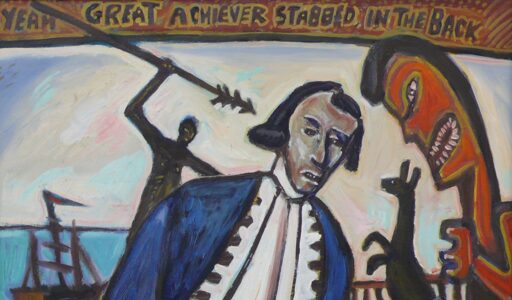
Nigel Brown’s 1992 work Yeah, Great Achiever condenses Cook’s Pacific career into a series of recognisable images: a ship, a kangaroo, and the Hawaiian god of war Kūka‘ilimoku. Cook is grey-faced and grim, about to be killed. The painting poses questions about the true nature of Cook’s achievements.
An important perspective was offered by Nick Tūpara of Ngāti Oneone, the kin-group that first met the British and experienced the destructive power of their guns. He explained that in a place like Tūranganui Gisborne, “Cook’s history has always been one-sided and the home people have always been a little hesitant to speak their own history. But they have held it and it now feels appropriate to have a bit of balance in the storytelling.”
Tūpara stressed that it was important that the Ngāti Oneone tipuna Te Maro was not defined by “the story of the last two seconds of his life”, when he was killed in that first collision with the British. Te Maro, he stressed, “was a grower of food and feeder of people; he read the stars and the sun and the wind and advised people about what they needed to do to keep their families fed and well, and we wanted to tell that story.”
In addition to sharing his kin’s perspective through the media, Tūpara played a leading role in the redesign of the old Cook Landing National Historic Reserve in Tūranganui Gisborne. He also constructed an impressive memorial to Te Maro at Ruatanuika, a powerful statement about the cultural presence of Ngāti Oneone and the resilience of mātauranga and kaitiakitanga.
The diverse approaches to history during Tuia 250 underscored that Cook’s position in New Zealand life was much more contested and contentious than in 1969. For many Māori and Pacific critics of Tuia 250, Cook loomed large as the embodiment of an imperial system that wreaked havoc through disease, exploitation, and violence. Many others looked to Tupaia as the central figure of Tuia 250, celebrating him as an embodiment of Pacific knowledge traditions and the persistent linkages that wove Māori into the wider world of Te Moana-Nui-a-Kiwa.
In a society that lives in the shadow of the violence of empire and inequalities of colonialism, the figure of Cook reminds us that memory is politically contentious and vigorously contested: the past is never settled, but rather provides the grounds for renegotiating power and identity in the present, and for making claims about how the future should be.
Within Māori framings of the past, Cook has become one of the most potent symbols of empire and its bitter and enduring legacies.

Tony Ballantyne is Distinguished Chair Poutoko Taiea in History at the University of Otago – Ōtākou Whakaihu Waka. His latest book is Captain Cook and the Unsettled Afterlives of Empire, published on August 5 by Bridget Williams Books.
Tony Ballantyne is Distinguished Chair Poutoko Taiea in History at the University of Otago – Ōtākou Whakaihu Waka. His latest book, Captain Cook and the Unsettled Afterlives of Empire, is published on August 5 (BWB).
The post Contested empire appeared first on E-Tangata.
From E-Tangata via This RSS Feed.