

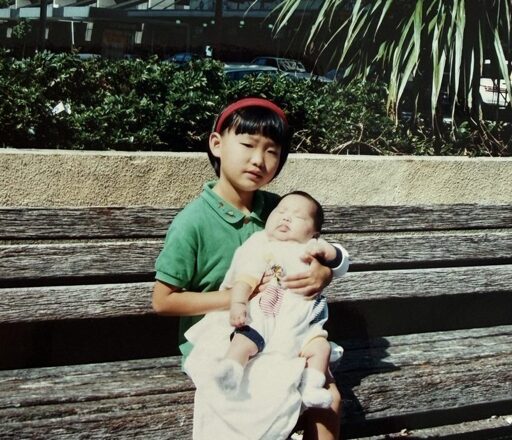

“I am part of a generation of Chinese migrants whose childhood and formative years were spent breathing in the racism generated by the ‘Asian invasion’ era,” writes Mengzhu Fu, pictured as a seven-year-old, a year after migrating to Tāmaki Makaurau in 1996. (Photo supplied)
When Winston Peters is racist, he is wearing old skin that refuses to shed, writes Mengzhu Fu.
Exactly 30 years ago, Winston Peters and New Zealand First were campaigning against the “Asian Invasion” in the 1996 elections. That same year, my family and I moved to Aotearoa. According to him, my family were part of this invasion.
This year, Winston Peters is at it again. This time, he is telling Green MP Lawrence Xu-Nan to “go back to your own country”.
Mandarin-speaking communities are so familiar with Winston, we have nicknamed him “Lao Pi”.
Lao Pi has a similar vibe to calling someone “Old Petey”. Pi is a shortened Mandarin version of “Peters”, and we put Lao (old) in front of people’s family names if we are familiar with them. So it’s not necessarily an insulting name, but it’s informal. The literal translation of Lao Pi is “old skin”.
Lao Pi is like that grumpy neighbour everyone knows is a problem.
Except he’s not a random neighbour. He is the foreign affairs minister and former deputy prime minister. He represents New Zealand on the global stage, and he’s in a position to make decisions for this country. He’s in a position to embolden racial abuse and violence, a violence many of us first met as children.
“Go back to your own country” brings back childhood memories. As children, my sister and I heard it from strangers on the streets, and from moving cars. This taunt is rarely, if ever, directed at white immigrants.
But I will go back, back to my country’s history for a moment. We are from Tianjin, where Lawrence Xu-Nan is also from. Our city has a history of European, American, and Japanese occupation and invasion. Our hometown was also the site of a treaty signing with colonial powers — the Treaty of Tianjin — a set of unequal agreements signed to end the Opium Wars in the mid-1800s.
This may seem distant and irrelevant to Aotearoa, but the city of Palmerston North was named in honour of Lord Palmerston, the British prime minister responsible for the Opium Wars. These wars involved the bombardment of Canton by the British Royal Navy, and the subsequent devastation was a factor in early Cantonese migration to British settler colonies.
Chinese migration to Aotearoa is tied to British colonialism over there, and also here. As Māori land was colonised, Pākehā companies wanted cheap labour to mine gold.
But while Chinese people may have supplied labour, they were denied citizenship. Between 1908 and 1951, Chinese people were denied voting rights, pensions, and welfare benefits. This is the New Zealand “democracy” that Winston Peters is reviving. The kind of democracy which is racist and limited to the “right” people.
Watching Winston Peters shout at Lawrence, his face seemed like the face of every person who has yelled the same words at migrants of colour, repeating the same racist imperative.
It is the face of a society that has enabled and normalised racism. It is old skin that refuses to shed.
If this racial harassment and abuse were to happen in any other workplace, there would be ample grounds for dismissal. The rōpū I am part of, Asians Supporting Tino Rangatiratanga, is calling for Winston Peters to be removed from parliament.
What disturbs me most is not the exact phrase that Winston Peters uttered. It’s that for decades now, Lao Pi and New Zealand First have been promoting overtly racist, anti-Māori, anti-Black, anti-Asian, colonial, Islamophobic, ableist, and transphobic discourse and policies. The harm and violence are intentional.
Yet in these decades, he has been rewarded with more power. We shouldn’t be surprised.
This New Zealand “democracy” is the same one that has been violating Te Tiriti, confiscating Māori land, and suppressing Māori culture and power since its inception. That same ”democracy”, for over a hundred years, limited Māori representation to four parliamentary seats. Racism in Aotearoa originates in the colonial parliament and continues to fester there.
To me, this issue is less about foreign diplomacy, offending China, or jeopardising trade relations. I’m more concerned about the further escalation of racial abuse against migrants of colour in Aotearoa.
I am part of a generation of Chinese migrants whose childhood and formative years were spent breathing in the racism generated by the “Asian invasion” era.
Once, I had a broken tooth with an exposed nerve, and I went to the hospital, but they refused to give me painkillers or treatment.
When I was eight years old, a Pākehā couple hit me with their car when I was crossing the road. Afterwards, they took my parents to court for the damage they claimed I caused their car. And they won.
Beyond the overt racism we experienced, there was the everyday covert racism that determined whether we could get a job, housing, access to justice, or decent healthcare. These things continue to have an impact on our lives today.
Our CVs may still be discarded if we have a ”foreign”-sounding name. Many of us are unemployed or working low-wage jobs well below our qualifications.
These systemic injustices lie beneath the iceberg of “go back to your own country”. They send a clear message: You don’t deserve care, you don’t deserve justice, you don’t deserve income, you don’t deserve to live with dignity.
This racism has been absorbed into our bodies, where it becomes internalised as white supremacy. It eats us from the inside and morphs into self-betrayal. Once racism is internalised, you don’t have to be white to be a white supremacist, to uphold the idea that white culture is preferable to all the other ways of being human in a democracy.
I don’t want that racial trauma to haunt another generation of children and youth in any community.
We have political agency, and we can draw from histories of resisting racism.
For some of us, part of healing our experiences of racism has been through learning the truth about Te Tiriti and engaging with te ao Māori. Te Tiriti represents Māori consent for immigration where belonging is not predicated on assimilation, but respect for tino rangatiratanga. Te Tiriti offers a relationship that is not based on domination, exploitation, or racial injustice. It is an alternative model to the colonial system.
Similarly, Matike Mai Aotearoa proposes values of place, tikanga, community, belonging, balance, conciliation, and structure to underpin a new constitution for Aotearoa that would overturn the imposed British Westminster system. These values offer a future where everyone has belonging and community.
Writing my pepeha taught me about whakapapa. That I should honour my ancestors and where I come from. In doing so, I started to realise that being “not from here” is nothing to be ashamed of. Rather, my ancestral lands and waters are to be named before naming myself.
Finally, witnessing Māori cultural revitalisation and political resistance helps us to see that white supremacy is not inevitable. It can be defied. From the gains that have been made, we know that through collective organising, movement-building, and solidarity, change is more than possible.
Old skins will eventually shed.
Mengzhu Fu is a Han Chinese migrant and a member of Asians Supporting Tino Rangatiratanga. He recently completed a PhD exploring diasporic Chinese solidarity with Indigenous movements in Aotearoa and Canada.
The post Why we call Winston Peters ‘Lao Pi’ appeared first on E-Tangata.
From E-Tangata via This RSS Feed.