

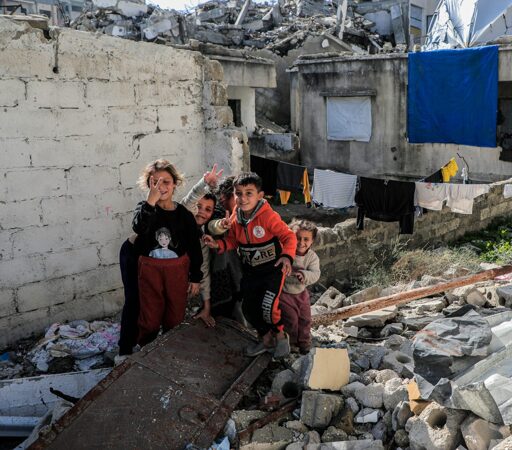

A lack of scrutiny and action from the international community, including New Zealand, is allowing illegal atrocities to continue unabated in Gaza, writes John Hobbs. (Photo: Mohammed Ibrahim on Unsplash)
The New Zealand government remains shamefully silent on Gaza, despite being a signatory to international agreements that oblige it to act, writes John Hobbs.
A friend who lives in Gaza, just posted the following:
From the sea of Gaza, I do not look out . . . I stand on the edge of the world, shouting in a direction that does not hear, and I know that between me and them there is not just a sea, but a silence that is skilled at betrayal.
The New Zealand government has remained silent on the issue of genocide by Israel against the peoples of Gaza, despite numerous other countries publicly condemning Israel’s actions as genocide.
From time to time, the government might call for a “two-state solution”, join allies to issue protestations that the harm inflicted on the Palestinian people must stop, demand a ceasefire, or take part in various resolutions at the UN calling for an end to atrocities.
But all the while, the Israeli government rapidly expands its illegal settlements and continues to allow settlers to kill Palestinians under the watch of the Israeli Defence Force. Israel is doing everything it can to drive the remaining Palestinian people out of their villages and cities in Occupied East Jerusalem and the West Bank.
The gap between the government’s insincere words and its willingness to take real action mirrors the coalition’s approach to Māori. Here at home, it claims to uphold, honour, and respect the Treaty relationship, all while rolling out policies to dismantle the rights owed to Māori as Treaty partners.
Just as it’s important to hold the government to account for domestic policy, it’s equally important to hold it to account for foreign policy. It’s erroneous to think that the two aren’t intimately connected.
The government’s disgraceful foreign policy approach to Gaza and Palestine was shown up recently during a visit to the Occupied Palestinian Territories by Helen Clark and the former president of Ireland, Mary Robinson.
The women were there on behalf of “The Elders,” an independent group of global leaders founded by Nelson Mandela, working for peace, justice, human rights, and a sustainable planet. They stated: “We believe that the policies of the current Israeli Government are leading to Palestine disappearing in plain sight.”
The evidence for this comes from the UN Office for the Coordination of Humanitarian Affairs (OCHA). In its Humanitarian Situation Report of June 19, 2026, it noted:
“6,200 Palestinians, including more than 3,000 children, have been forcibly displaced because of settler attacks and related access restrictions across 119 communities. Of these, more than 3,600 people were displaced from forty-six communities that have effectively been erased, meaning they were completely emptied of their residents. In 2026 alone, as of mid-June, Israeli citizens, armed and backed by the army, have expelled 2,200 Palestinians.”
This is what the person living in Gaza describes as the “silence that is skilled at betrayal”.
Just as it does with Māori, New Zealand uses laudable language to give the appearance of care and decency, but it is a veneer that masks deep insincerity and an unwillingness to take concrete steps to actively protect rights.
There’s no doubt the coalition government has “betrayed” the Palestinian people of Gaza, the Occupied West Bank and East Jerusalem. But in fact they’ve done worse. They have potentially made New Zealand complicit in the act of genocide.
It is likely that New Zealand has not fulfilled its obligations under the Convention on the Prevention and Punishment of the Crime of Genocide, 1948, which requires that “The Contracting Parties confirm that genocide, whether committed in time of peace or in time of war, is a crime under international law which they undertake to prevent and to punish.”
Chris Sidoti is an international human rights lawyer, an expert on national human rights institutions, and a member of The Independent International Commission of Inquiry on the Occupied Palestinian Territories. In a recent address in Wellington, he argued that, in addition to not committing genocide, states had an obligation to prevent it.
“States shall act to prevent the commission of genocide and shall punish the commission of genocide. New Zealand has an international legal obligation to act to prevent the commission of genocide.
That does not require that genocide actually occur. My prime minister, from Australia, is very keen on saying we can’t say whether this is genocide or not. We’re waiting for the International Court of Justice to decide that issue, which may be in the next five or 10 years.
That’s not the obligation. The obligation is to act to prevent genocide. It is a prior obligation, and it’s an obligation that is designed to ensure that genocide never exists. So it is an obligation in advance.
In January 2024, the International Court of Justice issued what are called provisional measures, which is like an injunction under your law and ours. And in issuing provisional measures, the Court said that there is a risk that the rights of Palestinians under the Genocide Convention are being or will be infringed. Now, you cannot get a more authoritative case. As of January 2024, all parties to the Genocide Convention have been under an obligation to act to prevent. And the question therefore is, what have you done?
I recently sought access, through the Official Information Act, to the advice received by the government on New Zealand’s complicity under the Genocide Convention. The government’s decision to withhold the information was reviewed by the Office of the Ombudsman, which in turn supported the government’s right to withhold the advice under legal privilege, as in their view it wasn’t outweighed by the public interest in releasing that information.
How could it not be in the public interest to understand New Zealand’s obligation to act, or otherwise, to prevent genocide?
Recently, Labour’s foreign policy spokesperson, Vanushi Walters, visited Canberra and met with Noura Saleh, Chargé d’Affaires for the State of Palestine. She is the Palestinian ambassador responsible for the diplomatic relationship between Palestine and Australia and New Zealand.
The last time New Zealand had one-to-one diplomatic engagement with the Canberra-based Palestinian Authority ambassador to New Zealand and Australia was in 2022, when Izzat Salah Abdulhadi visited Wellington at the invitation of former foreign minister Nanaia Mahuta.
That the current government has had no engagement with the ambassador speaks volumes. It’s another example of silence, and silencing.
Sure, New Zealand engages diplomatically at the UN and through its ambassadors in Türkiye and Egypt, but this is all done behind closed doors. The absence of any effort to build a relationship with the Palestinian Authority closer to home is another dimension of betrayal.
What is particularly important as a result of Vanushi Walters’ engagement with Noura Saleh is that she articulated the Labour Party position on Palestine heading into the 2026 election.
Walters stated that Labour was clear about what it would have done if in government now: “We would have recognised Palestine. We would have sanctioned Israel. We would have looked to join South Africa’s case against Israel at the ICJ. We would have ensured that New Zealand complies with the ICJ opinion on the Occupied Territories.”
This is similar to the Green Party and Te Pāti Māori positions. Both parties have consistently called out Israel’s actions in Gaza as genocide, and criticised the government for failing to prohibit New Zealand entities from engaging with illegal settlements in the West Bank.
Such engagement is illegal under international law, as reflected in a United Nations Security Council resolution (UNSC 2334), which New Zealand co-sponsored in 2016. The resolution states that nations must cease engagement with settlements in the Occupied Palestinian Territories. Successive New Zealand governments have ignored this requirement and continue to do so.
Last year, the Green Party championed a private member’s bill, which sought to apply sanctions against Israel for its illegal occupation and rapid expansion of settlements in the Palestinian territories. The bill, modelled on the Russia Sanctions Act 2022, which imposed sanctions on Russia for invading Ukraine, was supported by Labour and Te Pāti Māori, but the coalition government opposed it.
It’s time to support those political parties that more accurately reflect the values of compassion, kindness, and human decency, as expressed through tikanga Māori.
John Hobbs has been a career public servant, working for various government departments and Ministers. He has a Master of Commerce (Hons) in Economics from the University of Auckland and a Master of Arts (Thesis) with Distinction in Peace and Conflict Studies, from the University of Otago. He is currently undertaking a PhD at Te Ao o Rongomaraeroa, The National Centre for Peace and Conflict Studies – Te Tumu School of Māori, Pacific and Indigenous Studies, Otago University.
The post A shameful silence appeared first on E-Tangata.
From E-Tangata via This RSS Feed.