

Mexico teachers’ dialogue advances as Sheinbaum agrees to meet Oaxaca union, while launching a national plan to protect native corn and food sovereignty.
Related: Ayotzinapa Families Demand Progress in Investigation from Mexico
Mexico Teachers’ Dialogue as Sheinbaum Meets Oaxaca Union
Mexico teachers’ dialogue moved forward this week as President Claudia Sheinbaum Pardo agreed to meet with leaders of Section 22 of Oaxaca, part of the National Coordinating Committee of Education Workers (CNTE), on August 13 at 11 a.m. in the National Palace. The meeting is set to evaluate pending demands from the teaching sector in the state, following a working tour by the head of state in the community of Santiago Suchilquitongo.
The commitment was formalized when teachers, led by general secretary Yenny Aracely Pérez Martínez, delivered documents with their requests during the president’s visit. Union representatives clarified that the encounter will focus on local Oaxacan issues, maintaining a reserved stance regarding the reestablishment of dialogue with the national structure of the CNTE.
Mexico teachers’ dialogue and the Oaxaca meeting
The Mexico teachers’ dialogue is expected to address long-standing labor and professional demands from the Oaxaca section, which has historically been one of the most active and vocal within the CNTE. After the audience in the capital was confirmed, the union’s rank and file announced they would evaluate whether to proceed with mobilizations planned in the Mixteca region.
The political direction of the teachers’ union will analyze in community assemblies whether to maintain the protest plan scheduled in Huajuapan de León. That decision will depend in part on the signals sent by the federal government ahead of the August 13 meeting, and on whether concrete advances are perceived in the negotiation process.
The Mexico teachers’ dialogue is also being watched closely by other sections of the CNTE and by national education organizations, as it could set a precedent for how the new administration handles labor disputes in the education sector. For Sheinbaum, the Oaxaca case is both a test of her government’s ability to manage social conflict and an opportunity to demonstrate a different style of engagement compared to previous administrations.
Teachers in Oaxaca have long demanded improvements in working conditions, infrastructure, and professional support, as well as greater respect for their role in community education. The outcome of the Mexico teachers’ dialogue may influence how similar demands are addressed in other regions with strong union presence and social mobilization.
Native corn plan and food sovereignty
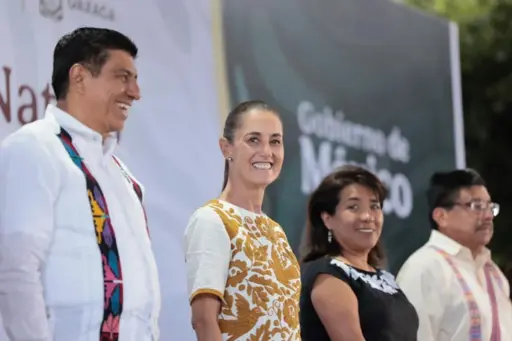
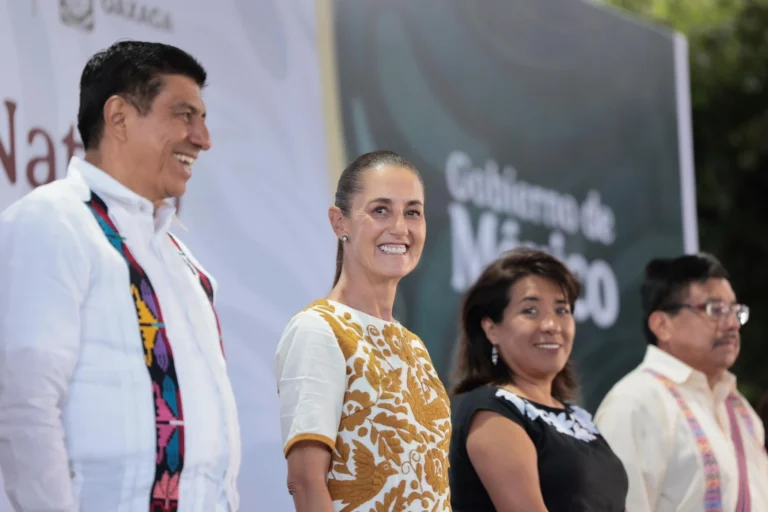
Alongside the Mexico teachers’ dialogue, President Sheinbaum also advanced a major agricultural initiative during her Oaxaca tour, leading the initial delivery of support under the National Native Corn Plan, called “Corn is the Root.” The program aims to protect the biodiversity of the 74 native corn varieties registered in the country and to boost the productivity of small farmers in the face of the transnational market for transgenic and hybrid seeds.
Sheinbaum emphasized the importance of defending food sovereignty and the historical heritage of original peasant communities against private agro-industrial models. She underlined that conserving native seed is a patriotic duty to safeguard the cultural roots of the Mexican people and guarantee the livelihood of working families in the countryside.
The Mexico teachers’ dialogue and the promotion of community agriculture reflect the federal executive’s commitment to social demands in the southern regions of the country. Both teachers’ and peasant organizations remain alert to ensure the effective fulfillment of the agreements assumed by the public administration.
The native corn plan is part of a broader strategy to strengthen food sovereignty, understood as the construction of conditions necessary to guarantee the constitutional and human right to sufficient, safe, nutritious, and culturally adequate food. One of the main dimensions of this strategy is to promote self-sufficiency in essential foods of the national diet, such as corn, beans, rice, and milk, through programs that strengthen national production and support producers.
Plan Nacional de Maíz Nativo: El maíz es la raíz. Santiago Suchilquitongo, Oaxaca https://t.co/tIwUave6GL
— Gobierno de México (@GobiernoMX) July 31, 2026
Geopolitical context
The Mexico teachers’ dialogue and the native corn initiative also carry significance beyond domestic policy. In a region where food security, labor rights, and social stability are increasingly linked to global market pressures, Mexico’s approach to these issues is watched by international organizations and neighboring countries.
For the United States and Canada, Mexico’s stance on native seeds and agro-industrial models has implications for trade, biotechnology, and environmental standards under the USMCA. For Latin America, the emphasis on food sovereignty and community agriculture resonates with similar debates in countries like Bolivia, Ecuador, and Venezuela, where the tension between transnational agribusiness and local production is also acute.
In that sense, the Mexico teachers’ dialogue is not just about wages and working conditions; it is part of a broader political project that seeks to redefine the relationship between the state, social movements, and the economy. How that project unfolds in Oaxaca could influence similar processes elsewhere in the country and the region.
What comes next
The next steps will be closely monitored. The August 13 meeting in the National Palace will be a key moment to assess whether the government and the union can reach tangible agreements. At the same time, the implementation of the native corn plan will depend on budget allocations, institutional coordination, and the ability to protect small producers from market pressures.
For now, the Mexico teachers’ dialogue remains open, and the government has signaled its willingness to listen. The challenge will be to turn that dialogue into concrete results that address both immediate demands and structural issues in education and agriculture.
En Santiago Suchilquitongo, Oaxaca, entregamos recursos del programa El maíz es la raíz.
https://t.co/hB58fKcLEW pic.twitter.com/T93J0ajbRh
— Claudia Sheinbaum Pardo (@Claudiashein) August 1, 2026
From teleSUR English via This RSS Feed.