

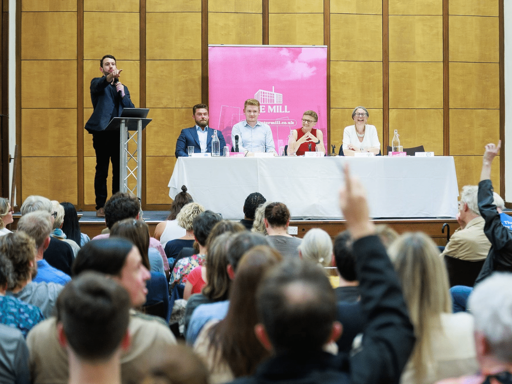

Two phrases — housing and affordability — sung out across Greater Manchester’s mayoral election. Perhaps unsurprisingly, they’ve dominated more than anything else in manifestos, hustings and social media alike.
In my view, these two terms are polished, neoliberal-era euphemisms for what we’re really talking about. These underlying, harder-hitting phenomena are actually: property (ownership) and poverty (often, lack of ownership). I think it’s time that we collectively note that point, first things first.
But even if there’s a hesitation to talk about property and poverty as such, they are still being discussed. One more remarkable aspect of my weeks covering this mayoral by-election is just how much different parties agree on this. It seems, no matter who you ask, politicians know this really matters to ordinary voters.
This year’s dramatic, fiery parliamentary by-elections clearly became proxies for national politics. Gorton and Denton became an outlet for dissatisfaction with Labour among younger, professional, urban and Muslim voters. Makerfield became a referendum on Keir Starmer, leading to his swift replacement. Both results, thankfully, showed far-right Reform UK and further-right splinter Restore/Advance where to go.
But unlike national or even local elections, or especially those by-elections, Greater Manchester apparently agrees on plenty in this mayoral race. All parties sing from similar hymn sheets on material issues.
@TheCanaryUK Greater Manchester Mayoral Election 2026@ManchesterMill election hustings
pic.twitter.com/x4Q9DO0lvE
— C.J.Mc. Baillie (@cjmbaillie) July 27, 2026
Manchester-ism meets materialism
Imagine my pleasant surprise when Conservative mayoral candidate, Phil Eckersley, said at the Mill hustings we must “build affordable housing across Greater Manchester”.
And that Labour, in power and if given another mayoral term needs to do something about the housing crisis across the region.
Eckersley also said that we must keep community spaces and not just sell them off. This is somewhat rich, coming from a councillor of the party of Thatcher and Cameron, but it’s still a very welcome point.
Lib Dem candidate, councillor Richard Kilpatrick, likewise put “affordability” central in his opening pitch and “vulnerability” central in his closing speech. These are both proxy terms for poverty — the latter gets slightly closer to being on the money.
Again, for a representative of the party which used its only time in power under Nick Clegg to raise VAT and lower high earners’ taxes, this is a bit rich. Not to mention saddling a generation of young, educated workers with hefty student loan debts. But still, the point stands.
Labour mayoral hopeful Bev Craig, who began sharing her Belfast-area council estate credential recently, made similar points during the debate. In her opening speech, she presented a plan that is “ambitious [and] radical” which “puts money in people’s pockets”.
That phrase — “putting money in people’s pockets” — was used repeatedly throughout her campaign.
Unfortunately for Craig, her top pledge of a continued £2 bus fare cap was pinched by Andy Burnham for national rollout. This left Craig offering a less ambitious 11-18 year-old free bus policy, compared to the Green Party’s promise of free buses for all under-22s. Not sounding too “radical” then.
Speaking of Greens, candidate Geraldine Coggins was ahead of the others with their committed plans to put affordability central in the campaign and manifesto. This involved public transport policies, help for town centres, charities and small businesses, and most of all an affordable public housing scheme.
Reform’s landlord candidate, Sian Astley, dramatically dodged the Mill‘s hustings. However, Mill staff say that her policy platform centred around immigration policies which fall outside the mayor’s remit. Desperate though Reform is to wedge immigration into every debate, this one clearly missed the mark.
Labour and Reform dodge Manchester mayoral election community hustings
Labour’s pitiful property record
Where Bev Craig lacks ambition in her bus policy proposal, she appears to be trying to outdo the Greens on addressing housing. Craig has promised 50,000 new homes as mayor, with 10,000 “in the pipeline” by 2028.
By contrast, Coggins is promising 20,000 — 10,000 built over time, and 10,000 bought and retrofitted more immediately. Importantly, Coggins commits to keeping these as council homes. On the surface, it seems less ambitious, but if Labour’s record is anything to go off, that change could be needed.
Here’s the thing: Craig and Labour have a housing record in Manchester. It’s not good. Note that the Times has described Craig as the “brains behind Andy Burnham.” If it’s his record, then it’s hers — she “worked really closely” with Burnham since she was elected City Council leader in 2021. So it’s their joint Labour record which has given rise to Coggins’ repeated promise to “take Greater Manchester back from ‘big money’”.
Across Greater Manchester, and nowhere more than in the city centre, rent is the number one outgoing cost for many households. Rent costs an average of 38% of an average household’s salary in the region. That’s up from 29% just a decade ago, when Burnham took office.
In the city centre borough, that figure has risen from 39% to a whopping 44% in the same period. No other council area in England or Wales has been hit harder than Salford during that timeframe. It’s a shameful direction of travel: private landlords profit at ordinary people’s expense.
This is where relations of property — who owns and who doesn’t — creates conditions for poverty. It’s where housing and its possession creates ‘cost-of-living’ or ‘affordability’ crises of dispossession.
Who is Manchester’s development for?
Craig says that more affordable homes were built across the city in 2024 alone than in any other year in the previous 15. That’s not a particularly high bar as only a few hundred have been built in a decade.
As chair of Greater Manchester Combined Authority (GMCA), Burnham handed nearly £1 billion in loans to private developers. For that, the GMCA development fund has received only 500 affordable homes out of some 11,000 built. Relatedly, homelessness levels have risen to the same peak they were when Burnham took office.
Notoriously, Burnham’s close ally, Daren Whittaker of Renaker, was given more than £600 million and built nothing affordable. Not a single affordable home, only luxury flats. Even the Tory candidate picked this up:
Two-thirds of GMCA money has gone to luxury developments.
Something about the Tories’ £10 billion in VIP fast-track Covid contracts comes to mind, but even he is right on this. The centi-million-pound Renaker loan is now even facing a Supreme Court challenge from a competitor for how it was awarded. (In fairness, this means the challenge didn’t win at the Court of Appeal.) On top of that, one barrister has alleged that the No.10 North deal might be unlawful too.
Apparently, Craig’s team just “picked a big number” — 50,000 homes — “because it sets an ambition” (see circa 43 mins here). Not because she believes it’s achievable, or because it provides the necessary affordable housing, seemingly. Any hopes for much change are not looking promising either.
Asked how she would differ as mayor from a man who is synonymous with the role, Ms Craig told The Independent: “There will always be an element of continuity.”
So, between suspect contracts and a record of failure, it’s quite a lot to expect much change with Bev Craig. And we can be certain that landlord Sian Astley, whose Reform PLC boss Richard Tice is a property development mogul, isn’t coming to save Manchester either.
Coggins: ‘Equal societies are happier societies’
Property and poverty will continue to dominate Manchester’s politics until someone is willing to address them as they exist. Though she won’t be Manchester mayor, Coggins at least saw this clearly. As one of only two mayoral candidates to show up to a cost-of-living/ housing/ affordability hustings, she said:
We hear so much about period poverty, bed poverty, fuel poverty, or food poverty. But at what point do we admit that these are all just about poverty and inequality?…
Equal societies are happier societies…They work for us all.
@TheCanaryUK Greater Manchester Mayoral Election 2026@ManchesterMill election hustings
— C.J.Mc. Baillie (@cjmbaillie) July 27, 2026
Featured image via Joel Goodman/ the Mill
From Canary via This RSS Feed.