

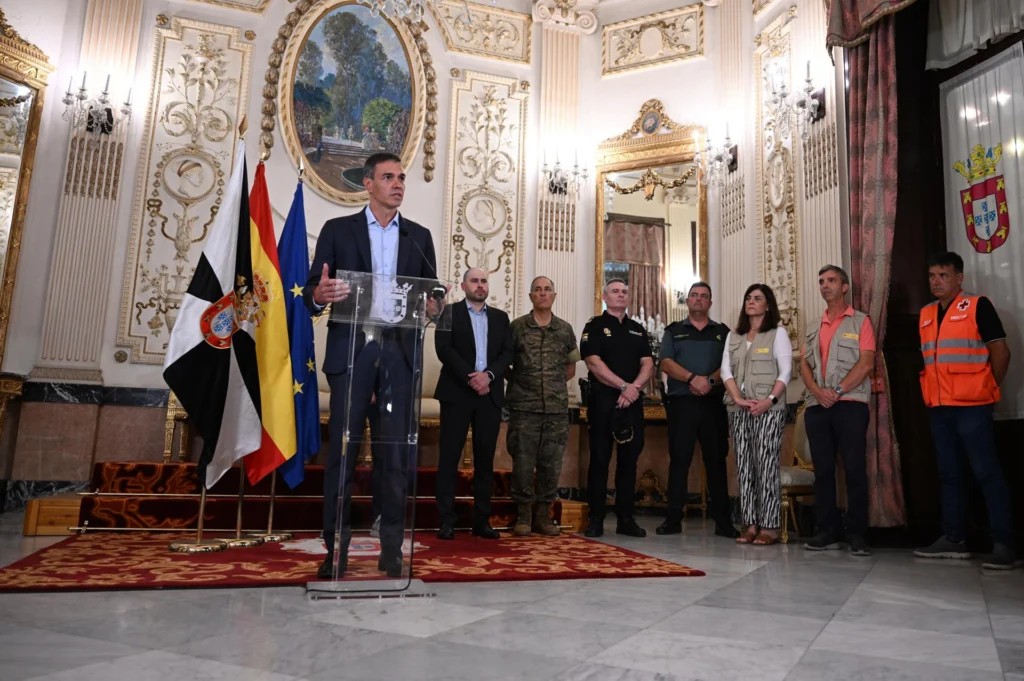
Madrid calls for an emergency EU interior ministers’ meeting after divisions emerge over the bloc’s response to the Ceuta migration crisis.
Spanish Prime Minister Pedro Sánchez has called for an emergency meeting of European Union interior ministers, urging the bloc to adopt a coordinated response to the migration crisis in Ceuta after some member states took unilateral measures that he said undermine European solidarity and EU law.
RELATED: Spain Returns Over 40,000 Migrants to Morocco After Ceuta Crisis
In letters sent on Saturday to European Commission President Ursula von der Leyen, European Council President António Costa and the Irish prime minister, whose country currently holds the rotating presidency of the Council of Europe, Sánchez requested an extraordinary videoconference “as a matter of urgency” to discuss the situation at the EU’s external border in Ceuta.
Sánchez said the meeting should establish a common response to similar crises and reaffirm that protecting the EU’s external borders is a shared responsibility rather than a burden borne solely by frontline member states.
Spain says 50,000 migrants who entered its North African enclave of Ceuta have returned to Morocco.
There are allegations they were actively encouraged to make the crossing, even as poverty and inequality drives people to seek opportunities in Europe. pic.twitter.com/7tzKUajUIv
— Al Jazeera English (@AJEnglish) August 1, 2026
The appeal follows what Sánchez described as sharply contrasting reactions among EU governments after the recent migration incident in the Spanish enclave. While he said most member states had expressed solidarity and offered assistance, he criticized others for attacking Spain and calling for its temporary exclusion from the Schengen area.
His remarks referred to Italy’s decision to introduce random checks, beginning Saturday, on non-EU citizens arriving from Spain through airports and seaports.
Sánchez argued that, in the current international context, the European Union cannot afford what he described as a “selfish, polarizing and illegal” response, saying the situation requires coordinated action.
Spain Defends Its Handling of the Crisis
According to the Spanish government, about 50,000 migrants entered Ceuta irregularly from Morocco before authorities restored full control of the border within 48 hours. Sánchez said Spain provided extensive humanitarian assistance, repatriated nearly all those who crossed irregularly and prevented any unauthorized movement into continental Europe.
He said those measures were implemented in close coordination with Moroccan authorities despite receiving limited support from other European countries.
Ceuta in chaos: Spanish army powerless as unarmed migrants pour over border
Spain has been forced to deploy its military in Ceuta after thousands of migrants swarmed the city from Morocco, overwhelming security forces. At least 15 people died trying to make the crossing,… pic.twitter.com/gFHihEIjm0
— Sputnik (@SputnikInt) July 31, 2026
Sánchez also defended Spain’s broader migration policy, saying it has sharply reduced irregular arrivals through Spanish territory and made the country the EU’s second most secure external border despite being the bloc’s only member state with a land border in Africa.
He added that Spain has previously assisted other EU countries during migration emergencies by receiving some of the migrants who arrived in Eastern Europe through Belarus in 2021 and on the Italian island of Lampedusa in 2023.
Criticism of EU Partners
Sánchez said the criticism from some European governments appeared to be driven by prejudice, misinformation, ignorance or domestic political interests. Such positions, he argued, are contrary not only to European law, humanitarian principles and solidarity, but also to Europe’s long-term interests.
He also noted that Ceuta is not part of the Schengen area, that almost all migrants who entered irregularly have already been repatriated and that, according to Frontex, Spain remains one of the EU’s least porous external borders, recording roughly half the number of irregular entries registered in Italy over the 2021-2026 period.
From teleSUR English via This RSS Feed.