

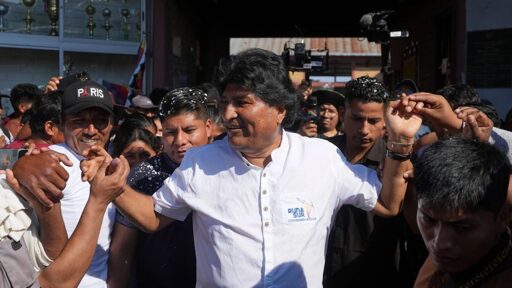

On July 29, the Bolivian Public Prosecutor’s Office in Santa Cruz issued an arrest warrant against former leftist President Evo Morales (2006–2019). Authorities accuse Morales of having led the recent anti-government and anti-neoliberal protests that rocked Bolivia for more than 50 days.
The specific charges against the Indigenous former president are terrorism, endangering the safety of transportation systems, criminal conspiracy, public incitement to commit a crime, endangering the safety of public services, and armed insurrection against the state. The prosecution is seeking between 20 and 30 years in prison for the alleged crimes of terrorism and armed insurrection alone.
The prosecution claims that Morales is responsible for these actions allegedly because he participated in massive protests, during which demonstrators demanded the resignation of the newly-inaugurated president, right-wing Rodrigo Paz, for having introduced a neoliberal bill that allowed for the expropriation of land to settle debts (something that is prohibited in the country) among other things.
The complaint that led to the issuance of an arrest warrant was initially filed by Stello Cochamanidis Garces and by the Interior Minister Marco Oviedo Huerta, who joined the complaint sometime later. Thus, the warrant states: “[Morales] must come forward to explain what his role was during the 53 days (of road blockades), to explain why he made the statements he did, why he took responsibility, and why he said that he was the one who was practically in charge of the actions.”
Morales claims this is political persecution
For his part, on his X account, Morales rejected the arrest warrant: “Today the government issued a new arrest warrant against me, accusing me of alleged crimes of terrorism and armed insurrection. They seek to hold us responsible for the social protests to hide the true tragedy Bolivia is facing: a deep economic and social crisis, the result of a model that has abandoned the people and protects corruption. Our position has always been clear: we stand with those suffering from austerity measures, fuel shortages, the rising cost of living, insecurity, and the spread of drug trafficking.”
In addition, the former president said that neither he nor the Bolivians demanding change will be “intimidated”: “They won’t solve the problems they themselves have caused through legal proceedings and political persecution; they’re just trying to divert attention with a new headline … We will continue to fight alongside the people, as we have always done, with the conviction that Bolivia deserves a different path: one of dignity, sovereignty, social justice, and the restoration of hope for everyone.”
It is not the first time that Morales is facing charges. In 2024, the Prosecutor’s Office issued an arrest warrant against him for the alleged crimes of human trafficking and smuggling, a warrant that (though categorically rejected by Morales) was renewed in 2025.
The prosecutor’s office accuses him of having had a romantic relationship with a minor, something Morales has called “absurd”: “The only thing missing was for them to order my immediate dismemberment in a public square, as happened in the colonial era when the conquistadors severely punished Indigenous people who rebelled against oppression,” he said in 2025.
However, the trial was halted because Morales didn’t show up for the hearings, claiming that the trial was flawed and designed to destroy him both politically and physically. It is speculated that he is in the Chapare region, in the department of Cochabamba, an area where thousands of peasants have vowed to defend him against any attempt to arrest him or take his life.
From BT News via This RSS Feed.