

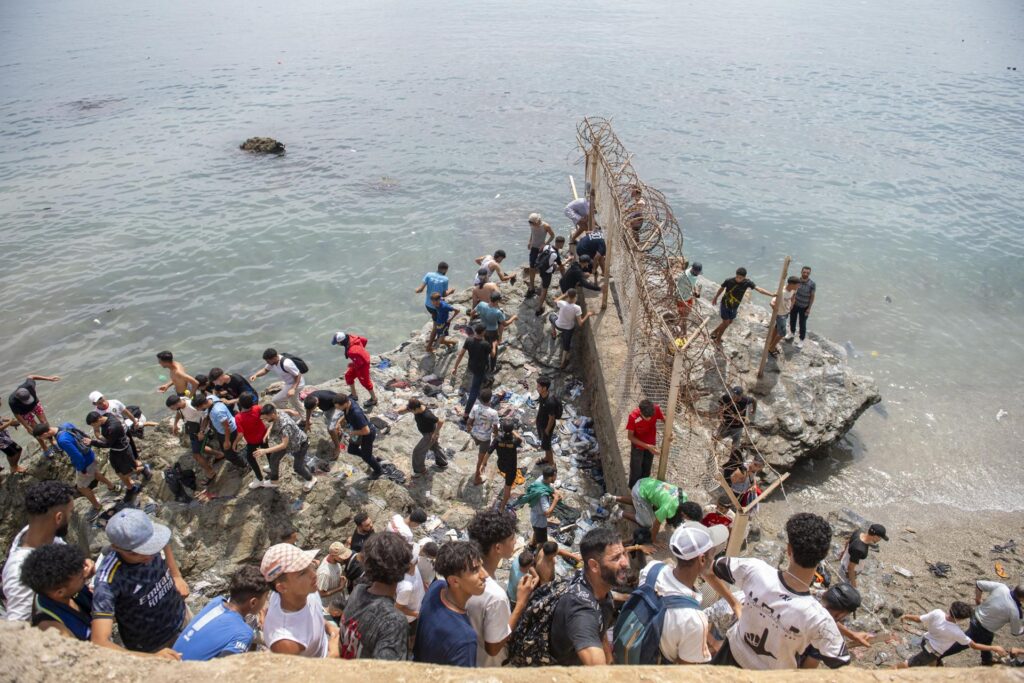
The European Commission ruled out suspending or expelling Spain from the Schengen area over the migration crisis in Ceuta, confirming on July 31 effective border control and no irregular movements toward the mainland or other EU states.
The European Union’s executive body confirmed this Friday that no movement of migrants in irregular situation has been recorded from Ceuta toward mainland Spain or toward other member states of the geopolitical entity.
The institution verified that Spanish authorities are exercising effective control of the external borders, a determination that removes the immediate basis for the sanctions requested by several governments.
RELATED: Morocco Deploys Border Controls as Strategic Weapon
EU Migration Commissioner Magnus Brunner reaffirmed the Commission’s commitment to collaborate with Spain to resolve the migration crisis in the area. Brunner recalled that Article 41 of the Schengen Borders Code establishes a special regime for Ceuta and Melilla, under which both cities are considered external borders of the European Union. For this reason, mandatory controls apply to all people leaving those territories bound for the peninsula or any other EU country.
“Our priority now is to carry out the returns from Ceuta to Morocco, stabilize the situation and guarantee that no new illegal entries occur from Morocco. Our immediate priority is to continue supporting Spain in the protection and management of the external border of the European Union in an effective and orderly manner. This includes fighting illicit human trafficking networks and preventing people from undertaking dangerous journeys,” explained a senior official of the European Commission.
Had a phone call with Minister Albares. He informed me that, after the sustained efforts, practically all those who had entered Ceuta have returned. Not a single person has crossed to mainland EU. We will remain in close contact and are in touch with ministers across Europe. https://t.co/FBgpOO3Ch7
— Magnus Brunner (@magnusbrunner) July 31, 2026
Pressure From the Right
The EU Commission’s position comes after a request from a group of countries -including Italy, the Czech Republic, Finland and Denmark- to consider suspending Spain from the free-movement treaty. Italian Prime Minister Giorgia Meloni, the first to raise the expulsion of Spain from the free-circulation area, suggested studying extraordinary measures. Her stance was seconded by Czech Prime Minister Andrej Babis, Finnish Interior Minister Mari Rantanen and Danish Prime Minister Mette Frederiksen.
In response, Spanish Foreign Minister José Manuel Albares summoned the Italian ambassador in Spain, Giuseppe Buccino Grimaldi, following statements in the same direction made by Italian Foreign Minister Antonio Tajani. The diplomatic move underscored the tension generated by the right-wing campaign around the crisis in the autonomous city.
From the executive body of the European Union, officials detailed that a contingent of 20 officers from Frontex, the European Border and Coast Guard Agency, is currently deployed at the maritime port of Ceuta providing support in routine controls. Spanish authorities have not requested additional deployment so far, indicating that the border situation remains manageable under current arrangements.
Protecting the Union’s external borders is a crucial part of our efforts to tackle irregular migration and prevent dangerous journeys.
I am in close cooperation with @magnusbrunner @dubravkasuica, who are working closely with authorities & partners to help manage the situation.
— Henna Virkkunen (@HennaVirkkunen) July 31, 2026
The Commission also recalled that the community space has the SchEval mechanism, a periodic peer review system that examines member states’ compliance with border rules. In case of serious deficiencies detected at a border crossing, the protocol establishes the issuance of a report, bilateral discussion and subsequent debate within the Council, with the aim of agreeing on a corrective action plan whose final decision corresponds to the European Council.
The decision consolidates Spain’s position within the Schengen framework while the migration crisis in Ceuta remains a battleground of European politics. For now, Brussels prioritizes technical cooperation, returns to Morocco and the fight against smuggling networks, steering clear of the punitive measures demanded by the most radical voices of the European right.
The autonomous city of Ceuta in Africa has received about 2,000 migrants by sea in less than two weeks, amid migratory pressure concentrated mainly at the maritime border with Morocco, which intensified on Thursday with the arrival of thousands of young people.#Ceuta #Africa… pic.twitter.com/VmQVw1L9Si
— teleSUR English (@telesurenglish) July 31, 2026
From teleSUR English via This RSS Feed.