

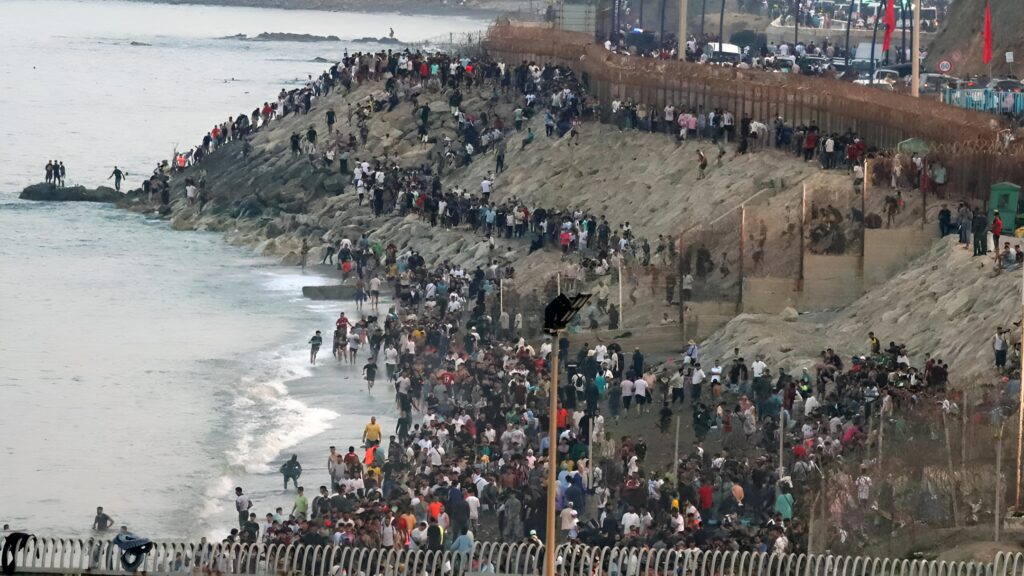
Relaxed patrol enforcement in Morocco along coastal checkpoints consistently forces policy shifts in Madrid.
The diplomatic relations between Spain and Morocco are defined by unresolved legacies, territorial disputes, and opposing foreign policies.
RELATED:
Violence Erupts as Migrants Attempt Overnight Storming of Ceuta and Melilla From Morocco
At the center of these tensions are Spain’s autonomous cities of Ceuta and Melilla on the North African coast, along with several small islands and rocks. While Morocco regards these enclaves as occupied national territory, Spain maintains that they have been integral parts of the Spanish state since the late 15th and 16th centuries.
The primary catalyst for ongoing diplomatic friction is the unresolved status of Western Sahara. Madrid long maintained a policy of official neutrality aligned with United Nations resolutions.
To restore bilateral security cooperation and border enforcement, Spanish Prime Minister Pedro Sánchez made a historic policy shift in March 2022 by officially endorsing Morocco’s autonomy plan for Western Sahara.
Although this concession reopened trade and diplomatic channels, underlying friction persists over maritime boundary claims near the Canary Islands and the strategic use of migration as a political lever.
Video Shows Moroccan Police Unloading Large Group of Young Men from Truck
A video shows Moroccan police officers stopping a large dump truck full of young men on a highway. The officers order the men to climb out of the truck, and dozens of young men quickly jump out and run… https://t.co/Z6mSqlEruD pic.twitter.com/ubghPglNA0
— Inside the conflict (@InsidConflict) July 31, 2026
Morocco’s Economy and Migration Dynamics
Understanding the movement of people from Morocco to Spain requires analyzing Morocco’s internal socio-economic and political conditions.
Despite significant state investment in infrastructure projects, such as the Tanger-Med port complex, solar energy facilities, and high-speed rail lines, economic inequality across the country remains pronounced.
According to economic indicators from Morocco’s national statistics agency, overall national unemployment has hovered around 10,8%. Youth unemployment among individuals aged 15 to 24 exceeds 29% nationwide, reaching 13,5% in urban centers and economically depressed rural regions.
Furthermore, informal labor accounts for an estimated 60% to 80% of total employment, leaving millions of workers without formal social security, health coverage, or stable wages.
Socio-economic regional disparities are particularly severe in northern Morocco, including the Rif region. Historically, the Rif has lower levels of state investment compared to central urban axes like Rabat and Casablanca.
The ongoing lack of economic opportunity and political expression in these northern provinces continues to drive young Moroccans to seek passage across the Mediterranean.
Global economic shocks, prolonged droughts affecting Morocco’s agricultural sector, and high inflation on essential commodities have further reduced household purchasing power across rural and working-class urban areas.
As agricultural yields decline, internal migration from rural areas to coastal cities increases, raising the number of people willing to attempt irregular entry into Europe through Spain.
A Tale of Two Moroccos
Yesterday, the King presented Morocco as a country steadily moving toward development, stability, and prosperity. It was a message meant to inspire confidence, attract investment, strengthen international partnerships, and convince Moroccans that their… pic.twitter.com/KwX0WFNaUm
— Brother Rachid الأخ رشيد (@BrotherRasheed) July 30, 2026
Migration as a Lever
Over the past two decades, the European Union and Spain have provided hundreds of millions of euros in financial aid, equipment, and training to Moroccan security forces to curb irregular border crossings toward Europe.
In 2022 alone, Spain’s Council of Ministers approved a direct transfer of 30 million euros to support Morocco’s border control operations, adding to a broader EU allocation of 500 million euros designated for Moroccan border management between 2021 and 2027.
When diplomatic disagreements arise between Madrid and Rabat, Moroccan border patrols have periodically reduced surveillance along key departure points in the Mediterranean and the Atlantic, as well as around the perimeter fences of Ceuta and Melilla.
Conversely, when diplomatic alignment is reached, Moroccan security forces resume strict containment measures, often involving targeted raids and the relocation of migrants away from northern coastal zones.
The structural reliance on Moroccan police and military cooperation limits Spain’s foreign policy flexibility. Because Spain relies on Rabat to prevent mass sea departures toward Andalusian beaches and the Canary Islands, Spanish governments face pressure to align with Morocco’s core geopolitical objectives, particularly regarding Western Sahara.
Flashpoint Ceuta: Border Crises, Human Realities, and the Reaction in Madrid
The Spanish autonomous enclave of Ceuta, situated on the North African coast directly opposite Gibraltar, represents one of only two land borders between the European Union and Africa. Due to its geographic position, Ceuta is a frequent focal point for border pressure and diplomatic friction between Spain and Morocco.
Border crises in Ceuta regularly result in significant humanitarian challenges and political escalation in Madrid, as we saw recently on July 30. During mass crossing events, thousands of individuals attempt to enter the enclave by scaling border fences or swimming around the Tarajal breakwater that extends into the Mediterranean Sea.
In major border breaches, local reception infrastructure, emergency medical services, and temporary holding centers become overwhelmed beyond operational capacity.
Humanitarian agencies report casualties, drownings, and injuries during these events, alongside complex legal questions regarding the processing and protection of unaccompanied minors.
In response to border breaches in Ceuta, Spanish Prime Minister Pedro Sánchez has repeatedly affirmed the government’s responsibility to protect state sovereignty. Sánchez has described unauthorized entries as a “violation of Spain’s territorial integrity” and an unacceptable breach of national borders.
Sánchez’s administration has deployed military personnel and extra national police units to reinforce border security, while simultaneously pursuing expedited return procedures in coordination with Moroccan authorities.
Sánchez also said that Spain’s policy of not automatically returning migrants without first complying with individual legal procedures for identification, respect for human rights, and judicial restrictions on summary returns at the border has been misinterpreted.
Within domestic Spanish politics, border incidents in Ceuta generate intense political debate. Conservative and far-right opposition parties, including the People’s Party and Vox, criticize the progressive coalition government for perceived weakness in border defense, calling for permanent military deployments and stricter immigration restrictions.
Conversely, left-wing parties and civil society organizations express concern over rapid deportations, demanding strict adherence to international asylum standards and greater European solidarity in handling regional migration flows.
Moroccan migration to Spain continues unabated and in staggering numbers.
It’s as if they were living in hell in their own country!
The Spanish security forces neither intervene nor stop them. pic.twitter.com/uVelwWqQy3
— Nassr al hada (@PalestineThred) July 31, 2026
The Zionist-Moroccan Alignment: Cyber-Surveillance, Geopolitical Pressure, and Friction with Madrid
The geopolitical dynamics surrounding Hispanic-Moroccan relations are influenced by the trilateral alignment between Morocco, Israel, and the United States. Under the 2020 US-brokered Abraham Accords, the United States recognized Moroccan sovereignty over Western Sahara in exchange for Rabat establishing formal diplomatic, economic, and security ties with Israel.
This normalization framework transformed security cooperation in the Mediterranean, providing Morocco with access to advanced military hardware, joint defense planning, and cyber-surveillance capabilities.
A major point of contention within this strategic alignment involves cyber-intelligence technology. Investigations by international media consortiums and digital rights organizations revealed that Pegasus spyware, developed by the Israeli technology firm NSO Group, was used by Moroccan intelligence agencies to target high-level foreign officials.
Target lists included Spanish Prime Minister Pedro Sánchez, Defense Minister Margarita Robles, and Interior Minister Fernando Grande-Marlaska during the peak of the 2021 diplomatic crisis over Western Sahara.
Defense cooperation between Rabat and Tel Aviv has deepened through formal security agreements. In January 2026, Israel and Morocco signed a comprehensive joint military work plan during the third meeting of their Joint Military Committee in Tel Aviv, expanding collaboration in intelligence sharing, border security technology, and joint naval exercises.
This deepening security partnership contrasts sharply with Spain’s recent foreign policy stance on the Middle East. In May 2024, Spain formally recognized the State of Palestine, joined international legal proceedings regarding military operations in Gaza, and implemented restrictions on arms exports to Israel. Spain’s critical stance on Israeli military policies led to diplomatic friction with Tel Aviv, including the recall of ambassadors.
During international debates on border management and decolonization, Israeli representatives at the United Nations highlighted Spain’s administration of Ceuta and Melilla, arguing that Madrid maintains European territorial footholds on the African continent while lecturing other states on international law.
|#Spain | This is not a migration crisis. It is a multi-front war orchestrated by the Mossad and the CIA and executed by Morocco against a nation that refuses to become an imperial vassal.
This is not a wave of migration, it is a carefully orchestrated geopolitical attack. The… https://t.co/LG37fxZWSf pic.twitter.com/wBUxBFc8cq
— Aprajita Nafs Nefes
Ancient Believer (@aprajitanefes) July 31, 2026
Geopolitical Realignment and the Future of Mediterranean Border Policy
The relationship between Spain and Morocco reflects the complex intersection of historical territorial disputes, economic pressures, and broader international alliances.
Morocco’s domestic socio-economic challenges, characterized by high youth unemployment and regional investment disparities, continue to drive migration flows toward Europe.
Spain’s reliance on Moroccan security forces to police European borders has created a delicate diplomatic balance. While Madrid seeks to protect its territorial integrity and fulfill EU border management obligations, it faces persistent political and operational challenges during mass migration events in Ceuta and Melilla.
At the same time, the integration of advanced defense technology and strategic alliances, such as Morocco’s security partnership with Israel, has reconfigured power dynamics in the Western Mediterranean.
As Spain continues to advocate for international law and Palestinian statehood, its diplomatic relationships with both Rabat and Tel Aviv remain closely linked to the security and management of its southern border.
Achieving long-term stability across the Strait of Gibraltar will depend on addressing the structural root causes of migration, establishing clear legal frameworks for territorial waters, and navigating the evolving geopolitical alignments that connect Europe, North Africa, and the Middle East.
Sources: teleSUR – Al Jazeera – El País – France 24 – Al Mayadeen – RTVE – MDPI – Moody’s Analytics – Red Diario – Izquierda Diario – El Mundo
From teleSUR English via This RSS Feed.