

By Javier Romero – Jul 30, 2026
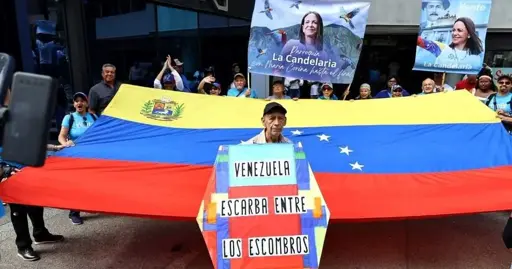
The political party Vente Venezuela had called, two days in advance, for “simultaneous assemblies in the 335 municipalities of the country” and a main gathering at the El Lido shopping center in the Chacao municipality of Caracas. The chosen slogan—”With our own hands,” and the symbolic date—the second anniversary of the 2024 presidential elections—aimed at what party leaders described as a demonstration of territorial strength. The result, measured in the number of people on the street, fell far short of that expectation.
Hundreds, not thousands: the figure reported by the opposition press
The media that usually amplify the calls of María Corina Machado’s party published notably modest figures. The Argentinian outlet TN, part of the Clarín Group, headlined that “around 300 opposition sympathizers” marched on Tuesday [July 28] in Caracas. Infobae, which dedicated extensive coverage to the day, avoided giving a number and limited itself to talking about “hundreds of Venezuelans” mobilized.
The Spanish newspaper ABC described the gathering in Plaza Venezuela and its route, but like Infobae, did not provide an attendance estimate comparable to the opposition mobilizations of 2024.
The absence of a claimable figure is significant. In earlier times, the leadership of Vente Venezuela itself used to close the events with its own estimates, which multiplied those of the official press. This July 28, the organizers did not announce a number from the stage.
Without the leader on the ground
María Corina Machado, the main figure behind the call and who signed the national appeal from exile, was not on the streets. She has been out of the country since the end of last year. Weeks ago, she announced her intention to return, but later reported that she had not been allowed to do so.
Her participation was limited to a recorded message broadcast on social media in which she claimed that “on July 28 we gave ourselves a mandate and we are going to fulfilll it.”
Edmundo González Urrutia, the other face that Vente Venezuela invoked during the day, has been in exile in Spain since 2024. The physical absence of both figures on such a symbolically charged anniversary left the organization without the figures that had historically given it mass traction.
A diversion that said more than the slogans
The coverage of the ABC newspaper from Spain described an episode that summarizes the political moment of the opposition movement. The march, which was originally to head “towards the center” of Caracas, deviated from its course and headed toward the Marriott Hotel in El Rosal, where staff from the US Embassy in the country are staying. The deviation, wrote the ABC correspondent, “says more than any slogan: the street is going to demand, without saying it, from the one who holds the table that she rejects.”
This is not minor. In a context where the national government is moving forward with a territorial reconstruction plan and a political dialogue scheduled for August 1, the symbolic destination of the demonstration—the accommodation of the US diplomatic representation—made visible a demand for external intervention that the Vente Venezuela leadership did not explicitly formulate from the stage.
Vente Venezuela out of the August 1 meeting
The call from Vente Venezuela comes the week before the start of the political dialogue process announced in June by the acting presidency of Delcy Rodríguez and a group of opposition ex-parliamentarians from the 2015-2020 period. The “work plan for the strengthening of democracy” formally begins on Saturday, August 1.
Neither Machado nor González Urrutia are among the participants. The leader of Vente Venezuela herself publicly acknowledged that she will not participate or attempt to obstruct the process. In this context, the July 28 march acquires a specific political interpretation: it is the party’s first mass call after being left out of the main political negotiation space of the year.
Henry Alviárez, Vente Venezuela spokesperson at the Caracas rally, summarized the position without any ambiguity. “If we want a transition, we have to participate in an election,” he declared. “When the date of the election is set, that is when the transition begins.”
This declaration admits, in a single statement, that the power to set the electoral calendar is not in the hands of Vente Venezuela.
An agenda displaced by reconstruction
July 28 arrived amid a national agenda dominated by another issue. A month after the double earthquake of June 24, Acting President Delcy Rodríguez launched the community phase of the Venezuela Reborn Plan in Caracas on Monday, July 27, with the launch of seven Community Brigades in the 23 de Enero parish, the official report of more than 30,000 inspected homes and 12,000 under active intervention, and the reaffirmed goal of delivering 4,000 homes before December.
The shift in the public axis is visible in the coverage. The main official portals—Presidential Press, Foreign Ministry, Telesur, Alba Ciudad, Correo del Orinoco—dedicated their front pages to the reconstruction and the honorary closure of the mission of the Cuban Rescue and Salvage Brigade, decorated by the acting president and the foreign minister.
In parallel, the United Socialist Party of Venezuela (PSUV) called for its own national mobilization to commemorate the 72nd anniversary of Hugo Chávez’s birth, with a march in Caracas that the international press called much more substantial than that of Vente Venezuela.
A trend that was already marked
The NGO Espacio Público, in its report on the right to peaceful assembly in 2025, had documented a 42.26% drop in protest activity in the country compared to 2024. The organization registered 235 protests across the national territory in 2025, compared to 407 the previous year.
Although the NGO attributed the decline to political context factors, the statistical conclusion aligns with what was observed on July 28: the opposition’s ability to sustain massive mobilizations has been consistently decreasing since the 2024 electoral cycle.
The July 28 call, with Machado and González Urrutia out of the country, with the party excluded from the August 1 dialogue, and with the public agenda absorbed by post-earthquake reconstruction, fits in that downward trend.
The members of Vente Venezuela themselves announced from the stage that they “will continue with the activities of citizen organization” and will maintain the municipal assemblies. It is, in fact, the tacit acceptance that July 28 no longer works as a lever for mass mobilization.
A symbol that is no longer enough
Two years after the elections that Vente Venezuela claims that it won, July 28 has ceased to be a date capable of gathering crowds. The street responded to the march call with hundreds, not thousands. The political leadership responded from exile. And the national government responded with a concrete agenda—housing, brigades, formal political dialogue—that occupies the center of public conversation.
The challenge for Machado’s party, beyond the symbolic efficacy of a date, is material: without a leader on the ground, without a seat at the negotiating table, and with a public absorbed by reconstruction, the promise of a “transition with our own hands” is only supported by rhetoric and not by the street.
Featured image: The Vente Venezuela gathering in Plaza Venezuela, Caracas, July 28, 2026. Photo: Vente Venezuela.
Sources
Infobae — Venezolanos marcharon en Caracas para exigir elecciones libres y que se permita el regreso de María Corina Machado
TN — Una marcha opositora exigió elecciones inmediatas en Venezuela
ABC — Seguidores de María Corina Machado salen en defensa de la libertad en la capital venezolana
Clarín — Venezuela se prepara para una jornada de marchas chavistas y opositoras
Diario Libre — El chavismo y la oposición se movilizan en Venezuela
teleSUR — PSUV se movilizará por natalicio del líder de la Revolución Bolivariana Hugo Chávez
Monitoreamos — ONG Espacio Público documenta 235 manifestaciones pacíficas en Venezuela durante el 2025
Translation: Orinoco Tribune
OT/SC/CD
From Orinoco Tribune via This RSS Feed.