


Amelia Schafer
ICT
A unique race is underway in Michigan where two members of different Potawatomi tribes are vying for the Democratic nod for a U.S. House seat.
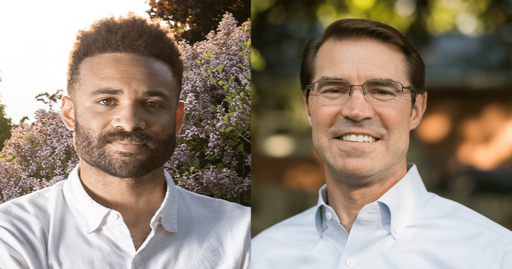
Diop Harris, a citizen of the Nottawaseppi Huron Band of Potawatomi headquartered north of Athens, Michigan, and Sean McCann, a citizen of the Citizen Potawatomi Nation headquartered in Shawnee, Oklahoma, are just days away from Michigan’s Democratic primary on Aug. 4. Each is hoping to win the right to face off this fall against incumbent Republican Bill Huizenga in Michigan’s District 4 U.S. Congressional District.
“It’s a huge opportunity for our people to have one of the first Indigenous members of Congress to represent the state of Michigan in the halls of Capitol Hill,” Harris said.
The fourth congressional district is home to the Pokagon, Nottawaseppi Huron Band and Gun Lake Bands of Potawatomi.
“This is an important population in this congressional district, it’s important history, it’s important heritage,” McCann said. “I would be thrilled to lift up and work with tribal folks as much as possible here should I get the chance to serve in Congress.”
Whichever candidate prevails is up against a big challenge. A Republican has held the 4th District seat for nearly 100 years. The last Democrat elected to serve the district was George Ernest Foulkes who served from 1933 to 1935.
While the district has been subject to numerous redistricting campaigns, it has remained one of the most Republican districts in the state.
The key to changing this, Harris said, could be historic efforts to engage Native voters districtwide.
“We’ve got forty-five thousand Indigenous people that live in our district, and they’ve suffered from a lack of engagement from both sides of the aisle,” Harris said. “And I’ve been able to consolidate support and bring in a brand new voting block to participate in our election, not only in the primary, but for the general upcoming. So we’re building an electorate right now that will be able to flip an eight term incumbent out of office. So it’s talking to every single community, but especially Native communities here.”
Area tribes, like hundreds of others across the country, are embroiled in a fight against prediction markets that tribes say threaten the viability of Indian casinos.That fight, in turn, has bled into various elections nationwide. Prediction markets describe themselves as investments contracts services, not gambling, and are regulated by the Commodities Futures Trade Commission, allowing them to skirt state and tribal gaming regulations.
“What we’re seeing is the prediction markets are infringing upon the sovereign rights of tribes and that that needs to be stopped,” McCann said.
Both candidates agreed that Americans are sick of the status-quo and will likely be looking for a change this fall, potentially swaying away from voting for Republicans.
“I think that there are people of all political stripes that are seeing that the promises that were made by President Trump and supported by this Congress just aren’t coming true,” McCann said. “I think that that may spur a desire of people to make change.”
No matter who prevails next Tuesday, a Potawatomi is going to advance to the general election this fall and face the challenge of flipping the seat.
Candidate profiles:
Diop Harris***(Nottawaseppi Huron Band of Potawatomi)***

Diop Harris, Nottawaseppi Huron Band of Potawatomi, will face another Potawatomi tribal member in the Michigan democratic primary for Congressional District 4 on Aug 4. Credit: Courtesy of Diop Harris campaign
Growing up in Battle Creek, Michigan, Harris experienced an oil spill on the Kalamazoo Enbridge Line 6B and said if elected he would fight to block a proposed new pipeline in the state known as Line 5.
“Line five represents a threat to tribal sovereignty with its mere existence,” Harris said. “Not only that, it has the threat to devastate our local environment. I’ve experienced this, being born and raised in Battle Creek in 2010, when we experienced the oil spill. … My hometown usually smells like cereal, like honey smacks or fruit loops then smelled like crude oil for a month. So in Congress, I would look to deconstruct the current pipeline and look to block the construction of the tunnel.”
“I stand on my record and I stand on my work. and the idea that anyone besides my constituents who I serve would control who I vote for or how I do my job is really kind of, I think, inappropriate,” McCann said.
Harris has a decade of experience working on campaigns both presidential and congressional nationwide, he said. He also has experience working on Capitol Hill as a legislative staffer where he worked to pass new laws, return resources to the community and work with the people so they can access the government, he said.
“People are fed up with the status quo,” Harris said. “So we’re gonna be reaching out to all of those people, from the cities in Kalamazoo and Holland, to the rural areas and in Dore Township as well as Martin. We’re reaching out to all corners of the Fourth District because every mile matters, and we’re gonna be doing it now until Aug. 4 to win our primary, and then we’re gonna be going through the finish line.”
Key issues:
- Reversing Citizens United
- Universal Health Care
- Issuing a one-year moratorium on datacenters
- Affordable housing
- Block the Bombs Act
- Support for the For the People Act
“Fighting for universal health care, the Medicare for All Act, is what I’m gonna be supporting Congress,” Harris said. “The rise of energy costs and the threat of data centers that pose problems to our communities, I’m fighting for at least a one-year moratorium at the federal level so that we can put in place those standards on consumer protections, labor, and the environment.”
Sean McCann (Citizen Potawatomi Nation)

Sean McCann, Citizen Potawatomi Nation, will face another Potawatomi tribal member in the Michigan democratic primary for Congressional District 4 on Aug 4. Credit: Courtesy of Sean McCann campaign
McCann, born and raised in Detroit, has decades of experience in local politics. McCann previously served in the Michigan legislature as both a House member and is currently a state Senator. McCann served in the state House for four years and the state senate for seven and a half years. Prior to those roles, McCann served as a part-time city commissioner in Kalamazoo, Michigan.
“I’ve been doing hard work and serving our community for a long time, doing everything I can to help people get ahead in the district that I represent and in the state of Michigan,” McCann said.
While serving in the Michigan House, McCann was a part of the state’s bi-partisan Medicaid expansion efforts. In the state Senate, he’s worked to pass an expansion of tax credits for low income families.
“I’ve been working basically all my career to try to help lift people up, help make the American dream more reachable, and this administration and this Congress are going in the wrong direction as far as I’m concerned,” McCann said.
McCann said his experience sets him apart.
“It’s great that new people come in and run, that’s our democracy, and that’s ultimately for the voters to decide if they want to try something new and different or if they’ve been satisfied with my public service career here in the Kalamazoo area,” McCann said. “Now obviously it’s a broader congressional district than just the areas that I’ve served, but you know, I’m happy to put my record out there, my service, my values and my ideas, and let the voters decide on Tuesday.”
Key issues:
- Extension of Affordable Care Act tax credits
- Reversal of Citizens United
- End to prediction markets
- End to congressional stock trading
- Affordable housing
“So there’s gonna be a lot to do, the budget’s gonna need to get restructured, the tax code needs to get tilted back in the favor of everyday folks,” McCann said. “I’ve worked on budgets for a long time in my experience in local and state elected office. … We just need a change of priorities.”
The post Two Potawatomi candidates facing off in Michigan primary appeared first on ICT.
From ICT via This RSS Feed.