

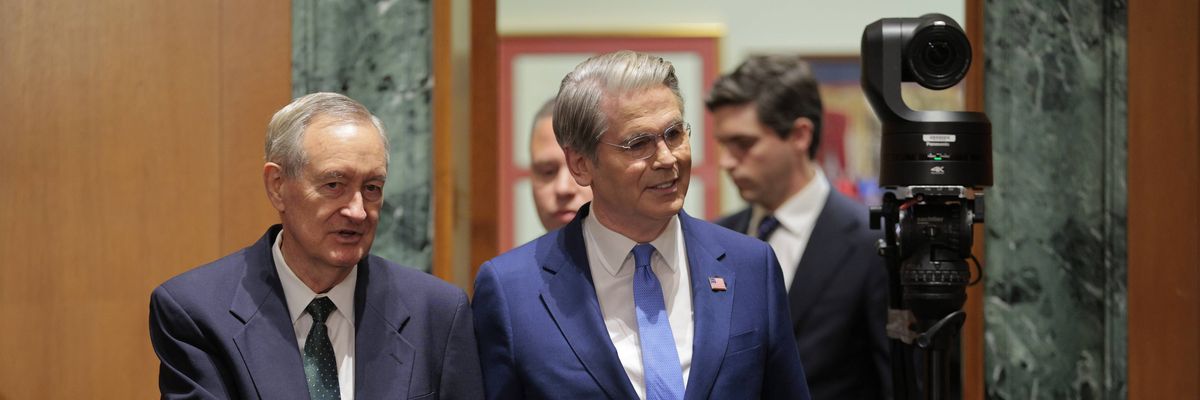
Republicans on the Senate Finance Committee voted Thursday to block a Democratic amendment that would have prohibited the Internal Revenue Service from giving sweeping tax audit immunity to President Donald Trump, his family, and their businesses.
If passed, the amendment would have nullified a central element of the deal that the US Justice Department cut with the IRS in May to settle Trump’s $10 billion lawsuit against the tax agency. Experts have argued that such broad audit immunity is unlawful, and Democrats have warned the agreement could leave the IRS with no recourse if Trump decided to dodge taxes on the billions of dollars he has pocketed during his second stint in the White House.
Democrats on the Finance Committee sought to attach their amendment to bipartisan legislation aimed at streamlining tax administration. The amendment failed in a 13-14 vote along party lines, and the bipartisan bill passed out of committee 26-1—with Sen. Elizabeth Warren (D-Mass.) the lone opponent. Warren told Politico that she “cannot support a bill that rubber stamps Donald Trump’s corruption.”
“Senate Republicans blocked Democrats’ proposal to end Donald Trump’s IRS sweetheart deal,” Warren wrote on social media following Thursday’s vote. “This deal gives him FULL IMMUNITY from audits on tax returns he’s filed. It’s corruption on steroids.”
The vote on the Democratic amendment came as Trump’s attorney general nominee, Todd Blanche, remained stalled in the Senate, in large part due to the Justice Department’s failure to commit to sufficient limitations on the IRS audit immunity deal, which Blanche signed.
Blanche, who is currently the acting attorney general, testified during a Senate confirmation hearing earlier this month that the IRS audit immunity deal is “not forward-looking,” but a key Republican said this week that the Justice Department has not yet provided sufficient written commitments to limit the immunity agreement.
Blanche reportedly met with the two Senate GOP holdouts—John Cornyn of Texas and Thom Tillis of North Carolina—on Thursday in an effort to hash out a deal to advance his nomination. Trump, who has aggressively avoided taxes throughout his career and broke with political tradition by refusing to voluntarily release his federal income tax returns, threatened on Thursday to pull Blanche’s nomination until Cornyn and Tillis leave the Senate next year, having lost reelection.
The New York Times summarized the IRS immunity deal, should it survive legal and political scrutiny:
First, the IRS has to drop any inquiries, whether civil audits or criminal investigations, it was pursuing into Mr. Trump, his family members, their companies, or ‘affiliated individuals.’ Second, the IRS can’t start any new investigations into tax returns that this potentially large pool of people and companies has already filed.
That means that any tax maneuver the Trumps have already used, whether the IRS was already auditing it or not, is now off limits. The agency typically has three years after someone files a tax return to assess more in taxes. So there are potential audits of Mr. Trump and his family that the IRS could have initiated—claims that ‘could have been asserted,’ in the language of Mr. Blanche’s order—that it is now not supposed to. But the next tax return that Mr. Trump files could, theoretically, still be eligible for an audit.
“Trump’s sweetheart audit immunity deal is perhaps the most brazenly corrupt action taken by a president in American history, and Congress must permanently put a stop to the unchecked greed on display,” Sen. Ron Wyden (D-Ore.), the ranking member of the Senate Finance Committee, said earlier this week. “Elected officials cannot look taxpayers in the eye and ask them to play by a set of rules that the president of the United States is exempt from."
From Common Dreams via This RSS Feed.
I thought a judge already blocked that immunity?
Edit: found it! https://www.bbc.com/news/articles/cn8q0e8d4ego
