

This article by Alma E. Muñoz and Néstor Jiménez originally appeared in the July 30, 2026 edition of La Jornada, Mexico’s premier left wing daily newspaper.
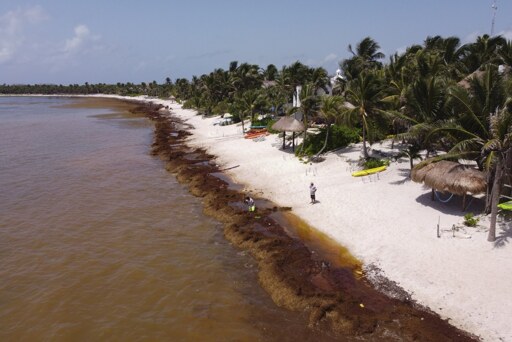
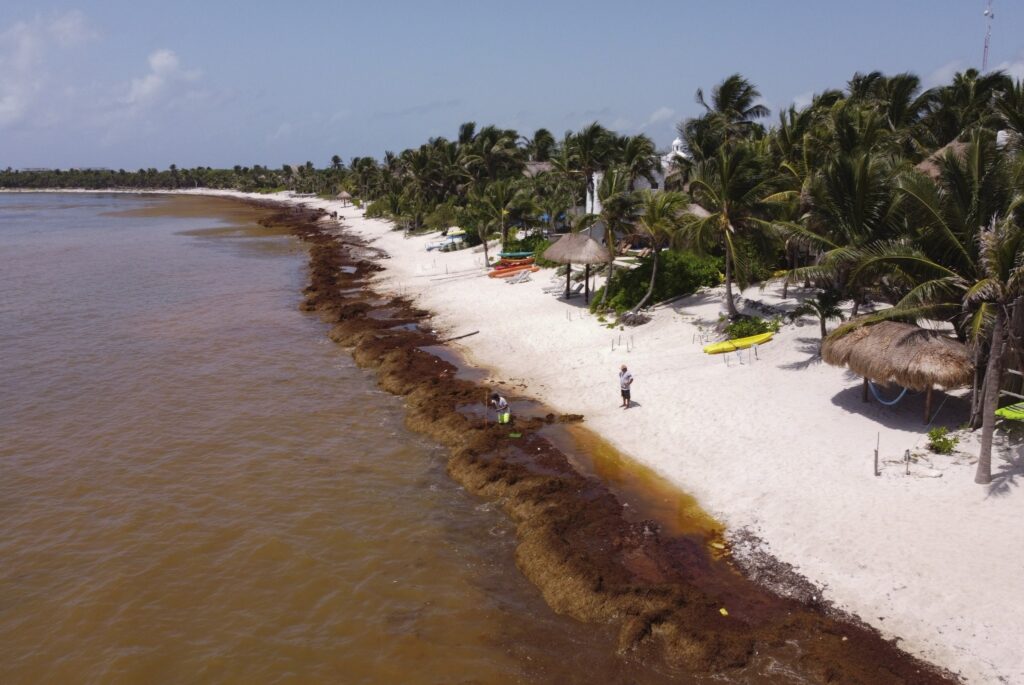
To address the massive arrival of sargassum in Quintana Roo, 9,000 tons a day that reach its shores, out of 90,538 tons that drift through the sea each day, the federal government is investing 2 billion pesos and will reinforce the strategy in the state’s five most important tourist zones: Cancún, Playa del Carmen, Puerto Morelos, Tulum, and Mahahual, which cover around 40 to 50 kilometers of beaches, President Claudia Sheinbaum Pardo reported.
With those funds, she specified, more boats will be acquired, two tugboats and six coastal sargassum vessels, along with more barriers and equipment for sustainable collection, “and we are looking for the best practices to unify them.”
“This year more sargassum arrived at the beaches of Quintana Roo and it is something that the scientists have to explain to us. 150 who are with Semarnat (Secretariat of Environment and Natural Resources) and with the Secretariat of Science analyzing why and also how to recycle algae,” she said.
At her press conference she explained that the Secretariat of the Navy is leading the strategy with various boats that make it possible to capture the sargassum in the sea, where it is most concentrated, and collect it around the containment barriers.
She highlighted the coordination with hotel operators, from small to large, “in order to carry out this reinforcement of the strategy,” while the state government reports through its satellite monitoring center where the sargassum is arriving and where it must be captured; “if more arrived on a given day, it informs the public which beaches can be reached, whether they are clean or not.”
It is a “titanic” effort “that has been made so far, but we have to do more to prevent it from reaching the beaches,” she said.
So “the government of Mexico is putting up 2 billion pesos for the comprehensive handling of sargassum,” and “we are going to capture more in the sea,” for which more sargassum vessels are being acquired. Each boat of this type has an average cost of 250 million pesos, depending on its size.
In addition, more barriers are being placed for collection on the beach, without carrying away the sand, based on environmental standards.
The President added that the coordination also includes the manufacture of products from sargassum.
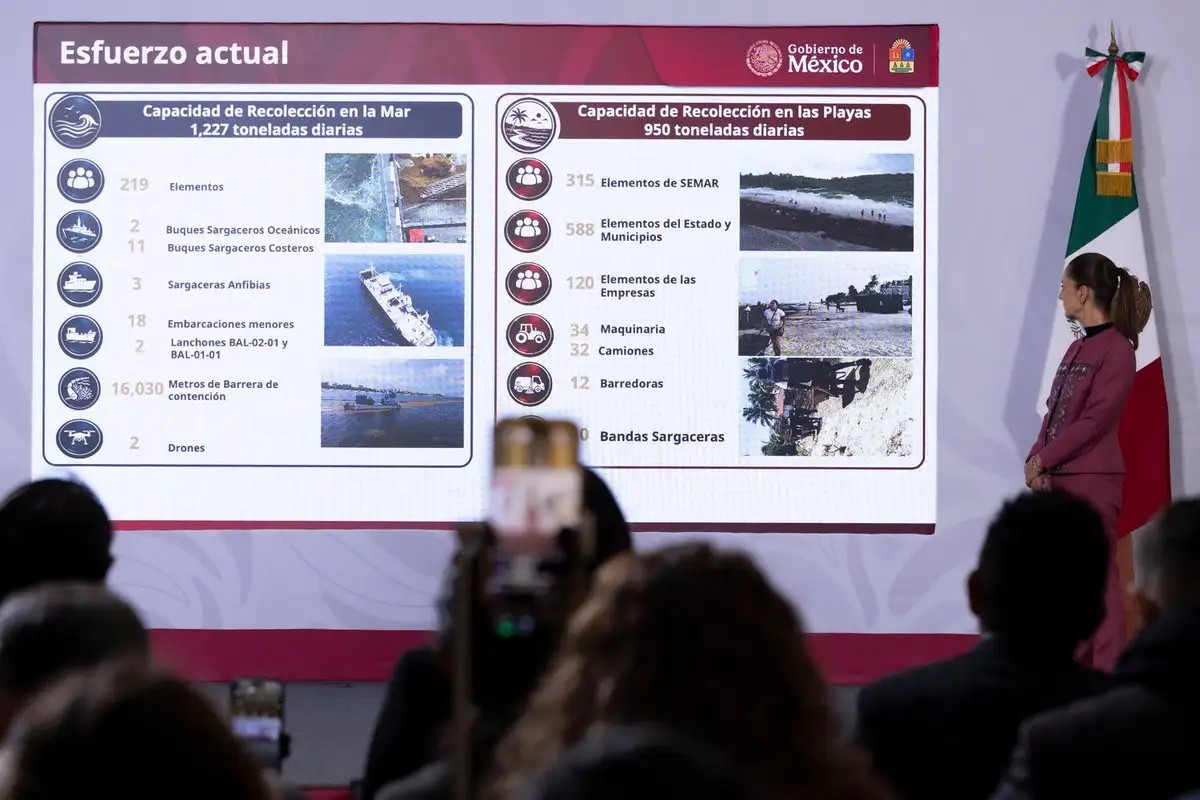
Photo: Presidencia
Sargassum, From a Temporary Phenomenon to One of Continuity
Alicia Bárcena, head of Semarnat, detailed that there are “198 initiatives at the national level, 11 with a potential for industrial scaling, and 39 companies in Mexico that already develop products from sargassum: biogas, bioethanol, sodium alginate, biofertilizers, plastic lumber, laminates, biochar, paints for selective coating, bioplastics.”
And what we want to do “is an inventory of companies and, of course, the circular-economy development hub in Puerto Morelos, which is where the sargassum that the Navy collects is arriving.”
At the mañanera, the Secretary specified that this year has been difficult, “atypical,” because we had “a mass arrival of sargassum from South America to the Eastern Caribbean, Central Caribbean, and the Mexican Caribbean.” In the latter, the sargassum drifts at a maximum of 90,538 tons a day, and it is estimated that 10 percent lands on the coasts of Quintana Roo. This amounts to 9,055 tons a day onto the coast, “which represents four times more than in 2025, and we have 27 times more than the historical average.”
She said that the sargassum arrives with serious impacts on tourism, on the beaches, on the biodiversity of Quintana Roo, since it has gone from being a seasonal phenomenon to a “very long one of continuous condition.”
She announced that on October 1 and 2 an international meeting will be held, initially financed by the European Union, “and all the countries of the Caribbean that want Mexico’s support are coming, because we are the largest country suffering the problem.”
Representatives from the Dominican Republic to Barbados will participate, “but we are also inviting Brazil and Japan, which has an enormous intention to support us, above all with sargassum vessels.”
Daily Collection to Be Expanded to 1,870 Tons
The Secretary of the Navy, Admiral Raymundo Pedro Morales, mentioned that they have an installed capacity to collect 1,227 tons of sargassum a day in the sea, and 950 tons on beaches.
“We are focusing our efforts mainly on the tourist beaches and with a great deal of support from private enterprise. We have two oceanic sargassum ships, 11 coastal sargassum ships, amphibious vessels, different sets of smaller craft, vehicles, personnel, and on the beaches we rely on personnel, manual equipment mainly, and on the municipal governments that, together with the state, assign around 588 people a day to sargassum collection on beaches with machinery and protective equipment,” he said.
In addition, “the businesspeople who hold concessions in the federal maritime-terrestrial zone also do their part, they have their barriers, they collect in front of their hotels and give the sargassum its final destination.”
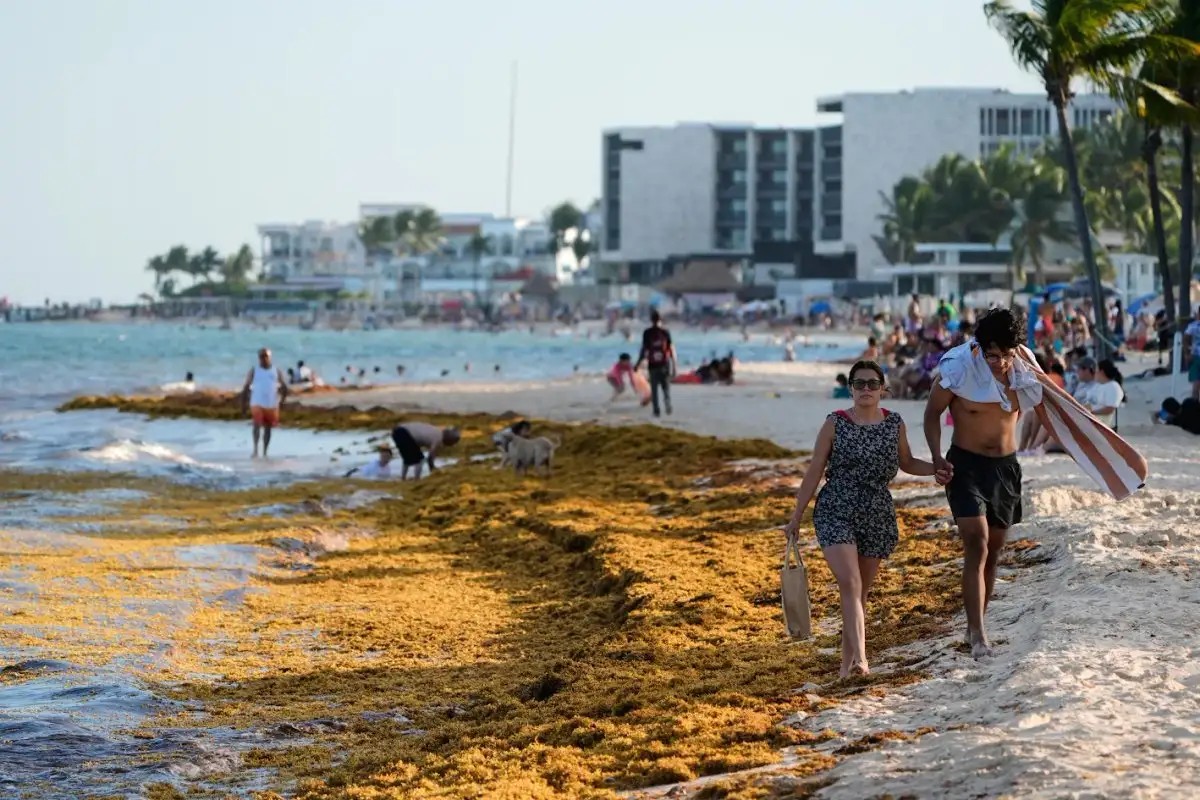
Photo: AP
He explained that today they have only two boats operating in the Caribbean and another is about to cross the Panama Canal to join the Caribbean, and with dynamic barriers to go fishing for the sargassum at sea.
He added that on the coastal side it is the same, with containment barriers anchored to the seabed, and we have collection groups with personnel from the Secretariat of the Navy, from the state governments, from the municipalities, as well as support from private enterprise.
He specified that of the 2 billion pesos, 768.7 million pesos are allocated to increase our capacity at sea to 1,870 tons a day with the acquisition of more sargassum vessels, escort craft, and tugboats, as well as to establish around 50 kilometers of coastal containment barriers to cover spaces in the most critical zones, such as Playa del Carmen, Cancún, Tulum, Puerto Morelos, and Majahual.
“In a second stage, with greater investments, we will try to reach what the average marks for us, which is 4,000 tons a day with more sargassum vessels, more containment barriers, and more collection equipment on the beach,” he said.
Mara Lezama, governor of Quintana Roo, explained that the massive arrival of this macroalga is a recurring, large-scale regional challenge that has put reefs, beaches, health, the well-being of families, as well as the economic activity of our coastal municipalities, and also of other places in the Caribbean, at risk.
She noted that in the state they have strengthened their capabilities with the state environmental monitoring center, the only one in Latin America, which uses images from 10 satellites of the European space agency to watch over more than 140 beaches.
It produces daily forecasts and also anticipates the arrival of sargassum, which “allows us to make a daily traffic-light system to know where the sargassum will arrive, where it is, and to always remember that the sargassum is not on all the beaches, nor every day.”
She said that during her administration more than 770 million pesos have been invested in the comprehensive handling of the phenomenon, “and experience has taught us that the best way to address it is to intercept it in the sea before it reaches our coasts.”
The President urged people to visit Quintana Roo:
“Many beaches are clean of sargassum, they have no problem, an enormous effort has been made by the Secretariat of the Navy, the state government, and the hotel operators. Go to Cancún, to Tulum, to Puerto Morelos, to Playa del Carmen, to Mahahual. This is a phenomenon that is not only for Quintana Roo. All the islands of the Caribbean have it.”
-
Mexican Government Invests 2 Billion Pesos and Reinforces Strategy to Contain Sargassum in Quintana Roo
July 30, 2026July 30, 2026
This year’s sargassum influx is four times greater than 2025 and 27 times the historical average, with some 9,000 tons washing onto Quintana Roo’s beaches every day.
-
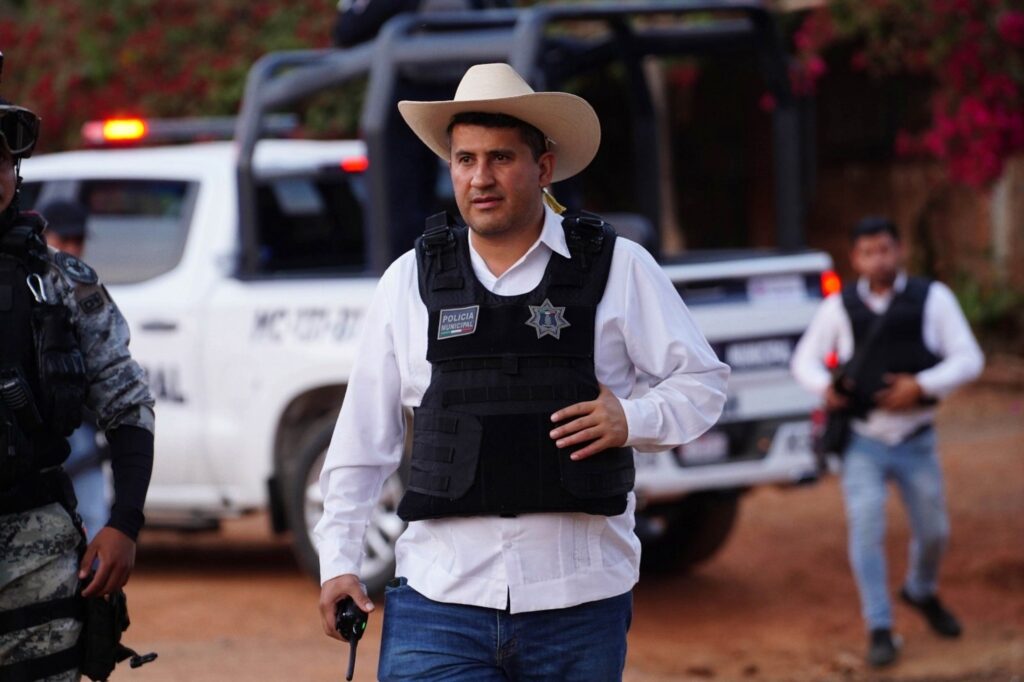
‘R1’ Arrested, Alleged Mastermind of the Murder of Former Mayor Carlos Manzo
July 30, 2026
Ramón Ángel Álvarez Ayala leads Los Rs, a CJNG cell; his capture brings to 31 the number detained over the Uruapan mayor’s November 2025 killing.
-
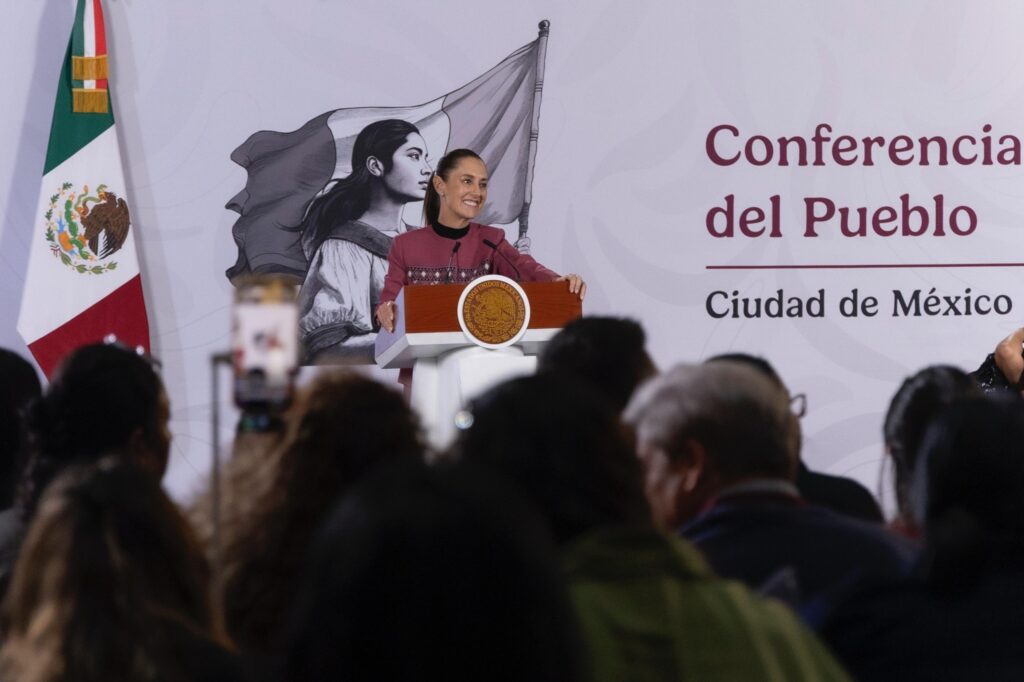
People’s Mañanera July 30
July 30, 2026July 30, 2026
President Sheinbaum’s daily press conference, with comments on the mañanera, political debate, the economy, sargassum, education, Cuba, and migrant protection.
The post Mexican Government Invests 2 Billion Pesos and Reinforces Strategy to Contain Sargassum in Quintana Roo appeared first on Mexico Solidarity Media.
From Mexico Solidarity Media via This RSS Feed.