


This story was originally published by The Imprint, a national nonprofit news outlet covering child welfare and youth justice. Sign up for The Imprint’s free newsletters here*.*
Nancy Marie Spears
The Imprint
Six years ago, the Osage Nation’s Social Services Agency began shifting its approach to child welfare. Leaders asked themselves a seemingly simple question: “How can we gain trust in our community?”
The answer quickly became clear. When maltreatment was reported,they needed to help families, not just take their kids away. At community events in the small town of Pawhuska — the tribe’s reservation capital, one hour north of Tulsa, Oklahoma — they distributed free food, diapers, medication lock boxes and fentanyl test kits.
Hoping to counter fearful perceptions of punitive child welfare workers, Osage Nation’s social services tried to project a different, more supportive image. The tribe embraced what staff called a “whatever-it-takes” approach to improve on their goal of preventing foster care entries and reducing trauma.
In March, the Osage Nation released a report highlighting the surprising outcome.
In February 2023, there were 27 Osage children in tribal foster care. But then, for a six-month period in 2024, not a single child entered the tribal foster care system.
“Safety remains essential always,” said Osage social services Director LaDonna Shadlow. “But when safety can be achieved without removal, that is how we will focus all our time.”
The Osage Nation’s ancestral lands span Oklahoma and Missouri. Among the nearly 26,000 members, about one in three are children.
Like all Indigenous peoples in the U.S., the tribe has weathered centuries of assaults on its land, people and sovereignty. There are few resources in the reservation’s towns and some residents travel 30 minutes or more to reach the nearest grocery store.
So protecting Osage children and families is vital to the tribe’s very survival, its former Principal Chief Geoffrey Standing Bear says.
“You must understand that the 5-year-old child in front of you is not only present now, but in the 50 years ahead,” Standing Bear stated in a March 6 report. “When you’re talking to a child, you’re talking to the future.”
In interviews, a retired tribal court judge and academics familiar with Indigenous child welfare practices found the Osage Nation’s reduction in foster care removals — and the six-month span with no child removed — impressive. They said they weren’t aware of any other tribes of its size achieving a sustained period in which no children were removed from home.
And 2025 data from Oklahoma’s Department of Human Services shows that 23 percent of the children in the state’s foster care system are Indigenous — despite only making up 9.4 percent of Oklahoma’s overall child population, according to 2025 Census data.
Tribal court judge and law professor at Michigan State University Matthew Fletcher, a member of the Grand Traverse Band of Ottawa and Chippewa Indians, called the Osage Nation’s results “laudable.”
“The problem with the child welfare system paradigm is it’s a punitive system,” Fletcher said. “So if you’re a parent who’s struggling with unemployment or other mental health issues or addiction issues, the government’s response typically is not to help you. It’s to punish you by taking your kids away.”
‘It filled a hole in my heart’
The March report details the story of Constance Bear, who spent time in foster care. The Osage mother of five lost her own children to foster care in 2016, and again in 2022.
Now 36, she said the tribe “has come a long way” in caring for foster children and families.
In 2016, the tribe had transferred her case to the state. When the Oklahoma authorities came to her home to take her kids, she recalled, she couldn’t hug her twins goodbye, or find out why they were being removed.
Six years later, with Bear still battling addiction, child welfare workers removed three of her other children due to substance use in the home. Because of her previous experiences with foster care as a child as well as the removals of her other children, she said it felt like her “worst nightmare.”
But this time, fellow tribal members spoke to her with empathy about next steps, she said. She had time to gather blankets and other essentials for the children’s move.
Bear said she felt better understood by tribal caseworkers. She got the help she needed with her addiction, and has been in recovery for over four years. Social services staff assisted her with everything from organizing notes about appointments to getting a new mattress.
“Those are things you don’t see in state cases, or even other tribal cases, because they don’t have those resources,” Bear said. “That communication, the patience in everything is almost foundational for somebody to be able to stand on their own.”
Bear has since reunited with her three younger children and regained joint custody of the twins, the Osage Nation reports.
“That filled a hole in my heart,” she said in the report. “It was exactly what I prayed for.”
How a tribe reinvented child welfare services
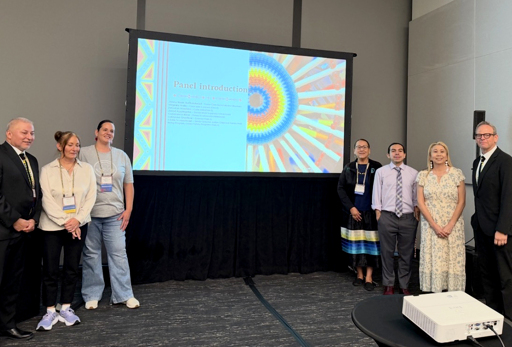
In April, the tribe’s social services staff discussed the improvements they’ve made at the annual National Indian Child Welfare Association conference in Oklahoma City. The work was supported with grants and technical support by the Casey Family Programs.
Shadlow said her tribe’s social service agency has also been aided by $167,629 in additional federal funding through the Family First Prevention Services Act, which began in 2020.
According to tribal data, child neglect is the most commonly reported allegation of maltreatment, largely driven by substance use and domestic violence exposure.
These days, no more than one child per month enters the tribe’s foster care system, on average. While the number of children in foster care has decreased, the Osage Nation’s child welfare team has grown, giving caseworkers more time to work closely with families in need. The number of agency staff — specialists in Indian child welfare and family preservation — grew from five in 2021 to 13 today. Indian Child Welfare specialists now average just 15 to 20 open cases in a given year.
The types of people they recruit has also changed.
“Any personal history with the system used to render an applicant ineligible for employment within the Indian Child Welfare team,” the March 2026 report states. “Now, however, that experience is viewed as an asset.”
While lived experience is valued, director Shadlow said, supervisors must have at minimum a bachelor’s degree in social work or a related field.
In interviews, two of the agency’s three case aides said much of their work goes “above and beyond” their job descriptions. Both emphasized the importance of being a steady, reliable resource for families — even if parents are struggling or uncooperative with their case plans.
“I’m going to scream this from the mountain top — meet them where they are,” said Case Aide Ginger Hollis, of the Osage, Iowa, Otoe and Ponca tribes. “It’s easier said than done. Sometimes these workers have to go even further than the parents.”
For staff, this means minimizing stressors by providing direct assistance with things like rent, utility bills or help with job applications.
“‘Whatever it takes’ is sometimes just sitting on the phone and making that personal connection,” said Zeb Hawkins, a case aide who is Osage and Chickasaw.
Sometimes it means doing more than what is required and looking beyond setbacks to remember the person, he said — like one mother he worked with who had relapsed. Hawkins remembers driving to her second rehab facility. On the way, he said, he stopped to buy her a meal.
“It’s not my job to drive her to Whataburger,” Hawkins said. “But for me, going above and beyond is saying, ‘That’s not my job, but I want to do it anyway.’”
Disclosure: Casey Family Programs, mentioned above, is a funder of Fostering Media Connections, The Imprint’s parent nonprofit. Per oureditorial independence policy, the organization has no editorial role in our news coverage.
The post The Osage Nation zeroed out entries into foster care for six months: Here’s how appeared first on ICT.
From ICT via This RSS Feed.