

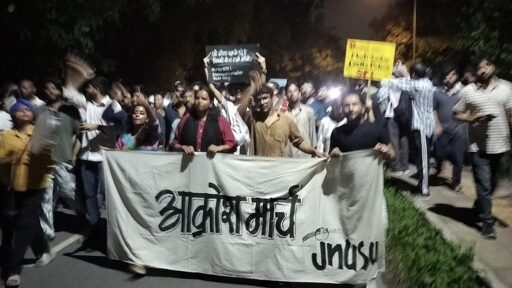
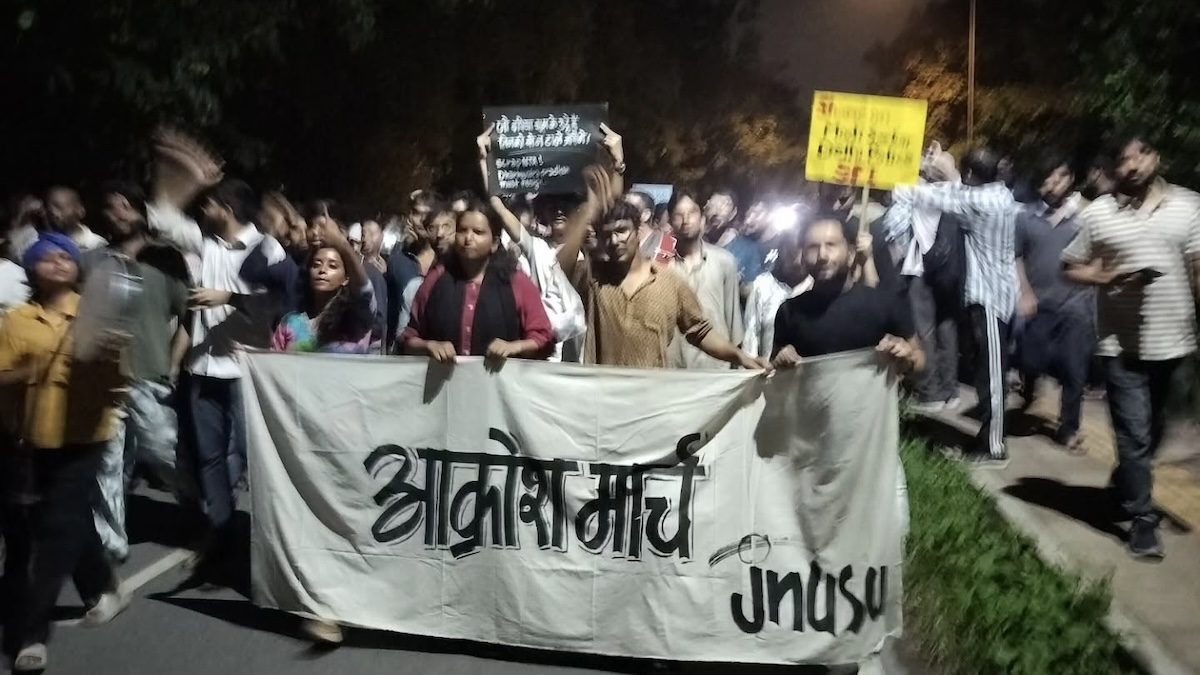
They came to Jantar Mantar in cockroach masks, throwing back at power a word that power had used against them. On July 25, 2026, after weeks of protest, a twenty-six-day hunger strike by Sonam Wangchuk, baton charges, tear gas and the closure of 18 Delhi Metro stations, Union Education Minister Dharmendra Pradhan submitted his resignation. By late afternoon on July 25, India’s students and young people had forced one of the cabinet’s most powerful figures from office.
Who are the cockroaches?
On May 15, 2026, during a Supreme Court session, the Chief Justice of India, Surya Kant, described the unemployed youth who ‘attack institutions’ as “youngsters like cockroaches”. The comment sparked anger amongst young people, and a creative response: the formation of the Cockroach Janta Party, a place for the young “cockroaches” to come together and organize their rejection of the system. Within twenty-four hours of its formation, the Cockroach Janta Party generated unprecedented momentum.
Founded on May 16, 2026 as a digital clapback to the judge’s jibe, the Cockroach Janta Party drew over twenty million online followers within a fortnight. But, it did not just accumulate followers. It published manifestos on different aspects of Indian political life, such as how Chief Justices are appointed, what electoral integrity should be, demands for media that is free and independent from corporate houses like Adani and Ambani, and on the national examination system. The CJP ran a nationwide “Pradhan Go Back” campaign centered around an indefinite sit-in at Jantar Mantar in New Delhi. As part of the sit-in, several activists were on hunger strike, including Sonam Wangchuk who sustained his hunger strike for 26 days. The youth and student movement also organized a mass mobilization of tens of thousands to march to Parliament on July 20, 2026.
In just two months, it forced a breakthrough that had eluded even the most resilient peasant and farmers movements, human rights advocates, independent journalists, and opposition groups over a decade of struggle.
The weight of that should be neither understated nor misread. For twelve years the Modi government has treated concessions as weakness. It outlasted the largest farmers’ mobilization in the country’s history, and when it repealed the three farm laws in November 2021 it kept its agriculture minister in place to pilot the repeal himself. It absorbed the anti-CAA protests, the female wrestlers’ sit-in ,and the agony of Manipur without losing a minister. Pradhan, only weeks earlier, had called the students “a B-team of terrorists” out to “divide the country”, a charge sharpened by his own past: he entered politics protesting a paper leak in 1997. That a government so practiced in refusal has given up a cabinet post marks a genuine shift in the balance of forces.
The long apprenticeship of Indian democracy
The young have carried this burden before. India’s students have repeatedly tested whether the republic’s promises mean anything, and each time expanded them. When the colonial state partitioned Bengal in 1905, students tore up the circular threatening them, walked out of government colleges, and built a parallel “national education” that survives today. When Gandhi called for non-cooperation in 1920, they emptied the Raj’s classrooms and founded Jamia Millia Islamia. In 1942, with the Congress leadership in jail, it was students who hoisted flags over secretariats and ran Usha Mehta’s underground Congress Radio.
After independence, the pattern deepened into something more than protest.
In 1965, students across Tamil Nadu rose up against the imposition of Hindi. The state killed scores of them, then reversed its language policy and lost two Union ministers from the region. In the winter of 1973 to 1974, a hostel fee rise in Ahmedabad became the Nav Nirman Andolan, which forced out Gujarat’s chief minister Chimanbhai Patel and dissolved the assembly. That current ran to Bihar, where a student agitation drew in Jayaprakash Narayan, hardened into the movement Indira Gandhi answered with the Emergency, and returned in 1977 to remove her. A student union led the Assam agitation of 1979 to 1985 and compelled a national government to sign an accord; Osmania University’s students were central to the birth of Telangana in 2014. None of this was won by decorum but by pressure, by forcing the state to answer to people it preferred to ignore. That is what deepening a democracy means.
The visible concession and the structural test
Here the sober reading begins. Across all these cases runs a single pattern: the state gives up the visible while the structural becomes the real terrain of contest. The anti-CAA and NRC protests of 2019 and 2020 imposed a real cost. The nationwide National Register of Citizens was shelved and has not been developed, while the government is still telling Parliament that no decision has been taken. Yet the Citizenship Amendment Act itself was passed and its rules notified in March 2024. The movement won a pause, not a repeal.
Pradhan’s exit sits inside this same logic, and the government has moved quickly to be seen taking action. In the days around the resignation, the Union Cabinet cleared a tougher anti-paper-leak bill, doubling prison terms and raising fines to ten crore rupees, with fast-track trials promised within three months, while the National Testing Agency dismissed forty-seven officials and announced an overhaul of its outsourcing model.
So far, the measures taken are focused on punishment and personnel, aimed at those who breach the system rather than the system that produces the breach. Whether the promised overhaul delivers a meaningfully new structure, or refurbishes the same commodified examination process that turns the futures of millions into a market of coaching fees and leaked papers, is precisely what remains to be seen.
While student leaders have now called off the protests at Jantar Mantar after securing government commitments to drop police cases and compensate affected families, the retreat from the streets is best understood not as the final settlement of a grievance, but as a conditional pause – leaving the broader account of structural reform still waiting to be drawn up.
Unity is the real target
What made the victory possible also marks its point of greatest vulnerability. Its strength lay in a solidarity that cut across the lines ordinarily used to fragment popular anger, a constituency defined not by caste, faith or region but by a shared material condition: the cheated aspirant, the graduate without work, the family that mortgaged land for a coaching fee. Grievances of that kind belong to everyone at once, which is why they unsettle a government fluent in communal arithmetic.
The record shows how such unity dissolves. In 1990 the mobilization against the Mandal Commission’s reservations (also known as Other Backward Caste reservations) split the student body along caste lines, upper-caste youth against the quota, Bahujan youth for it, and the common antagonist, an unaccountable state, slipped from view. The Assam movement built a formidable unity, but on an ethnic and exclusionary basis that ended in the massacre of some 2,000 Bengali Muslims at Nellie in Assam.
The instrument that breaks a movement of this kind is rarely the baton. It is the reminder to students that they are Hindu or Muslim, forward or backward, before they are the exploited youth. Pradhan’s charge that the protesters sought to “divide the country” inverts the real danger, which is that the country’s rulers divide the protest.
The apparatus that met them remains where it was. The lathis, the tear gas, the internet shutdown near Parliament, the facial-recognition cameras, and the automatic weapons at its gates were withdrawn only when the political cost of using them grew too high. A concession extracted under pressure lasts only as long as the pressure stays credible.
None of this diminishes the achievement. For the first time in twelve years an administration built on the appearance of invulnerability has been made to retreat by ordinary people standing together. But a retreat is not a rout, and a resignation is not a reckoning. The students have shown that the state can be moved. Whether it can be changed will be settled not at the moment of a minister’s exit but in the far longer contest over the structures left behind.
Atul Chandra is the Asia Co-Coordinator of Tricontinental: Institute for Social Research.
From BT News via This RSS Feed.