

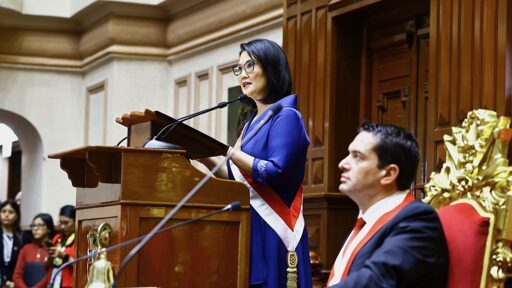

On July 28, right-wing candidate Keiko Fujimori took office as president of Peru. After being defeated three times in a row (2016, 2021, and 2022), Fujimori managed to secure a victory that had eluded her until now due to the significant resistance caused by the figure of her father, Alberto Fujimori, who ruled Peru through a combination of an iron fist and the rapid implementation of the most predatory neoliberalism throughout the 1990s and proclaimed himself a dictator.
Paradoxically, Keiko Fujimori has simultaneously used her father’s legacy as a political springboard; for while it provokes widespread rejection, it also guarantees a loyal voter base known as “Fujimorism,” which has enabled her to reach the runoff election four times, including in 2026.
A recent history of instability
But this year, things seem to have finally gone her way. After a vote count marred by controversy, allegations of electoral fraud, rule changes, and heated exchanges, Fujimori was declared president-elect over Roberto Sánchez. The leftist candidate was backed by Pedro Castillo, Peru’s former president, who is currently in prison for attempting to convene a Constituent Assembly. The opposition, including Fujimori’s supporters, labeled the move an attempted coup.
Following this, Peru was plunged into a wave of protests demanding the resignation of Dina Boluarte’s government. Boluarte, the country’s new president, did not hesitate to harshly suppress the months-long demonstrations, leaving more than 50 dead; as a result, Boluarte is now facing a criminal investigation for alleged human rights violations. Boluarte was subsequently succeeded by several interim presidents whose brief tenures merely underscored the clear political crisis the country is facing.
And it is, in fact, a crisis of legitimacy that Fujimori must now overcome. In the first round, her vote share did not exceed 17.19%. In the runoff, she secured a (highly contested) victory with just 50.14% to 49.86%. Her victory was by a margin of barely 50,000 votes. Sánchez managed to secure nearly 50% of the vote share thanks to the support of part of the center and even many right-wingers who were willing to negotiate with the left rather than face a government led by a new Fujimori.
Unity and neoliberalism
However, beyond the allegations of electoral fraud and the civil resistance that Sánchez has promised, the fact is that Fujimori was sworn in on July 28. She is the new president of a country that, despite its constant political crises, remains economically stable. However, many critics of the current neoliberal system argue that it is a system that benefits international capital (which holds a strong position in the Peruvian economy) and the country’s wealthiest but keeps the vast majority of Peruvians in poverty, informal employment, and material insecurity.
Fujimori, 51, as she stated in her inaugural address, did not promise to transform Peru’s neoliberal model, but rather to reinforce it. To do so, the new president does not appear to wish to disrupt the economic functioning of Peruvian neoliberalism, but rather to secure the other leg of the table needed to maintain stability: the political situation.
At least that is what she hinted at in her speech: “I am committed to achieving the goals of order and national reconciliation, in perfectly compatible terms. The real enemies are Peru’s major and serious problems.”
Clearly, Keiko is seeking to secure, as soon as possible, a sort of truce among Peruvian political groups that, in recent years, have been marked by relentless conflict. To this end, Fujimori has established two areas of focus that she hopes will earn her greater legitimacy from her opponents: crime and natural disasters.
“The fight will not be limited to common criminals. We will go after the national and international mafias that finance extortion, contract killings, drug trafficking, and illegal mining,” said Fujimori, while also stating that the Armed Forces will assume new responsibilities for internal security and promising to improve the National Police’s equipment. According to the president, nearly 24% of companies in Peru have been subjected to extortion by criminal groups.
She also promised to tackle the upcoming El Niño phenomenon with intelligence and planning; according to some experts, it could become the most devastating natural disaster of its kind in decades. For this reason, Fujimori announced that she is elevating this issue to a “national emergency,” on par with the fight against crime.
Likewise, Fujimori, like the other newly elected presidents, kept a trump card up her sleeve in case she needed it. She stated that Peru’s situation is complex and painful. “We inherited a state weakened by corruption.” She even went so far as to describe the country’s situation as “catastrophic” due to inadequate basic services, thousands of stalled public works projects, and a “chaotic” transportation system – all resulting from “decades of governments that shirked their responsibilities.”
Thus, Fujimori decided to begin her term with a somewhat cautious speech, yet one that signaled her readiness to launch a new phase in the development of neoliberalism in Peru. And this cannot be separated from the region’s current geopolitical context. With the victories of Fujimori in Peru and De la Espriella in Colombia, the ideological balance of these governments is clearly shifting toward a right wing aligned with Washington’s agenda.
A clear yet complex shift to the right
It comes as no surprise to see right-wing and far-right presidents in the front row during Fujimori’s speech: Nasry Asfura of Honduras, Daniel Noboa of Ecuador, José Raúl Mulino of Panama, Santiago Peña of Paraguay, Rodrigo Paz of Bolivia, José Antonio Kast of Chile, and Javier Milei of Argentina – all of whom have signed the Shield of the Americas, the new hemispheric strategy led by the Trump administration.
Thus, with only Yamandú Orsi, Uruguay’s president, representing the center-left in attendance at the presidential inauguration in Lima, the region’s clear shift to the right was evident. Perhaps the most notable absence was that of Brazil’s center-left President Lula da Silva (a country with which Peru shares a border of more than 2,800 kilometers) who declined to attend both Fujimori’s inauguration and that of De la Espriella, scheduled for next month.
However, Fujimori will face a dilemma similar to that of Kast. While they may align politically with Washington, Peru’s main trading partner is China, a country that recently inaugurated the massive Chancay seaport, which promises to become the primary gateway for Chinese products into South America via the Pacific Ocean.
For now, Fujimori has maintained a pragmatic stance on economic matters and has instead focused on restoring the legitimacy of a political system whose state of near-perpetual crisis has become the norm – a situation that could cause significant difficulties for a newly inaugurated government, which marks the ninth administration in just 10 years.
To that end, she announced an increase in the minimum wage to $381 (1,300 soles) and compensation for companies, signaling that her administration is kicking off with executive orders. “From this moment on, an irreversible countdown begins. We have 1,826 days of administration ahead of us, during which every ministry, every region, and every public official will have to work intensely, with measurable goals and constant accountability.”
Keiko Fujimori is Peru’s first female president, a fact that has been celebrated by many. However, her most important challenge now will be to prove that she can be the first female president to successfully complete her term since 2016. For now, she has Congress’s support, although if recent Peruvian political history has taught us anything, it is that nothing is more fragile than the apparent certainty of power.
From BT News via This RSS Feed.
The right claims another country
Peru has been in a presidential crisis for a few years, it’s a revolving door, presidents go in-and-out of the charge constantly.
Resigned, removed or arrested. It’s likely that she’ll be the next in this nightmare.
i came here to share this and that i’m not sure how to feel that i hope that this sort of political dysfunction keeps on going for this fujimori as much as it did for her father.