

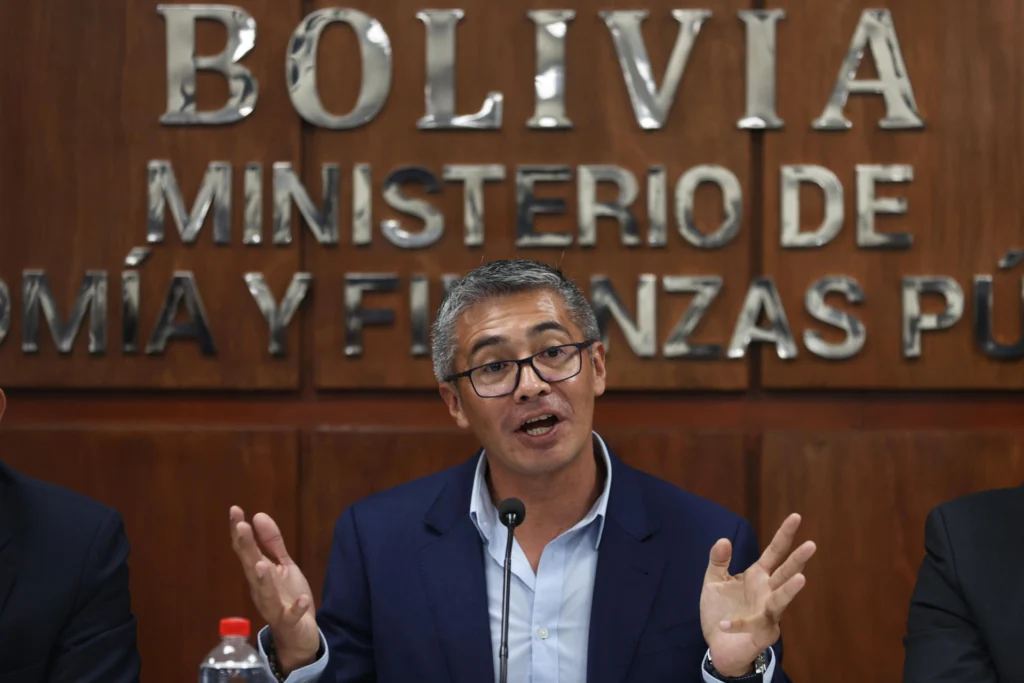
Bolivia secured this Thursday the first IMF credit in two decades under austery conditions, which needs to be approved by the IMF’s Executive Board and the Plurinational Legislative Assembly before funding can take effect.
Bolivia enters a decisive period as the Paz administration must navigate between fiscal commitments derived from the 1.900 million dollar IMF credit and growing social opposition determined to block a neoliberal rollback of the country’s sovereign economic model.
The preliminary agreement announced this week between the Government of Rodrigo Paz and the International Monetary Fund (FMI) represents more than a financial arrangement: it seals a sharp ideological turn in Bolivia’s relationship with international financial institutions.
RELATED: Bolivia Orders Arrest of Former President Evo Morales Amid Political Crisis
The IMF credit agreement marks a definitive end of a two-decade policy of distance maintained by the Movement for Socialism (MAS) , which had rejected multilateral financing to preserve national sovereignty over economic decision-making.
ACUERDO CON FMI: Min. Finanzas anuncia acuerdo, para un programa de 3 años, con el Fondo Monetario Internacional. Afirma que ampliará nuevos créditos con otros organismos internacionales como el BID, BM, etc. @teleSURtv pic.twitter.com/v4plIgXxPp
— Freddy Morales (@FreddyteleSUR) July 29, 2026
Text reads: “Agreement with IMF: Min. Finance announces a 3-year program agreement with the International Monetary Fund. It states that it will extend new credits with other international organizations such as the IDB, the World Bank, etc.”
During more than two decades, first under President Evo Morales (2006–2019) and later under Luis Arce (2020–2025), Bolivia maintained a limited and often adversarial stance toward the Washington-based lender.
Morales’ administration built a model of economic nationalism that deliberately reduced the country’s dependence on the IMF and the World Bank. Through nationalization of hydrocarbon resources, strict exchange rate controls, and robust public investment, the Bolivian governments achieved what the World Bank and the UN Economic Commission for Latin America and the Caribbean (ECLAC) recognized as significant gains: extreme poverty fell from 38.2 % to 15.2 % between 2006 and 2019, while Bolivia’s gross domestic product quadrupled over the same period.
The rupture deepened during the interim government of Jeanine Áñez (2019–2020), when negotiations with the IMF were initiated. Upon taking office in 2020, Luis Arce rejected that financing, arguing that the conditions attached would compromise Bolivia’s developmental model and social achievements.
New Course, New Conditions
The current far-right administration of President Rodrigo Paz, which took office in November 2025, has taken the opposite direction. The 1.900 million dollar credit, negotiated under the Structural Adjustment Facility (ESAF), has a program that includes the review of price structures, reduction of public spending, adjustments to state-owned enterprises, and structural regulatory reforms.
The Ministry of Economy, led by Gabriel Espinoza, has framed the agreement as a necessary stabilization tool amid what officials describe as severe economic imbalances: persistent fiscal deficits, a sharp decline in hydrocarbon production -historically Bolivia’s main export- depletion of international reserves, rising inflation, and distortions in the currency and goods markets.
Espinoza has insisted that the IMF imposed no specific conditions and that the program was designed by the Bolivian executive. However, critics note that the 30 % cut to public spending and the elimination of fuel subsidies announced in late 2025 align closely with standard IMF prescriptions. Analysts also point to the elimination of four taxes, including the wealth tax on large fortunes, as measures that reduce fiscal revenue while the government seeks external financing.
The IMF projects that the agreement could mobilize at least 5.000 million dollars over three years with contributions from the World Bank, the Inter-American Development Bank (IDB) , and other institutions. The government argues these resources will strengthen the Central Bank’s reserves and stabilize the dollar exchange rate in the domestic market.
The agreement must still be approved by the FMI’s Executive Board and ratified by the Plurinational Legislative Assembly, where the ruling party faces a fragmented opposition. Social organizations, including the Bolivian Workers’ Center (COB) and native people confederations, have already announced they will oppose the deal, calling for the defense of public enterprises and the social gains achieved during the previous years.
IMF Conditions Under Scrutiny
The credit agreement with the IMF is part of a broader effort by the Paz government to stabilize an economy hit by a severe shortage of foreign currency reserves, declining natural gas exports, and rising inflation.
The debate over the IMF’s role in Bolivia revives memories of past adjustment programs implemented in the region during the 1980s and 1990s, which were widely criticized for their social costs. In the current context, the combination of a floating exchange rate, potential subsidy cuts, and reduced public spending raises alarms about the impact on the most vulnerable populations.
Meanwhile, social organizations maintain that the mobilizations will continue until the government presents a viable alternative that does not sacrifice the well-being of the majority. The Bolivian Workers’ Union (COB, in Spanish) and native people’s confederations have called for a thorough review of the IMF agreement, demanding that any economic adjustment be designed with social equity as a guiding principle.
The coming weeks will be decisive for the Paz administration, which must navigate between the fiscal commitments derived from the international credit and the growing social pressure on the streets. The Plurinational Legislative Assembly is expected to receive the bill for ratification next week, setting the stage for a political battle that will define the direction of Bolivia’s economic future.
From teleSUR English via This RSS Feed.