

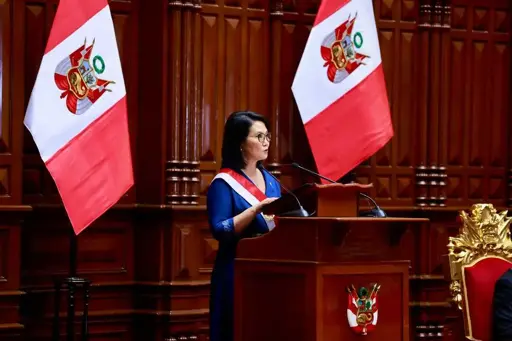
Peru’s president-elect, Keiko Fujimori, assumed office on Tuesday after being sworn in at a ceremony held at the Legislative Palace in Lima.
Amid protests to her presidency and her regime’s threats of a “tough” approach, Keiko Fujimori was sworn in as president of Peru, while members of Congress from the Together for Peru coalition left the chamber before President Fujimori began her first State of the Nation Address. The congress members displayed photographs of those who died during protests under the administration of Dina Boluarte (unelected president from 2022-2025).
The country’s last general elections in 2021 resulted in the election of left-wing leader Pedro Castillo, who was arrested and imprisoned by the Peruvian National Police shortly thereafter with the diplomatic support of the US and its regional vassals.
Following this year’s elections, which were beset by allegations of vote-rigging, Keiko Fujimori was declared the victor. Keiko is the daughter of disgraced former President Alberto Fujimori, former right-wing dictator of Peru from 1990-2000 who was convicted of crimes against humanity. Keiko thus becomes Peru’s first “elected” president since Castillo, who is still languishing in prison after his arrest in 2022.
Earlier in July, a United Nations Working Group concluded that Castillo’s detention was arbitrary, finding multiple violations of his due process rights. Castillo is a left-wing former rural schoolteacher and union leader. Before being removed from power in December 2022, he promised to rewrite the Constitution to ensure that all Peruvians shared in the profits from the nation’s mineral wealth.
Fujimori, in contrast, has been consistently backed by the leading imperialist power of the United States and its vassals, including Israel and Canada.
Prior to her swearing-in, Fujimori held a video call with Israeli President Isaac Herzog, with whom she discussed strengthening bilateral cooperation. The Peruvian president had already received a call from Zionist war-enabling Foreign Minister Gideon Sa’ar.
Keiko Fujimori was rejected in Congress and on the streets
Hundreds of protesters initially gathered in front of the Palace of Justice, a few blocks from the Congress of the Republic, where Keiko Fujimori was sworn in as president. Later, the demonstration moved toward Plaza San Martín, where clashes with National Police officers occurred as the participants marched.
Despite police resistance to prevent the protesters from entering the plaza, they managed to enter the public space, exercising their right to peaceful protest. “We remain vigilant against any human rights violations,” posted the organization Consensus for Human Rights on its social media account. Consensus for Human Rights is a network of 74 organizations working to defend, promote, and report on human rights in Peru.
“This plaza belongs to the people” was the slogan of the citizen mobilization that erupted in San Martín Plaza despite a police contingent attempting to prevent it. Relatives of victims, university students, social organizations, cultural movements, and other groups participated in the mobilization to reject what they called “Fujimori 2.0.”
Relatives of victims of the 2022 and 2023 protests, civil organizations, activists, regional representatives, and former presidential candidate Roberto Sánchez participated in the march to express their rejection of the new government. Meanwhile, inside Congress, opposition members also staged protests.
Sánchez, who faced Fujimori in a runoff election, reiterated his refusal to recognize the results abd stated his willingness to engage in dialogue with the new president. “I am capable of meeting with any devil, as long as we achieve justice for our people, and if now is the time, so be it,” he declared during the demonstration.
During the inauguration ceremony, legislators from the Ahora Nación party stood with their backs turned while some of the official proceedings took place. Other opposition members of parliament wore black armbands on their chests as a sign of protest.
Likewise, when Keiko Fujimori began her first address to the nation, members of Congress from Together for Peru, the party led by Roberto Sánchez, left the chamber along with a group of legislators from Ahora Nación to express their condemnation of the new regime.
Finally, Keiko Fujimori was sworn in as president of Peru with a speech that, as she had done during her election campaign, focused on citizen insecurity and the economy, announcing a 15% increase in the minimum wage, reaching 1,300 soles (335 euros).
“Starting this July 28, 2026, we will begin to write our future for the next five years. Not one day more,” she claimed during an approximately one-hour address, after receiving the presidential sash from the President of the Senate, Miguel Ángel Torres, and taking the oath of office.
Fujimori swore by the Peruvians who “have been historically neglected,” claiming that she would respect the “importance of the Catholic Church in the cultural and moral formation” of the country and that she would work “tirelessly for a safe, prosperous, and united country.”
“From this moment on, an irreversible clock starts ticking. We have 1,826 days of governance ahead of us, during which every ministry, every region, and every public official will have to work intensely, with measurable goals and constant accountability,” she claimed.
The leader of Fuerza Popular has stated that her government’s two “immediate” priorities are addressing the effects of El Niño and, as she has done previously, ensuring the safety of citizens—two issues she has categorized as “national emergencies.”
“We will employ extraordinary resources,” she alleged.
“We inherited a state weakened by corruption, where institutions ceased to serve the citizens … In many cases, institutions fell into the hands of opaque interests seeking benefits and privileges through public contracts and state regulation, to the detriment of citizens and free competition,” Fujimori stated.
“In terms of security, we will reclaim every neighborhood, every road, and every public space for Peruvian families. Wherever organized crime, drug trafficking, and illegal mining have wrested control from the state, we will use all the tools the Constitution makes available to the government … We will undertake a profound prison reform so that prisons become centers of detention once again, and not centers of operation for organized crime,” she claimed.
Along these lines, she announced that the Armed Forces will temporarily assume security and public order operations in those areas of the country where a state of emergency has been declared.
Furthermore, she alleged that her goal “is to improve the quality of life for all Peruvians, from conception to old age.”
Fujimori, who called for unity, dialogue, and thinking about future generations “and not the next elections,” also announced a “universal pension for impoverished senior citizens.” “We will begin by doubling the Pension 65 payment, from 350 soles every two months to 700 soles every two months (from 90 to 180 euros) for senior citizens living in extreme poverty,” the Peruvian president added, before addressing other objectives such as improving infrastructure and reorganizing the Public Administration.
“We inherited a state weakened by corruption, where institutions ceased to serve the citizens … In many cases, institutions fell into the hands of opaque interests seeking benefits and privileges through public contracts and state regulation, to the detriment of citizens and free competition,” she stated.
Forced Sterilizations Haunt Peruvian Candidate Keiko Fujimori
(Diario Red) with Orinoco Tribune content
Translation: Orinoco Tribune
OT/CB/SL
From Orinoco Tribune via This RSS Feed.