

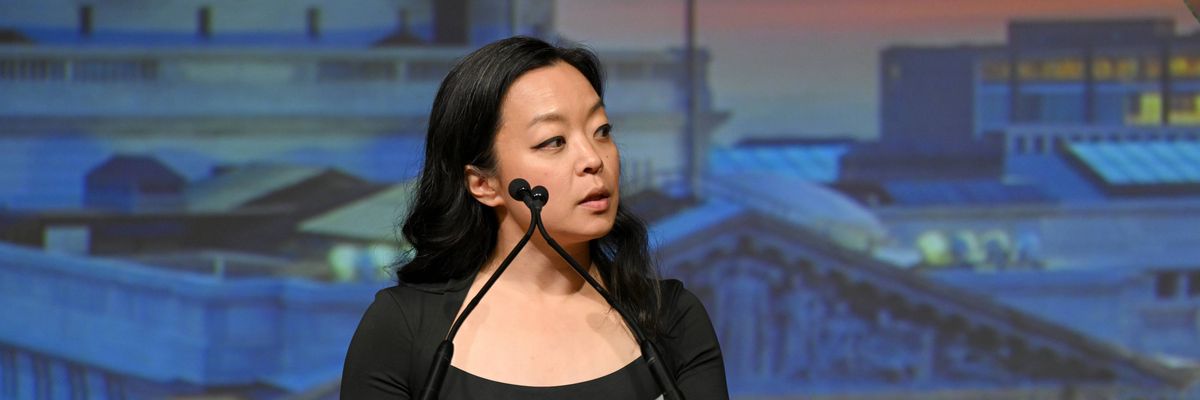
In a recent interview, Wisconsin state lawmaker Francesca Hong—the front-runner in the Wisconsin Democratic gubernatorial primary race, according to numerous polls—shared plans to counter President Donald Trump’s attacks on left-wing organizers that journalist Ken Klippenstein said he had “not seen from any other candidate” running for public office.
Klippenstein, a resident of Wisconsin, sent a questionnaire on national security to the top three candidates running in the primary scheduled for August 11—Hong, a democratic socialist; former state Lt. Gov. Mandela Barnes; and Milwaukee County Executive David Crowley, who has emerged as the Democratic establishment’s pick with an endorsement from Gov. Tony Evers.
Hong indicated in her response last week that should she win the primary and the November general election against GOP US Rep. Tom Tiffany, she “may be the first” governor in the US to curb the power of the state’s Joint Terrorism Task Force (JTTF), which like other FBI-led task forces across the country has been directed by President Donald Trump to “coordinate and supervise” a national strategy to “investigate and disrupt networks, entities, and organizations that foment political violence so that law enforcement can intervene in criminal conspiracies before they result in violent political acts.”
Hong said she would use her authority over state police forces as governor "to cease any cooperation with a federal joint operation task force that is designed to target American citizens exercising their civil liberties.”
Trump’s directive came last year in the form of National Security Presidential Memorandum 7 (NSPM-7), which was issued in the weeks following the assassination of right-wing activist Charlie Kirk. Trump declared immediately after the killing—before any investigation had taken place—that the “radical left” was to blame, and swiftly took steps to crack down on left-wing organizers, despite extensive evidence that a majority of political violence in the US is perpetrated by people on the far right.
The president signed an executive order declaring that “antifa”—which is not an organization—was a domestic terrorist group, and included in NSPM-7 a list of viewpoints held by left-wing organizers he also viewed as “domestic terrorists,” including anti-capitalism; anti-Christianity; extremism on migration, race, and gender; and hostility toward those who hold traditional American views on family, religion, and morality.
Under NSPM-7, local law enforcement agencies participate with JTTFs that were established in every state after the September 11, 2001 attacks.
Less than a year after the memo was signed, NSPM-7 has “already produced results,” said Klippenstein. The document underpinned the convictions of a group of activists who demonstrated against US Immigration and Customs Enforcement (ICE) at Prairieland Detention Center in Alvarado, Texas. The activists were sentenced last month to 30-100 years in prison, with the shortest sentence going to Daniel “Des” Rolando Sanchez Estrada for moving a box that contained leftist zines to avoid incriminating his wife. Sanchez Estrada was found guilty of “corruptly concealing a document or record” under NSPM-7.
A US attorney in Minnesota also cited the directive by name when 15 anti-ICE protesters were convicted, and Klippenstein argued in January that an ICE agent’s fatal shooting of protester Renee Good had "NSPM-7 written all over it,” with then-Homeland Security Secretary Kristi Noem accusing Good of “domestic terrorism.”
Earlier this month, Secretary of State Marco Rubio said that under NSPM-7, the administration had “designated four violent far-left extremist groups as foreign terrorist organizations, and there will be more designations soon.”
But in Wisconsin, Hong suggested she would discontinue the memorandum of understanding (MOU) that commits local police departments to work with the JTTF.
“These MOUs are a loophole to essentially federalize local police forces," she told Klippenstein last week in response to the questionnaire. "I do not wish to see Wisconsin become a patchwork of communities where people are unsure if they are safe depending on which side of the county line they may find themselves.”
Klippenstein credited Barnes with also responding to the questionnaire with “skepticism” of the MOUs, saying that as governor, he would "carefully review MOUs to ensure that any federal-state law enforcement cooperation is aimed squarely at keeping Wisconsinites safe, not supporting Trump’s dangerous, unconstitutional attacks on Americans whose only crime is disagreeing with him.”
Crowley did not respond to Klippenstein’s questions.
Hong and Barnes also said they would not support Trump’s use of Wisconsin National Guard troops in the US-Israeli war on Iran, with Hong saying she would “refuse to comply with any request from this administration that perpetuates war and genocide around the world to the extent I can.”
Hong said she would file a legal challenge to stop such a deployment, and Barnes said he would also consider a lawsuit.
“Hong’s answers suggest a willingness to stand up to the federal government even when the odds look slim,” wrote Klippenstein. “That stands out at a time when so many see the Democratic Party as pre-folded lawn chairs allergic to conflict. The sense I get from talking to her supporters is that this willingness to throw a punch is a big part of her appeal.”
Barnes was an early favorite in the race, while Lt. Gov. Sara Rodriguez was seen as the candidate preferred by the Democratic establishment. Crowley dropped out of the race and endorsed Rodriguez in early July, but restarted his bid after a campaign finance controversy pushed Rodriguez to drop out.
Hong has been consistently leading in polls tracked by The New York Times since February, with the latest survey from Marquette University Law School, released on Thursday, showing her with a 25-point lead.
From Common Dreams via This RSS Feed.