



From CENTCOM commanders to Elliott Abrams, calls are growing to rethink U.S. bases in the Middle East. Ending the war should include closing those bases.
By David Vine, The Nation, July 30, 2026
Their names were James Feehan, Isabella Gonzales, Michael Emmanuel Swinton, and Angel S. Rampersad. The four US soldiers, one just 19, were killed amid President Donald Trump’s recent escalation of the war on Iran. Their deaths at US military bases in Jordan and Iraq highlight the vulnerability of US troops across the Middle East.
Since the illegal war’s first days, US bases have suffered extensive damage from Iranian retaliation. The losses include 18 US military deaths, dozens killed in host nations, and billions in infrastructure costs. This damage and the limited military utility of US installations are forcing a much needed reconsideration of the US military presence in the Middle East. A growing consensus finds that dramatic changes are needed.
The result will almost certainly be the end of the nearly half-century-long era when scores of US bases have occupied the Middle East. The sooner US leaders accept this reality and start moving the military out of the region, the safer our nation, our troops, and our world will be.
Base Buildup, and Vulnerability
US bases began dotting the Middle East around 1980 when Presidents Jimmy Carter and, after, Ronald Reagan started building installations in response to the Soviet occupation of Afghanistan and Iran’s 1979 revolution. More appeared during the 1991 Gulf War and the 2001 and 2003 wars in Afghanistan and Iraq. They remained long after original rationales disappeared. Today, the military has at least 80 installations in almost every country across the region.
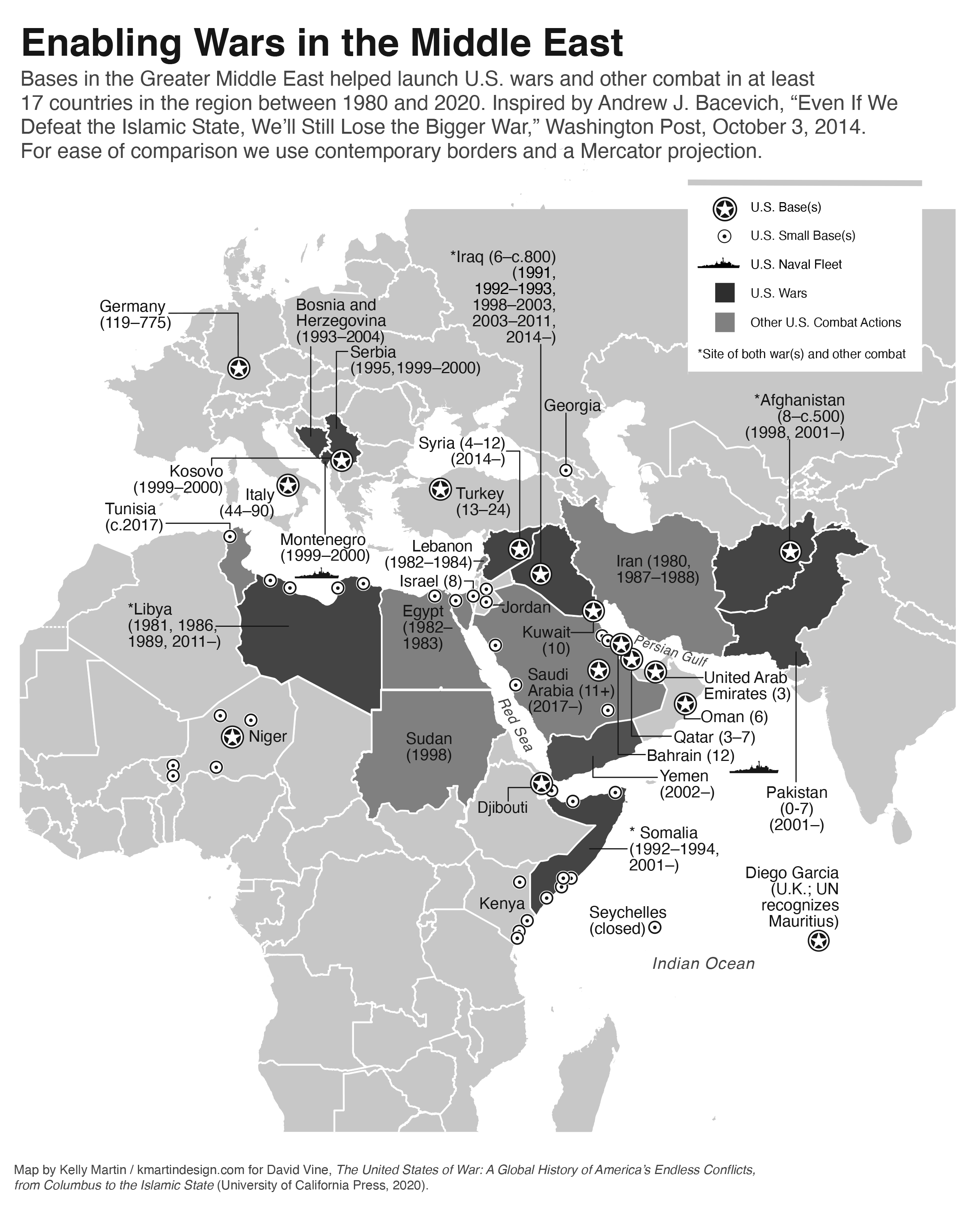
The Iranian military has attacked most countries hosting US bases because they’ve helped enable the US–Israeli war. In addition to the human toll, damage to military infrastructure and hardware runs into the tens of billions of dollars.
US troops have been so vulnerable that military leaders moved many to local hotels and offices, likely violating the laws of war. Iran has made many Middle East installations “all but uninhabitable,” reports the New York Times.
Calls for Change
Many, including former military leaders, are urging change. Current infrastructure “has become an anachronism that endangers US troops,” writes one of the architects of US Middle East basing, former high-ranking George W. Bush and Trump 1.0 administration official Elliott Abrams.
Some want to “harden” installations by improving their ability to survive attacks. Others want to “disperse” troops to more locations, especially those farther from Iran, including Israel.
Both supposed solutions would cost taxpayers tens, if not hundreds, of billions of dollars in construction and operational costs. No amount of hardening and dispersing can fully protect US troops, let alone host nations. Iran could still hit US bases farther away, Abrams acknowledges, as recent deaths and injuries in Jordan show.
Governments may refuse to host as they increasingly question allowing US bases to occupy their territory. The US military turned hosts into targets for Iran rather than offering protection, as US leaders promised.
Moving more US forces to Israel would be even more dangerous. Thousands of troops have already moved there due to damage to other bases. No missile defense system, including Israel’s “Iron Dome,” can keep US troops completely safe, as recent Iranian missile and drone strikes demonstrate.
Politically, Israel is increasingly isolated internationally and dramatically less popular across the US political spectrum. Expanding the US military presence would deepen US complicity in Israel’s crimes in Gaza, encourage more untethered Israeli aggression, and increase the likelihood that retaliatory attacks on joint bases draw the US into Israel’s wars.
Ending the Era
The era of US bases in the Middle East isn’t over yet. US officials have already announced contracts to rebuild in Qatar.
Still, closures are inevitable, just as past empires eventually abandoned bases overseas. US leaders can choose whether closures will happen through a careful process involving replacing troops with empowered diplomats or through chaos, potential military defeat, and wasted billions.
Every president since the Cold War’s end has closed bases, including in the Middle East. President Trump has openly questioned the hundreds of US bases worldwide. “What are we getting out of this?” he’s asked.
What we’re getting isn’t peace and security, as conventional wisdom long said. The war on Iran has shown how US bases are rarely defensive. Instead, they’ve been platforms for disastrous offensive wars in Iran, Afghanistan, Iraq, and beyond.
With overwhelming public opposition to this war, we should demand an end to US bases in the Middle East as part of ending the conflict. Taxpayers shouldn’t spend another nickel on installations that enabled endless wars responsible for the deaths of James Feehan, Isabella Gonzales, Michael Swinton, Angel Rampersad, and thousands more across the region.
Bio: David Vine, PhD, is a political anthropologist and author of a trilogy of books about war and peace including The United States of War: A Global History of America’s Endless Conflicts, from Columbus to the Islamic State. Vine was a professor of anthropology at American University in Washington, DC, for 18 years, before resigning with the rank of full professor in 2024.
The post Is the Era of U.S. Military Bases in the Middle East Over? appeared first on World BEYOND War.
From World BEYOND War via This RSS Feed.