

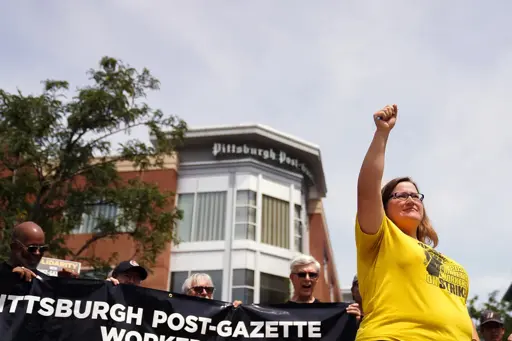
When workers at the historic Pittsburgh Post-Gazette newspaper hit the picket line in October of 2022, they had no idea that they would be on strike for over three years—or that the strike would end with new owners taking over the paper and most strikers losing their jobs. But now, a new chapter is being written in their epic story. This week, workers and community supporters launched the Pittsburgh Progress, “a cooperative news organization, owned and democratically run by its workers and members… dedicated to looking out for, and telling the stories of, the working-class people who form the heart and soul of our diverse communities.” In this episode of Working People, we discuss the birth of the Pittsburgh Progress, and what it means for working people in and beyond Pittsburgh, with Steve Mellon and Natalie Duleba, both former strikers at the Pittsburgh Post-Gazette and both founding worker-members of the newly launched Pittsburgh Progress.
Additional links/info:
- Pittsburgh Progress website, Facebook page, Bluesky page, and Instagram
- Steve Mellon, Pittsburgh Progress, “This new media cooperative invites the community to join us on our journey of creation”
- Maximillian Alvarez, Working People / TRNN, “The longest-running strike in the US is over—and the workers won”
- Maximillian Alvarez, Working People / TRNN, “They won their strike fair and square. Now their rich bosses are closing up shop”
- Maximillian Alvarez, Working People / TRNN, “Venetoulis Institute ‘saves’ the Pittsburgh Post-Gazette by purging union members who went on strike”
Featured Music:
- Jules Taylor, Working People Theme Song
Credits:
- Audio Post-Production: Jules Taylor
Transcript
The following is a rushed transcript and may contain errors. It will be updated.
Maximillian Alvarez:
Alright. Welcome everyone to Working People, a podcast about the lives, jobs, dreams, and struggles of the working class today. Working People is a proud member of the Labor Radio Podcast Network and is brought to you in partnership with In These Times Magazine and the Real News Network. This show is produced by Jules Taylor and made possible by the support of listeners like you. My name is Maximillian Alvarez, and today, amidst so much bleak and awful and overwhelming news bombarding us at all times from all over the world, we’re going to do something different and we’re going to talk about some good news for once. Because this week, a new worker-owned cooperative launched in Pittsburgh, Pennsylvania, and it’s called the Pittsburgh Progress. Here’s their story, which you can find on their website. “The Pittsburgh Progress is a cooperative news organization owned and democratically run by its workers and members.
It was formed in the weeks and months after owners of the Pittsburgh Post-Gazette announced on January 7th, 2026, their intention to close the newspaper. This move by the post-Gazette came just weeks after unionized workers there had won a strike lasting more than three years. Those workers and their community supporters initially formed the organization Pittsburgh Alliance for People Empowered Reporting or Paper, with a mandate to research the creation of a daily news outlet more deserving of Pittsburgh. Paper quickly resolved that any new publication would, unlike the block-owned Post-Gazette, respect its employees and address the concerns of all working class people in the region. The publication would serve as an essential and sustainable source of communication and connection in the Pittsburgh region. Workers and their supporters decided on a publication name, the Pittsburgh Progress, in a nod to the striking Post-Gazette Workers Award-winning strike publication, The Pittsburgh Union Progress.
Work continues on the Pittsburgh Progress website, marketing strategy, and the building of a newsroom. We continue to raise funds to lift up worker-centered journalism in Western Pennsylvania, and those funds will be used to hire full-time staff and freelance journalists dedicated to looking out for and telling the stories of the working class people who form the heart and soul of our diverse communities.” So to talk about the birth of the Pittsburgh progress and what it means for working people in and beyond Pittsburgh, I am really grateful to be joined once again on the show by some familiar voices. Steve Mellon is a journalist who was on strike at the Pittsburgh Post-Gazette for more than three years and is now a founding worker member of the Pittsburgh Progress. And Natalie Duleba is a former post-Gazette striker. She serves as local secretary of the newspaper Guild of Pittsburgh, and is now also a founding worker member of the Pittsburgh Progress.
Natalie, Steve, it is so great to see you both and thank you so much for coming back on the show for over three years while you guys were on strike at the Pittsburgh Post-Gazette. We’ve gotten to know you and your coworkers over the many conversations that we’ve had on this show, on the Real News Network, when I was at Breaking Points. It’s been a long road. Did you ever think that it would lead you here?
Steve Mellon:
No, I certainly did not. Our hope, I think Natalie probably feels the same way. I won’t speak for you, man and Natalie, but we were hoping to win the strike and get a contract. That was our goal. And we thought we had accomplished that. We had an incredible community support during the strike. That was a long, hard battle. And Max, you know that. You guys cover the strike more than any other publication, more than any other organization, you know that. But we did win the strike. We won. We went back to work. Things were going pretty well. We had a big rally in front of the Post Gazette. All the community showed up to support us. We went back in. Things were going pretty well. I think we were as acrimonious as the strike was, we were working together. We were resolving conflicts. We were actually producing good journalism.
That all changed on January 7th when the company announced it was just. Max, this came just about an hour and a half after the Supreme Court had denied the Post-Gazette’s request for a stay on a healthcare issue that was related to the strike. It was think of the last gasp effort of the owners of the Post-Gazette to delay the consequences for their lawbreaking actions. Don’t forget that this strike was a result of a law-breaking action by the owners of the Post-Gazette. So they announced the closure of the paper within, I think, what, Natalie, two hours or so after that announcement came down that the Supreme Court had denied their request for a stay. They announced the closure of the Post-Gazette. And it’s like at that point, I think that among a lot of us, Max, there was a lot of anger and frustration is that we did all this stuff to win, and yet the system still fails you.
The system’s not going to let workers win. And at that point, I think a lot of us, we were angry, we were frustrated. That very quickly settled into, we have to do something about this. We cannot let this stand. And we had an extraordinary meeting that night. I think January 7th was a Wednesday, Natalie, I believe. And that night we had an extraordinary meeting of our membership and we just decided like, no, we’re not. You learn things about yourself and your community when you strike for three years, about your colleagues. I looked at Natalie and Erin and all the people we’ve been to strike on. I thought we can do whatever we want. We have a community support, we have the skills, we had the talent, we had the determination. And after a series of meetings, we though, let’s form our own publication, one that we can inoculate against corporate abuse, against the influences of money.
And the result was a worker, community-owned cooperative, a multi-stakeholder. So no, I had no idea I’d be in its position to be like a co-owner with so many other people in the community and my coworkers of a publication. So no, I did not expect to be here, but it feels good.
Natalie Duleba:
Yeah. During the strike, our goal was always to get back to work, but also to build a Post-Gazette that ourselves, but also journalists that came after us could build a life with. And the Post-Gazette still remains. The Venetulas Institute for Journalism did buy the Post-Gazette from the blocks. And Steve and I were among the journalists who were not retained, who were not hired by Venetulas. But we do still have former strikers who are at the Post-Gazette doing the good work to get a new contract with new owners. And we’re hoping that the victories that we got during the strike are carried forward in that bargaining. There’s a bargaining session that is happening today.
And I think that the Venetulas at least knows that the journalists of the newspaper Guild of Pittsburgh aren’t afraid of a fight. But I think that the strike really taught us that if you want something, you got to get it yourself. And when we were looking at the possibility there was no Post-Gazette, a huge vacuum in Pittsburgh, they’re like, “Well, something should replace it.” And some of the other publications in the city were circling vultures, and some of them have expanded into areas that they weren’t in before. But even with the Post Gazette continuing, the new owners did cut the newsroom by about 40%, 80% of which were strikers. We all have an intimate understanding of the gaps in the coverage and communities that told us during the strike and after the announcement of the closure that they felt underrepresented, misrepresented. Those of us before we were not rehired, we were willing to bring that knowledge and that trust in the community to Venetulus to maybe start to repair the damage and reputation the post-Gazette suffered underneath the blocks.
But they weren’t interested in that, at least from us. So yeah, it is wild to think that we’re building our own news outlet. That’s not something that any of us though was going to happen. We wanted to get back to the post-Gazette, but now we’re in control of our own destiny in a way that we weren’t during the strike. Yes, we were out there fighting for ourselves, but also we’re at the mercy of the slow cogs of the justice system. And this is like we’re setting the pace, we’re doing the work ourselves, and it’s fully under our control, which is really amazing, but it is also a lot. It’s like, it’s our responsibility. Yay. It’s our responsibility.
Maximillian Alvarez:
I know it intimately. Yeah, it’s such a head spinner where you’re like, oh shit. Now we got to do that. Oh shit, we get to do that. It forces you to confront the sort of decision-making that affects our lives on a day-to-day level. And it is both liberating and terrifying to have more of that decision-making power yourself instead of just trusting it to be done for you by our higher ups. But so many of us, for that reason, I don’t think have even considered what it would look like in our day-to-day work lives to have that agency, to have that democratic cooperative sort of model rather than the kind of top-down authoritarian model that we’re all so comfortable and used to, which we’ve been conditioned to be used to by force for many, many generations. But I digress. I wanted to hover on that for a second and ask about your time at the Pittsburgh Post-Gazette.
What did working and striking at a paper like the Pittsburgh Post-Gazette teach you about what a project like the Pittsburgh Progress needs to be and why it needs to be?
Steve Mellon:
Well, we learned several things during the strike. Quite honestly, when I was a journalist, I tried to be out on the street a lot and talking to people. But it wasn’t until I went on strike that I was put into conversations with people in various communities that were underrepresented. And I learned a lot during the strike, especially after the strike was over. After we’d won the strike and the Post-Gazette announced its closure. And at that point, Max, we had conversations with people in the community. One of the first questions we asked, I remember, was what does it mean to lose the Post-Gazette? What does it mean to you and your community to lose the Post-Gazette newspaper? Because at that point, we didn’t know that the Venezuelas Institute was going to step in and buy it. And one of the responses really stuck with me is a young woman stood up and she said, “The closure of the Post Gazette doesn’t mean anything to me because they’ve not been relevant to my community for years.” Now, as a journalist who spent his life, a good chunk of my professional life reporting on this city, that was heartbreaking to hear that these institutions that I’d given my life to were irrelevant to the communities that had supported us during the strike and had leaned into our effort, Max.
That’s like, well, what’s wrong with this? What’s wrong with this? This is an issue. And it gets not just to journalism. It’s like we’re seeing the crumbling of communities all over this country.
There are a lot of forces that profit from creating division. And newspapers, news organizations have failed in their duty to be the cohesive force. And it’s like, okay, that’s an issue. How do we solve that? We kicked around several different ideas. And one, I don’t know anything about co-ops, Max, but in our discussions, when we brought up the fact that. Because we talk about nonprofit models, these different models. When somebody said, “What about a co-op?” People got really excited about that. And when we started talking about a co-op, that’s when we started to see a lot more people to show up. I was at a journalism conference in Hershey, Pennsylvania about two months ago, and there was a lot of talk at that conference about engaging with your audience. How do you engage with your audience? Honestly, if we haven’t figured out that at this point, then we failed anyway.
But we thought, okay, well, we’re not going to engage in our audience. We’re going to ask them to become stakeholders in this process. And I think that is a game changer. I think this model going forward is one that can be replicated. There are co-ops, successful news co-ops that exist in other places, a whole list of them. So we’re not new to this. But I do think that what we can do here in Pittsburgh is build on those models and take the lessons we learned from the strikes, take ideas from the communities, the people that we met during the strike, the people that we reported on for a pup, and use those to build a publication where we are not going to have people stand up at a town hall and say, “The Pittsburgh progress is irrelevant to my community.” We’re trying to make sure that that does not happen to us.
And our way of making sure that happens is having that young woman in the room when we’re making decisions.
Natalie Duleba:
The things that I learned at the Post Gazette, besides the things like the skills that I built there that I’m bringing in, I was a copy editor and a pay designer before the strike. I came back to be full-time on the web desk. I’m bringing those skills into this. I’m glad that I can bring that extra oomph to what I can offer. But also I think that being on strike, we saw what it was like to be on the other side of business interests overriding journalistic ethics or the coverage of the strike was just insulting, honestly, because we knew where these things were being obfuscated, but it went deeper of the Post Gazette trying to hide the fact that people weren’t talking to them because they were holding our picket line and getting around not saying the mayor is not responding to comment on this issue because he’s not responding to any comment, but not putting in, he’s not talking to us at all because he’s respecting a picket line, shades the way that people may have perceived that article.
They may think the mayor is running away from accountability on this issue or leaving off said in a press release so it looks like somebody who was holding a picket line maybe gave them a quote. And an average reader might know about the strike, but not know that that came from a press release. And then they’re like, maybe they could see the way that these perceptions change potentially. Or even a local news station that has a business relationship with the post Gazette had coverage during the summer when SAG and WGA were on strike and they had a segment where they talked about all the active strikes in the country and they didn’t mention us. The strike that at that point I think had gone on for over a year at that point. We were deep into our strike. It wasn’t like it was brand new.
And to just see, okay, so the business relationship you have with the post Gazette, I mean allegedly, it’s not like I got this confirmed by anybody, but why else would they leave it out if not because of that business relationship? There’s no other reason why I could think to not put the strike that’s happening in your own city into report about strikes that are happening across the country. And there’s no way that there’s not other communities, other issues that have been covered in that way that have felt like the nuance has been left out or that there has been gaps that have not been filled with reporting. And us being so intimately on the other side of it, I think really places us in such a great position to poke at that. What is not being said in these press releases?
What is the CEO or the founder of this big company obfuscating with legal language? Where when you poke at it, you can like, oh, well, technically what they said is correct, but there’s all this stuff that they’re leaving out that we learned by talking to the working class, the people of Pittsburgh, the regular everyday citizens that are affected by these decisions, who have first person experience being the little guy who was affected by that. And it sucks to be on that side of it, but it has allowed us to build that extra lens of looking at things that way. I mean, journalists are trained to ask questions and poke at things, but I think seeing behind the veil intimately and personally is going to allow us to easily see where that is happening. And also, I mean, we had a little exercise when you’re in one of our founders’ meetings about what don’t we want our newsroom to look like?
What behaviors do we want to avoid when we’re building our newsroom and our editorial practices? And a lot of it came down to not understanding why things are being done.
Why is this decision being made? Why is this policy in place? And why aren’t these things being communicated to the people who actually have to follow these rules? And I think that the transparency that comes in being a worker-created newsroom and a worker-led newsroom will allow. When someone’s laid off, that sucks, but a lot of times an owner just says, “We got to lay you off because we are losing money, I guess.” And you just have to take the word for it. But hopefully we don’t have to ever confront that type of thing. But if we do, that’ll be a decision that is made collectively where you understand what’s gone into it, why. And it’s not a callous just cutting of the cord there so that the owner, I guess, doesn’t get to buy a second summer home. It’s like you’ve been involved in the whole process and there’s trust that is just baked into a democratically run newsroom or any business, I suppose, but we’re talking about a newsroom here.
But we want to try to build a newsroom that people are on the same page, that is collaborative, and that people understand the mechanics that are going on and that the work and the journalism that is being done is ethical and not bowing to business interests. And I think that we’re well on our way to doing that.
Maximillian Alvarez:
Oh yeah. Well, let’s bring this down to paper level and talk about what this looks like in the now officially launched publication. I know as we said in the intro, and as y’all say on your website, this is a work in progress. Y’all are growing, but you have officially launched. So tell folks more about what the Pittsburgh progress is, where it’s going, and what they’re going to find there, and what they can do to support y’all.
Steve Mellon:
Well, right now, we did launch on Monday. We’re considering that our soft launch. We’re working up to becoming a regular daily publication. We just started this process. It’s kind of crazy, Max, to think that this wasn’t even a topic of discussion until January 7th. And it took a couple of weeks before we had consensus about to even move forward with the idea of a new publication. And so a lot has happened very quickly. We’ve had to come up with a business. We’re journalists, Max, we’re not business people, but we’ve had to become business people. And it’s like, okay, the learning curve for this is very, very steep. We’ve had to come up with a business plan. We’ve had to come up with bylaws. It’s over and over and over again. It’s your social media strategy. We’ve had to hire people to do some of the things that we just don’t know how to do, and we don’t want to mess them up.
We have to become incorporated. How do you do that in a timely manner? And all these things. So a lot has happened very quickly. It wasn’t until quite honestly a couple of weeks ago that we were able to sit down and think about, “Oh, wait a minute. If we’re going to publish, we got to have some stories in this damn thing.” So we put together a slate of stories that we felt matched what we want to be and what we want to do that align with our mission to give people a glimpse of what we hope to be in the very near future. If you look at pittsburghprogress.com right now, you’ll see, I think, five or six stories. Our lead story right now is about organized nurses here who are fighting for our contract. That’s a big, big story in this town where these big medical companies have such a big footprint.
Nurses on the front lines of that. So that’s one of our lead stories. Natalie has a story on third places for the members of the LGBTQ community. We have a review of a new book on WPA workers. Kim Kelly wrote the foreword for that. You guys all know and love Kim Kelly. So we have our origin story is another part of that. We have a couple sports stories. We are really going to lean into high school sports because we’re interested in not covering the millionaire. God love them, our millionaire sports heroes. We are interested in covering the sports played by the sons and daughters of the working people of this region. So that’s what you’ll find when you go there now. We’re going to continue to build on that. We’re still working. We’re a small team right now. We’re building and adding, but we’re a small team and we’re having to walk and chew gum and tie our shoes and bake dinner and comb our hair all at the same time.
So it’s going to take a minute to get this thing up to where we want it to be. And we’ve learned, Max, that this group of people, when we get together, we set our mind to something, we can accomplish that thing. And this is a goal we have set for ourselves. And I know we’ll do it. I know we have a community of support. People who want to support this, learn more about it, go to pittsburghprogress.com. You’ll find a button that says join us. It’s like a maroon button, a red maroon button. Click join us. You can learn about progress. You can learn how to support this effort. If you have questions, you can reach out to me or Natalie, I’m sure you’re willing to answer questions too. We’re hoping that there are. I’ve been in journalism a long time, Max. Most people that I was in journalism with, most of the people that I knew in journalism all over the country, none of them are in the business now.
They’ve had to get out. Their newspapers have closed. They did not make enough money to support their families. For one reason or another, they’re out of the business. That’s got to stop. What’s the model for that? Well, we think this is a model that can be replicated in other cities. One of the things, we have a couple of goals here. At least that’s the way I see this. One goal is to do just what Natalie said, provide news coverage that is ethical and that focuses on the needs and concerns of the working class people in our region. But another goal is to say, “This can be done and this is possible. There are other cooperative news organizations that have done this. This is our model. We want to build on those models and say, okay, we’re going to take the baton and run with it.
We are going to run like hell with that baton, and we want somebody else to pick that up too. So we’re all running here and building news organizations that are engaged in covering the news, informing, being a source of communication, but are also building community. And I think that’s one of the things I learned about working in newspapers as a young man. This is back in the ’80s. I worked at weekly newspapers. These weekly small daily newspapers in small towns were part of the fabric of that community and held the community together by being a voice where people could look at that publication and recognize themselves and recognize their community. That’s gone. What we see in a lot of newspapers that post, because that is an example of this, we have an institution talking to other institutions. And what happens when that worker voices, regular people voices are lost?
One of our goals is to do that here in Pittsburgh is create a publication that does not do that, where people can look at that publication and recognize themselves and recognize the community that they care about and that they’re willing to invest in. So that’s where I see where we’re at right now and where we want to go.
Natalie Duleba:
Yeah. The pittsburghprogress.com is our website, but we’re also on Instagram, BluSky and Facebook. You can find us on all three of those by searching for the Pittsburgh Progress and all the same, the link to how to join us is available in all those places. And giving us a follow there is really helpful. And also you can stay up to date on the next steps in our rollout. But I think that having edited all of the stories that went up for the soft launch, that I would encourage people who want to support us to really. Obviously, I’d like you to read all of them, but if you do, you’ll see the way that they actually plug into each other, that they build on each other, the same concepts of building community. We have a high school football coach who has led an incredible team, but he’s also committed to staying at this high school to build up these young men into not only good football players, but also good young men and having that commitment there.
And there’s a football club, a soccer football that’s for a community football club. And the runner of that is similarly aligned and also has similar goals of making the players better people as well as improving their skills. The review that Erin put together of American-made stories of work, it’s a look at the working class voices of many generations ago and how they echo into today’s concerns, even if the technology has changed, but it’s still working class people trying to carve out a space for themselves and finding connections through the lens of history. Also, it’s just like you feel smarter after reading it. And my own story, these are business owners who you think that the kicker is more than money. Obviously they’re running a business, but they want to build community with their customers and fill gaps that they see in their own communities. These are all sober spaces, trying to have that safe third space for people to come to and build community and find like-minded people they can be themselves around.
And then the McGee story of nurses trying to fight for the best for their patients because they’re passionate about what they do and they’re going against big UPMC interests. And I think that seeing the way that came together and how when you let journalists pick where they can find these stories and how they do blend together, if we can continue that, I’ll be so happy and so pleased. And as Steve said, I think that as people feel more alienated from each other and from the bigger interests that control the country, that they will turn to one another and be like, “Let’s do it with each other, with our neighbors who are the people that we know and trust, and we can count on to follow through on what they’re saying they’re going to do.” I mean, our strike was sustained by donations from regular people and the other worker-led newsrooms that we’ve spoke to, they’ve been so open with us about how they did it, how we can follow their example and learn from their mistakes.
There’s been no gatekeeping amongst the worker-led newsrooms that we’ve spoken to. And it’s the same story of journalists who were let go by a new owner or had their publication shut down, and they just turned to one another and said, “What if we did it?” We have the skills, we can learn the new skills that we need to get it off the ground and get it going. And I think that the contraction and consolidation of, as Steve said, of these local newspapers that serve communities as that continues to happen and be gutted by private equity, I think that’ll be the workers who build those things back up, that we’ll see more worker-led newsrooms under various models pop up and fill the gap that business interests left in the pursuit of more profit, more money. And I’m excited to be part of the fabric of that, that there’s other rust belt cities or cities maybe who don’t have the same kind of working class history as Pittsburgh to be like, “We know how to cover our city.
We know these communities. We don’t need permission from a rich person to do this work. Let’s do it ourselves. Let’s get off the ground and they can rely on our lessons and the resources that collectively these worker-led newsrooms are putting together to offer.” And I would really love to see that. And I’m hopeful that we can find our place there, get our legs under us, and that we continue to see the support that we saw during the strike and during the past six months, which it is wild to think it’s only been six months since January 7th. I mean, a little bit more than six months, but what’s that? Is it that Margaret Mead quote of, “Never undermestimate the work that a small dedicated group of people can do.” I’m butchering that, but that’s the sentiment is that people who are passionate and committed to a thing can achieve it because that’s how everything has ever gotten done is people roam up their sleeves and putting in the sweat equity.
This way, all of our work is going to directly benefit us, not rich owners who don’t actually need the money and have never had to worry about being able to pay for the food on their table or keeping the lights on. And Steve said that in his origin story on our website, and it was echoed in the conversation that Aaron had with the editor of American Made. If you resonate with any of that, you’re going to resonate with what we’re doing. So if you want to be part of our story of our effort, check us out on pittsburghprogress.com, on Instagram, BluSky, Facebook. You can hear everything that we’re doing in the next couple months as we head toward our hard launch. We really love it.
Maximillian Alvarez:
All right, gang, that’s going to wrap things up for us today. I want to thank our guests, Natalie Duleba and Steve Mellon, both former strikers of the Pittsburgh Post Gazette, and both now founding worker members of the newly launched Pittsburgh Progress, a cooperative news organization owned and democratically run by its workers and members. Go check them out using the links that we provided in the show notes. And of course, I want to thank you all for listening, and I want to thank you for caring. We’ll see y’all back here next time for another episode of Working People. And in the meantime, go explore all the great work that we’re doing at the Real News Network, where we do grassroots reporting that lifts up the voices and stories from the front lines of struggle. Check us out across our YouTube channel, our podcast feeds, our website, and our different social media pages, and help us do more work like this by going to therealnews.com/donate and becoming a supporter today.
I promise you guys, it really makes a difference. I’m Maximilian Alvarez. Take care of yourselves. Take care of each other. Solidarity forever.
From The Real News Network via This RSS Feed.
Worker owned is the way forward.