

By IPAN, July 30, 2026
It is with great sadness that we share the news that Bevan Ramsden passed away on 27 July 2026.
Bevan was an integral member of IPAN, a mainstay of the organisation from when he joined in 2015, and the editor of our monthly publication, Voice. He was a husband, father, grandfather, mentor and friend to so many. Others knew him through the movement for Australian independence, through his writing, his radio broadcasts, his workshops, or by having the fine print of the Force Posture Agreement patiently explained by a man who had read every clause.
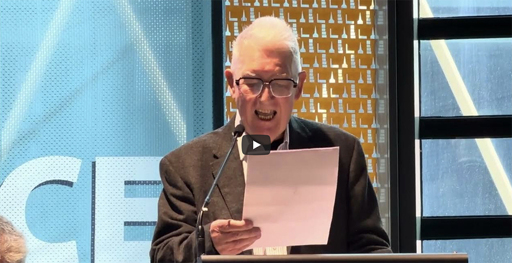
For more than sixty years, Bevan dedicated himself to the pursuit of an independent, peaceful and sustainable Australia, free from US domination and its war machine. Right to the end of his life, he remained as active and committed as ever. Just days before his passing, he spoke at IPAN’s National Conference, Time to Break Free from the US, in Adelaide. With his great humour, he negotiated for more time on the stage, he shared poetry, and he honoured those whose work he built his own upon. For those who could not be there, and for those who would like to hear him again, the recording of his talk, ‘US Economic Domination’, is available here.
Bevan was optimistic in his last week. Friends say he believed this conference represented the culmination of decades of work and struggle for Australia’s independence and peace. It brought together ideas, campaigns and people he had spent a lifetime helping to build.
Bevan’s life was immense.
Born in Thornbury, Melbourne, in 1939. At 26, in 1965, he travelled to Zambia as an Australian Volunteer Abroad. The two years he spent there, witnessing first-hand the enduring legacies of colonialism, racism and struggles for national independence, profoundly shaped his political outlook and set the direction of the rest of his life. Returning to an Australia at war, Bevan threw himself into the growing movement against the Vietnam War and conscription. As a Sunday school teacher and active member of the Doncaster Methodist Church, he and his friend Max Anderson sought to encourage discussion of Australia’s role in Vietnam within their church community. When those efforts were repeatedly resisted by church leaders, Bevan eventually left organised religion. Yet throughout his life he continued to work alongside people of every faith and background in pursuit of peace, justice and human dignity.
Bevan became one of the leading organisers of the Diamond Valley Moratorium Group. Such was his contribution that, when Dr Jim Cairns was asked in Federal Parliament whether communists were directing the Vietnam Moratorium Campaign, he replied that the motion to hold the Moratorium march had been moved by “Bevan Ramsden, a Sunday school teacher”, a reminder of the broad coalition of ordinary Australians who stood together against the Vietnam war. It was during this period that Bevan met his lifelong friend Andrew Fullerton, with whom he would continue organising, broadcasting and campaigning for more than five decades.
Throughout the 1960s and 1970s, Bevan was arrested several times for opposing conscription and Australia’s involvement in the Vietnam War, on one occasion spending several days in Melbourne’s Pentridge Prison. During the 1970s he also became active in the Australian Independence Movement, campaigning against US military installations such as Pine Gap and North West Cape, while advocating for an Australia free from foreign military, economic and cultural domination.
Drawing on his background as a telecommunications engineer, Bevan recognised that newly available broadcast frequencies could give community organisations direct access to the airwaves. He and others set to work organising the Community Radio Federation and in 1975 the communications minister, Dr Moss Cass, in one of last acts as minister before the Whitlam ALP government was overthrown, approved the licence application. Having secured one of Australia’s first community broadcasting licences, Bevan was then instrumental in the founding of Melbourne community radio station, 3CR. In 1976 using a second-hand transmitter purchased from the local fire brigade for $200 and salvaged studio equipment from ABC Adelaide. A studio was set up in a back room at High Street Armadale, and 3CR went to air in September 1976. Fifty years later, he was still behind the microphone, presenting a regular program with his friend Andrew Fullerton.
His commitment to grassroots organising extended well beyond the peace movement. He worked as a telecommunications engineer, taught electrical engineering at TAFE, and was a proud member of the NSW Teachers Federation. He played a leading role in the United Melbourne Freeway Action Group, helping mobilise community opposition to plans that would have transformed Melbourne with an extensive urban freeway network. Bevan also worked tirelessly opposing AUKUS and nuclear submarines. He was one of the initiators and a founding member of the Australian Anti-AUKUS Coalition established in March 2022.
Whatever the issue, Bevan believed that lasting change came when ordinary people organised together. That conviction never left him. He remained an active organiser throughout his life, generously sharing his knowledge at IPAN conferences in Brisbane (2015), Alice Springs (2016), Melbourne (2017), Darwin (2019), Canberra (2022), Perth (2024) and Adelaide (2026). He was a passionate advocate for building a broad and united front for peace and independence. In everything he did, Bevan sought to make the world more peaceful, more democratic and more humane.
Perhaps Bevan’s most enduring recent contribution was the work he did to bring the Force Posture Agreement into public view, including among experienced peace activists who had not grasped its significance. Bevan had a rare gift for cutting through the deliberately opaque language used to keep the electorate in the dark, and he paired it with meticulous attention to detail.
In his January 2023 piece for Pearls and Irritations, “US-Australia ‘Force Posture Agreement’ undermines sovereignty, must be terminated,” he laid out the evidence and argued that neither ANZUS nor AUKUS had opened the gate to a foreign military build-up on Australian soil and the integration of the ADF into its war preparations. “Only the FPA does that”, he wrote.
His commitment to public education never wavered. He wrote and engaged endlessly in grassroots campaigns and movements for justice, peace and independence. Month after month as editor of IPAN’s Voice, thirty-three articles for Pearls and Irritations, twenty-seven for Independent Australia, page upon page for Green Left, on the People’s Inquiry, on AUKUS, on the militarisation of Western Australia, on the nuclear ban treaty, on Gaza, and on Australia’s capacity to stand on its own feet.
Yet Bevan was never only a critic.
He worked as hard on the alternative as on the objection, and he took that work to every room he entered. He made significant contributions to IPAN’s Alternative Self-Defence Policy. In 2024 he travelled to Bogotá as IPAN’s (and Australia’s) representative at an international congress on neutrality convened by World Beyond War and the International Peace Bureau, where fifty speakers from twenty-five countries met inside the Colombian Parliament. Characteristically, he came home with his thinking sharpened, rather than simply confirmed. Having heard the objection that neutrality can shade into isolationism and lead to abstaining from condemning injustice and oppression he argued that IPAN had to spell out exactly what it meant: a neutrality that is not isolationist but actively engaged, opposing oppression and injustice, hosting meetings between belligerents, mediating disputes, building peace in our region and beyond.
Underlying all of this was an unwavering belief in democratic decision-making and the transparency it demands. He believed in people making decisions together and in the power of a broad united movement to change the world for the better.
Two days before he passed away, he convened a workshop on organising and facilitating kitchen-table discussion groups. Passing on his knowledge, especially to grassroots organisers, was one of his greatest passions. Those fortunate enough to be in the room spent those hours with one of the giants of Australia’s peace movement. Even in his final days, Bevan was doing what he had always done: bringing people together, sharing ideas, and helping others discover their own capacity to act.
Bevan’s own words remain the best guide to how he lived, and what he would ask of us now:
“Things are not going to change unless we do something about it. Don’t sit on the sidelines. Become involved.”
The IPAN campaign to end the Force Posture Agreement was Bevan’s. You can learn more at ipan.org.au/end-the-force-posture-agreement, and, if you have not already done so, add your name to IPAN’s Public Call to the Australian Government, at ipan.org.au/public-call-to-the-australian-government.
Messages of condolence for Bevan’s family can be sent to ipan.assistant@gmail.com. His memorial service will be on Friday 7th August at 3 pm, in Sydney. If you would like to be told of further details confirmed, please also respond to this email, so we can share this with you.
Nick Deane was a great friend to Bevan, and for a long while the two of them were IPAN’s NSW representatives. Nick tells us that he and Bevan had an expression they used whenever they parted: Mutende mukwai. It is a greeting in Bemba, a language of Zambia. It means something close to “peace be with you”, with mukwai adding a layer of mutual respect. They would clasp right hands while holding the other’s wrist with the left, so that both sides of you were joined in the saying of it. English gives us no word for that. Mutende mukwai, Bevan.
Yours was truly a life well lived.
IPAN national committee members, his friends and comrades
The post Bevan Ramsden – A Tribute appeared first on World BEYOND War.
From World BEYOND War via This RSS Feed.