


Amelia Schafer
ICT
Since 2022, the number of Indigenous candidates running in Minnesota has continued to steadily increase, mirroring a larger trend nationwide of record-numbers of Indigenous people running for public office across the United States, according to data collected by ICT and Advance Native Political Leadership.
Four years ago, eight Indigenous Minnesotans ran for public office in the state, in 2024 11 Indigenous people ran for office and now (ahead of the 2026 midterm primary elections) 13 different Indigenous candidates have launched campaigns statewide representing eight different tribes.
“This is a new high-water mark for Minnesota in particular,” said Holly Cook Macarro, a Democratic political pundit and a citizen of the Red Lake Nation. “Which I think is a great demonstration of both Native engagement in our political system and how we are stepping up.”
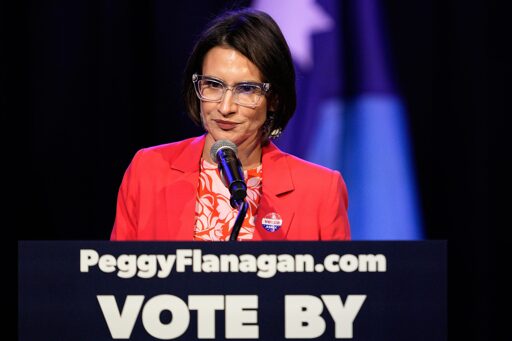
Among these 13 candidates is Peggy Flanagan, who could make history as the first Native American woman elected to the United States Senate (along with Mary Peltola in Alaska if successful). Flanagan, who is from White Earth Nation, currently serves as Minnesota’s lieutenant governor.
If she wins in November, she would be the fifth Native American to serve in the U.S. Senate, according to the U.S. Senate archives. Others before her included: Robert L. Owen, Democrat, of Oklahoma who was Cherokee; Charles Curtis, a Republican who served Kansas and from Kaw Nation; Ben Nighthorse Campbell, Northern Cheyenne, who served for Colorado from 1993 to 2005; and Markwayne Mullin, Cherokee, a Republican who served Oklahoma.
Flanagan will face off against Angie Craig, who currently serves as the U.S. House of Representative for Minnesota’s 2nd Congressional District, in the state’s Democratic primary on Aug. 11. The race is already the most expensive primary in state history, fueled in part by spending from prediction market companies, the online outfits that allow users to place “bets” on real-world events. Tribal officials say the industry threatens Indian gaming and Flanagan is outspoken against it.
“I think it’s a really exciting time for Indian Country when it comes to politics,” Flanagan told ICT in June. “Our time has come. Native people have long registered to vote, turned out to vote in high numbers, run for office, and now we get to, mobilize our communities for these victories and make sure that Indian Country is well represented, where decisions are being made about us all of the time. We deserve to have a seat at the table.”
Across Indian Country, people will be watching to see if Flanagan can make history, Cook Macarro said. Along with Mary Peltola who is Yup’ik from the Orutsararmiut Traditional Native Council andis also running for the U.S. Senate seat in Alaska as a Democrat.
“So it is a very hot race,” Cook Macarro said. “This is something all of Indian Country is watching, not just because she is a Native American candidate, because of the substance, because of the issues. Whoever wins the seat is likely to hold it for the next quarter of a century.”
While the general election isn’t until November, whoever wins the primary is likely to be the next senator from Minnesota, Cook Macarro said, as the state hasn’t elected a Republican candidate statewide since 2002.
Other Native candidates in Minnesota:
- Audrey Thayer, Bemidji City Council, At-Large — White Earth Nation
- Geri Lopez, Mahnomen County Commission, District 39 — White Earth Nation
- Sheila Lamb, Mayor of Cloquet — Fond Du Lac Ojibwe & Cherokee
- Jeannice Reding, Minnesota Fourth Judicial District Court, Position 57 — Stockbridge-Munsee
- Alicia “Liish” Kozlowski, Minnesota House of Representatives, District 8B — Grand Portage & Fond Du Lac Bands of Ojibwe & Mexicana
- Shelley Buck, Minnesota House of Representatives, District 47A — Prairie Island Indian Community
- Mary Kunesh, Minnesota State Senate, District 39 — Standing Rock Sioux Tribe
- Steve Green, Minnesota State Senate, District 2 — White Earth Nation
- Chris Jourdain, Red Lake Schools School Board, At-Large — Red Lake Nation
- Deanna Lasley, Red Lake Schools School Board, At-Large — Red Lake Nation
- Nicole Desjarlait, Red Lake Schools School Board, At-Large — Red Lake Nation
- Heather Keeler, U.S. House of Representatives, District 7 — Yankton Sioux Tribe
- Peggy Flanagan, U.S. Senate — White Earth Nation
“I’m super excited about the fact that there are 13 people running for office in the state of Minnesota,” Cook Macarro said. “[And] that we have such an incredibly strong candidate running for the United States Senate.”
Outside of the 13 Native Candidates, there are several other elections in Minnesota that Native voters could make an impact on, one of which being the state’s gubernatorial election.
Sitting Senator Amy Klobuchar, Democrat, has announced her candidacy for governor and will likely be up against My Pillow CEO and salesman Mike Lindell, Republican, who recently received an endorsement from President Donald Trump.
The current administration of Gov. Tim Walz and Lt. Gov. Flanagan set a high bar for the next administration in terms of relationship-building with tribal governments, Cook Macarro said.
“The 11 tribes in the state of Minnesota, I know have higher expectations than they’ve ever had before in terms of what a relationship with the highest executive office in the state of Minnesota should look like,” Cook Macarro said.
Between the two candidates, Lindell and Klobuchar, Klobuchar has the better record when it comes to supporting tribal nations, Cook Macarro said.
Klobuchar brings experience serving on the Senate Agriculture Committee, which oversees the Food Distribution on Indian Reservations Program also known as commodities. Klobuchar also worked with tribes on the Farm Bill, Cook Macarro said.
“She has been a friend of Indian Country and I think that support will carry over into her race for the governor,” Cook Macarro said.
Lindell has not previously held a position in public office and as such has no visible record when it comes to tribal-relationships.
“In terms of the races and the political atmosphere in Minnesota, there is an extremely high level of engagement and number of races for tribes in Indian country to be watching,” Cook Macarro said.
The post Record number of Natives on Minnesota ballot appeared first on ICT.
From ICT via This RSS Feed.