

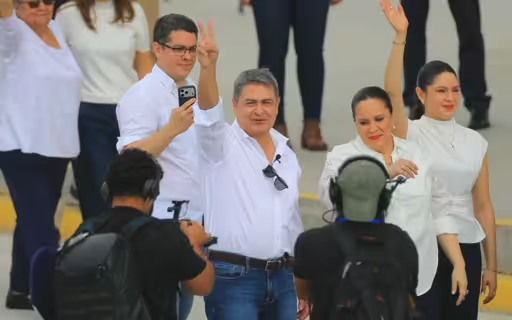
The return to Honduras of former President Juan Orlando Hernández, convicted in the United States for drug trafficking and later pardoned by US President Donald Trump, has reignited the debate on impunity, corruption, and the links between political power and organized crime in Honduras.
According to various analysts, Hernández’s return does not mark the end of an episode, but rather reopens an institutional crisis characterized by the capture of the state by drug trafficking and the strengthening of structures linked to the crime.
Parliamentarian Fabricio Sandoval pointed out that Hernández was sentenced by a New York court to 45 years in prison for drug-related crimes, but he later received a pardon from US President Donald Trump.
The legislator also questioned the US president, stressing that he has a history of human rights violations and breaches of the United Nations Charter, referring to aggressions against Iran, Yemen, Venezuela, and extrajudicial killings in the Caribbean Sea.
In the opinion of analysts, Hernández’s return represents a decisive test for the Honduran judicial system, which has been criticized for years for favoring the power structure created during Hernández’s administration.
They warned that if the justice system does not act independently in the cases still ongoing against the former president for alleged fraud and money laundering, the perception that impunity continues to protect those who used state institutions to remain in power will be strengthened.
The legal expert Alexa Solórzano stated that the pardon and return of Hernández convey a message that normalizes drug trafficking and corruption, in addition to reinforcing the idea that justice acts selectively, benefiting those who possess political power or sufficient economic resources to avoid sanctions.
The return of the former president also raises questions about his true political objectives. Various sectors believe that his presence could favor the reactivation of the networks of influence built during his administration, while expectations rise for new revelations related to Hondurasgate, audios of which have fueled accusations of an alleged reconfiguration of political power.
Similarly, analyst Elvin Trejo warned that Hernández’s presence could deepen political and social polarization in Honduras. In his opinion, the former president retains significant leadership capacity, both among his supporters and through the pressure and power structures that were built during his administration with the backing of groups associated with organized crime.
‘Hondurasgate:’ A Symptom of Deeper Crises in Honduras and a Warning for Latin America
Despite the pardon granted in the United States, investigations and demands for justice related to allegations of corruption, abuse of power, violations of the Constitution, and alleged financial crimes remain open in Honduras.
On August 3, Hernández will have to appear before a Honduran court in a hearing that analysts consider a litmus test for the judicial system. The way that process unfolds will determine whether selective justice prevails for those in power or if the institutions will act independently against accusations of alleged embezzlement of public funds and violations of the constitution.
(Telesur)
Translation: Orinoco Tribune
OT/SC/SH
From Orinoco Tribune via This RSS Feed.