

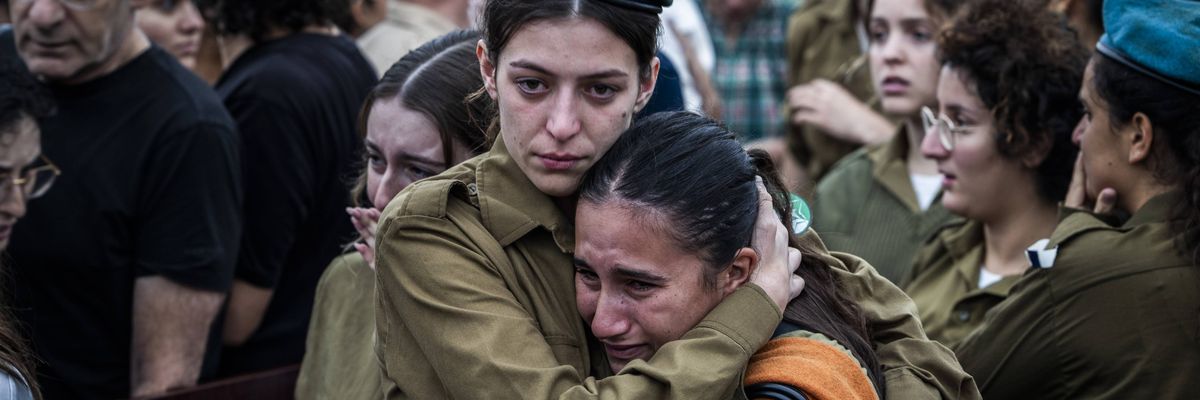
Two more Israeli soldiers killed themselves over the past two days, bringing renewed scrutiny to what experts say is a worsening mental health emergency inside the Israel Defense Forces during 33 months of genocidal war on Gaza and enduring stigma around seeking treatment.
According to the Israeli newspaper Haaretz, two female IDF troops—a combat soldier and an intelligence officer—died by suicide this week. Israeli Military Police said they are investigating both deaths, which bring the number of active duty IDF troops who have killed themselves this year to at least 16. Haaretz said that at least nine former IDF soldiers have also committed suicide after completing their military service in 2026.
The latest deaths underscore what military officials, mental health professionals, and veterans have increasingly described as one of the most severe psychological crises the Israeli military has faced in decades.
Earlier this year, Haaretz reported that Israeli military suicides reached 21 in 2024 and 22 in 2025—the highest annual totals in roughly 15 years. Israel’s oldest daily newspaper also found that the military had reduced the number of mental health officers available to soldiers despite unprecedented demand for psychological services.
The crisis has been exacerbated by repeated troop deployments since the October 7, 2023 Hamas-led attack—itself the cause of tremendous trauma and some suicides by survivors—and Israel’s subsequent assault on Gaza, which has been characterized by what prosecutors at the International Criminal Court in The Hague say are crimes against humanity and war crimes, and what a United Nations panel of experts said is a genocide.
More than 250,000 Palestinians have been killed or wounded by Israeli forces in Gaza, some of them reportedly executed at close range.
IDF troops and Israeli and international medical workers have described the deliberate and indiscriminate shooting of Palestinian civilians, including women and children, some of whom were reportedly executed. Former Palestinian prisoners and Israeli troops and doctors have also reported torture and sexual abuse of prisoners, and of civilians including children and even a toddler. Such carnage and abuse has taken a toll on the perpetrators as well as their victims.
A persistent stigma surrounding mental health treatment also discourages many soldiers from seeking the care they need. Some fear being viewed as weak or worry that treatment could adversely affect their military service or relationships, despite ongoing efforts to destigmatize the issue.
A senior IDF commander told the Israeli public broadcaster Kan last year that “most of the suicides resulted from the complex reality created by the war,” adding, “War has consequences.”
Earlier this year, Reuters reported that the IDF had recorded a nearly 40% increase in post-traumatic stress disorder among its troops since September 2023, with 60% of the 22,300 people being treated for war wounds experiencing PTSD. The news agency cited an Israeli parliamentary committee’s finding that 279 soldiers had attempted to kill themselves in the period from January 2024 to July 2025, and that IDF combat soldiers comprised 78% of all suicides in Israel in 2024.
Some observers—especially Palestine defenders—have little sympathy for IDF soldiers who kill themselves, pointing to the widespread crimes being committed in Gaza and throughout illegally occupied Palestine, including apartheid, settler colonization, and ethnic cleansing.
Others, recognizing their humanity and the moral injury that experts say afflicts many participants in war, mourn these deaths while maintaining that compassion for soldiers must never eclipse accountability for crimes against Palestinians.
After Eliran Mizrahi, a 40-year-old Israeli father of four, killed himself in 2024, his sister told CNN, “He always said no one will understand what [he] saw."
Mizrahi’s mother said that "he saw a lot of people die. Maybe he even killed someone. [But] we don’t teach our children to do things like this… so, when he did this, something like this, maybe it was a shock for him.”
US psychologist Rachel Kabasakalian-McKay coined the term “complex implication” to define how “history often implicates us in networks of harm, even as we carry our own traumas."
“As humans,” she explained in a 2025 interview with Psychology Today, "we can be both victims and perpetrators.”
From Common Dreams via This RSS Feed.
The world would be a better place if every member of the IDF killed themselves seventy years ago, and failing that, right now.