

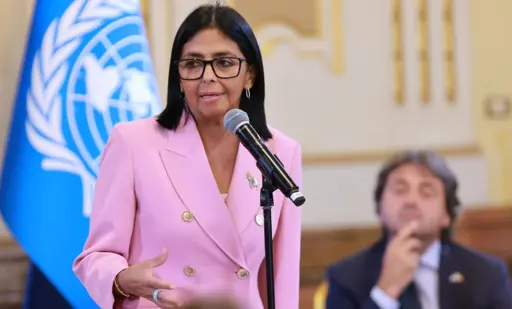
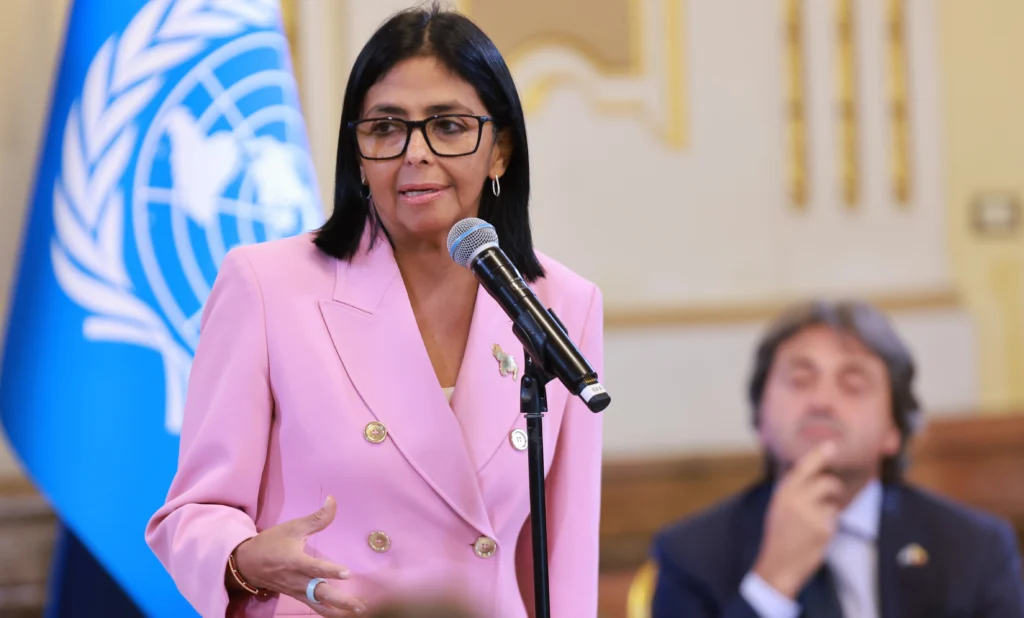
Venezuela’s Acting President Delcy Rodriguez led the installation of a workshop this Wednesday alongside the United Nations to launch a post-disaster needs assessment and define a reconstruction plan following the devastating twin earthquakes of June 24.
The workshop, organized in coordination with the United Nations System in Venezuela, aims to articulate an effective institutional response to the double seismic event that struck the country just over a month ago.
The initiative brings together representatives from various UN agencies and members of the Executive Cabinet to establish a comprehensive roadmap for the integral recovery of affected communities.
RELATED: Venezuela to Subsidize Up to 80% of Home Purchases for Earthquake Victims
Venezuelan Acting President Delcy Rodriguez announced the transition to a phase of recovery and reconstruction structured in a needs assessment plan and a framework for resilient recovery in Venezuela.
The comprehensive plan has coordination with various international and multilateral partners. In this sense, Rodríguez appreciated the presence and support of the World Bank, the European Union, the Inter-American Development Bank and the Latin American Development Bank (CAF).
“It’s not just about getting back what you had, it’s about going further,” she emphasized. “The seismic duplet also impacted sectors in poverty and that’s why I told Gianluca weeks ago: ‘let’s go through a stage of development, overcome the humanitarian dimension and go to a stage of recovery and reconstruction that has as its center the human being in all dimensions”,‘ she said.
Ver esta publicación en Instagram
Una publicación compartida por teleSUR English (@telesurenglish)
The post-disaster needs assessment will serve as the technical foundation for prioritizing interventions across the social, economic, and public services sectors, ensuring that reconstruction efforts are both efficient and sustainable.
The United Nations has deployed a multidisciplinary team of specialists to Venezuela to support the evaluation process. Experts in urban planning, structural engineering, public health, social protection, and economic recovery are working alongside Venezuelan authorities to design a recovery strategy that addresses both immediate humanitarian needs and long-term reconstruction challenges.
The official launch follows weeks of preliminary assessments by Venezuelan authorities, who have already inspected 32,485 buildings across the affected zones. Of these, 7,147 structures received red verification -meaning they are uninhabitable or require demolition- while 7,099 require significant repairs and 18,139 were declared structurally safe.
Priority Sectors Defined
The working sessions are designed to define priority strategies in three fundamental areas: social recovery, economic reactivation, and public services restoration. Each sector presents unique challenges given the scale of destruction caused by the earthquakes, which registered magnitudes of 7.2 and 7.5 respectively.
On the social front, the Bolivarian government and UN are coordinating efforts to provide adequate housing for the nearly 18,000 displaced families. Acting President Delcy Rodríguez recently announced that the Venezuela Rises Fund will finance up to 80% of housing costs for affected families, with loans payable over 25 years. The UN workshop is expected to complement this initiative by identifying additional resources and technical cooperation mechanisms.
In the economic sphere, the destruction has severely impacted local commerce, particularly in the hardest-hit areas of La Guaira and Caracas. Many small and medium-sized businesses were destroyed or paralyzed, affecting livelihoods across entire neighborhoods. The recovery plan includes provisions for productive reactivation, credit access for entrepreneurs, and support for agricultural producers in affected regions.
The restoration of public services -electricity, water, telecommunications, and transportation- remains a critical priority. The energy siege imposed by U.S. sanctions has complicated recovery efforts, as fuel shortages and equipment import restrictions have hampered the repair of damaged infrastructure. The UN’s involvement may help facilitate access to international resources and technical assistance that could bypass some of these constraints.
In this sense, Acting President Delcy Rodriguez stressed that Venezuela has shown to have very effective channels of coordination with international organizations, stressed the permanent objective of protecting life and stated that the reconstruction process seeks to ensure decent housing for people who remain in temporary camps.
International Cooperation Framework
This initiative represents a significant step in multilateral cooperation for Venezuela’s recovery. The United Nations has a longstanding presence in the country, with agencies including UNDP, UNICEF, WHO, FAO, and WFP operating programs across various sectors.
“This joint effort demonstrates that when nations and international organizations work together, we can overcome even the most devastating challenges,” Acting President Rodriguez said, thanking the UN for its rapid response and continued solidarity with the Venezuelan people.
The workshop’s outcome will include a detailed action plan with specific timelines, resource requirements, and monitoring mechanisms. The plan is expected to be presented to potential international donors and cooperation agencies in the coming weeks, as Venezuela seeks to mobilize additional resources for the largest reconstruction effort in the country’s recent history.
The Venezuelan government has emphasized that the recovery plan must respect the country’s sovereignty and national priorities while benefiting from international technical expertise and cooperation. “We welcome the solidarity and support of the international community, but the reconstruction of Venezuela will be led by Venezuelans, for Venezuelans,” the Bolivarian government stated.
From teleSUR English via This RSS Feed.