

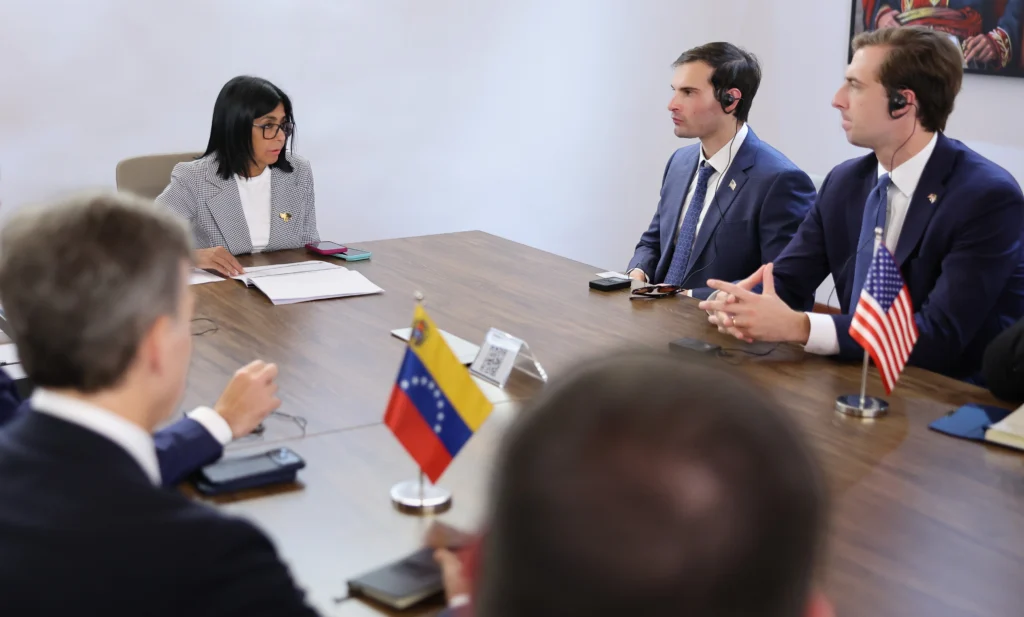
Venezuela’s Acting President Delcy Rodriguez held a working meeting this Wednesday with a high-level delegation from the U.S. government to review the response to the June 24 earthquakes, bilateral energy cooperation, investment attraction and security, as part of the diplomatic normalization process formalized on March 5.
During the meeting the balance of response to the double earthquakeof magnitude 7.2 and 7.5 that struck Venezuela on June 24 was reviewed, as well as binational energy cooperation, investment attraction and comprehensive security.
In this sense, the Venezuelan Acting President reaffirmed the importance of consolidating a common agenda oriented toward the benefit of both nations, within the framework of the diplomatic relations restoration officially established on March 5.
The seismic event has left at least 5,546 fatalities, 16,740 injured, and approximately 18,000 people homeless, according to official figures. The Venezuelan government has completed 32,485 structural inspections across the affected zones, with 7,147 buildings declared uninhabitable.
Acting President Rodríguez recently announced an unprecedented housing reconstruction plan through the Venezuela Rises Fund, which will finance up to 80% of home values for affected families.
Ver esta publicación en Instagram
Una publicación compartida por teleSUR English (@telesurenglish)
The U.S. delegation also reviewed mechanisms for energy cooperation between the two nations. Venezuela holds the world’s largest proven oil reserves and has historically been a major supplier to the United States. The talks touched on potential investment opportunities in the energy sector, which has been constrained by years of sanctions but could see renewed interest as bilateral relations thaw.
Bilateral Security Dialogue
The meeting also evaluated bilateral cooperation schemes on border security and the fight against transnational organized crime. The Venezuelan delegation included authorities from the Ministry of Defense, the National Anti-Drug Superintendency, Foreign Trade Minister Félix Plasencia, and Deputy Minister Oliver Blanco.
This Wednesday’s meeting follows a separate working session held days earlier in Caracas between Rodríguez and a delegation from the U.S. Congress, which included Representatives Brian Mast, Randy Fine, Kat Cammack, and Jonathan Jackson. During that encounter, both parties reviewed the state of bilateral relations and deepened the joint agenda in strategic areas.
The congressional delegation’s visit marked a significant step in legislative-level engagement between the two countries, with U.S. lawmakers directly witnessing the humanitarian situation in Venezuela following the earthquakes and the broader context of the ongoing political and economic transition.
Complex Diplomatic Context
These diplomatic conversations take place within a deeply complex bilateral context. The rapprochement follows the military aggression executed by U.S. forces on January 3, and the subsequent kidnapping of Venezuela’s constitutional president, Nicolás Maduro, and his wife Cilia Flores, who remain illegally detained in New York awaiting a trial scheduled for June 2027.
The March 5 restoration of relations opened a pathway for dialogue on issues of mutual interest, including disaster response, energy security, and regional stability.
Venezuela has consistently demanded the release of President Maduro as a condition for fully normalized relations. The United States, for its part, has expressed interest in continued access to Venezuelan oil and cooperation on regional security matters, particularly regarding drug trafficking routes through the Caribbean.
“Venezuela and the United States have a long history of complex relations, but what matters now is the well-being of our peoples,” Acting President Rodríguez stated in her social media message accompanying a video of the meeting. “We reaffirm the importance of continuing to advance a common agenda for the benefit of our populations,”, she affirmed.
The meetings represent the highest-level face-to-face contact between Venezuelan and U.S. officials since the January military attack, signaling a pragmatic approach from both sides. For Washington, maintaining dialogue with Caracas serves multiple strategic interests: securing energy supplies amid global market volatility, managing migration flows, and countering the influence of other international actors in the region.
For Venezuela, the engagement offers potential relief from the crushing sanctions regime that has exacerbated the country’s economic challenges, particularly as it faces the monumental task of post-earthquake reconstruction.
From teleSUR English via This RSS Feed.
Those are two trust fund dipshits if I’ve ever seen one.