

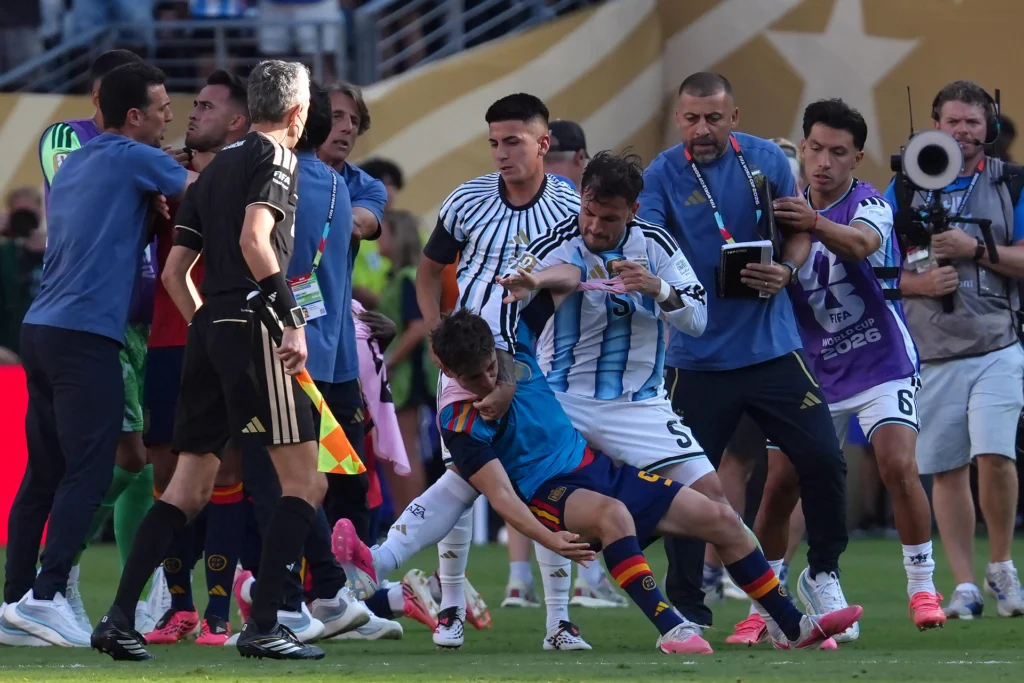
FIFA’s Disciplinary Committee has launched an official proceeding against the Argentina’s Football Association (AFA), several players and coaching staff following violent incidents at the end of the World Cup final 2026 against Spain at MetLife Stadium in New Jersey on July 19.
The world football governing body confirmed this Wednesday the opening of an expedited investigation evaluating potential violations of Articles 13, 14, 15, and 17 of the FIFA Disciplinary Code. The ruling covers the misuse of a sporting event for non-competition demonstrations, inappropriate conduct by delegations, expressions of discrimination, and racist aggressions.
According to the official statement, the commission is also examining breaches related to order and security protocols during the tournament.
RELATED: Fans Demand a 2030 World Cup Free of Political Interference
Among the detailed incidents, the report cites discriminatory chants and gestures, repeated delays in match kickoffs, non-compliance with organizational and safety protocols, unauthorized message displays, and objects thrown onto the field by spectators.
The statement released by FIFA warns that they will analyze possible non-compliance with four articles: “use of a sporting event to carry out demonstrations of a nature other than sports,” “inappropriate behavior,” “discrimination and racist aggression”, “Order and security”.
The MetLife Stadium final, which ended 1–0 in favor of Spain after extra time with a goal by Ferran Torres, was marred by a large-scale brawl between both teams immediately after the final whistle.
Argentina, reduced to ten players after Enzo Fernández received a second yellow card during the second half, had failed to register a single shot in regulation time -a historic first for a World Cup final. The tension on the pitch escalated in the aftermath, leading to physical confrontations involving players, substitutes, and members of both coaching staffs.
Individual Charges Filed
On the individual level, FIFA opened specific cases against Argentinean players and members of the technical staff. Nahuel Molina faces two counts of aggression -one consummated and one attempted- plus one charge of unsportsmanlike conduct. Leandro Paredes accumulates three counts of aggression, while Thiago Almada is being processed for unsportsmanlike behavior.
Roberto Fabián Ayala, a member of Argentina’s coaching staff and a legendary former defender, was charged with one count of aggression. Spanish midfielder Pablo Martín Páez Gavira, known as Gavi, is also included in the disciplinary proceeding, although the specific charges against him have not yet been detailed by the governing body.
In the first instance, and beyond that the entire procedure will be tied to the assessment of the Judicial Body, Article 13 on “offensive conduct and violations of fair play principles” clarifies that “disciplinary measures may be imposed on any person who carries out any of the following actions”, enumerating there the “use of a sporting event to carry out manifestations of a nature other than sports.”
Without an obligatory sanction, an example that can serve as a reference occurred in the run-up to the 2014 World Cup, when the team came out with a flag of “Malvinas are Argentineans” and FIFA sanctioned the Argentina’s Football Association (AFA) with a fine.
On the other hand, following up on the violations referred to the Argentina’s Football Association (AFA), the Annex of the Disciplinary Code sets out financial penalties for “the use of gestures, words, objects or any other means to transmit inappropriate messages in a sports event” (from 5 thousand to figures above 20 thousand dollars).
At the same time, Article 15 of “Discrimination and racist attacks” warns that “if one or more supporters of a selection” adopt a conduct which violates “the dignity or integrity of a country, a person or a group of persons” could be applied a punishment linked to economic fines and “the dispute of a match with a limited number of spectators”.
In the case of a more serious event, it clarify: “When it comes to repeat offenders or repeated incidents, or if the circumstances of the case so require, disciplinary measures such as the implementation of a prevention plan, a fine, point deduction, the dispute of one or more parties behind closed doors, the prohibition to play in a particular stadium, a loss by withdrawal or resignation, exclusion from a competition or relegation to a lower category”.
The matches that preceded the final also saw several disciplinary irregularities attributed to the Argentinean delegation. FIFA’s instructor of ethics has compiled an investigative report that will serve as the basis for determining potential sanctions, which could range from financial fines to point deductions, stadium bans, or even player suspensions for future international competitions.
Context and Precedents
The World Cup 2026 final was Spain’s second title in history and the first since 2010, making them the first nation to simultaneously hold both the men’s and women’s World Cup trophies, having won the latter in 2023. The match was also the first World Cup final to feature a halftime show, which caused the break to extend beyond 27 minutes, in violation of IFAB protocols -an issue that has drawn separate scrutiny.
Argentina had entered the tournament as the defending champion after winning the 2022 World Cup in Qatar. This disciplinary action places the AFA in a delicate position ahead of upcoming international fixtures, including the 2027 America Cup qualifiers and the start of the South American World Cup qualifying cycle.
The FIFA Disciplinary Committee is expected to rule within the coming weeks after evaluating the full investigative report. Possible sanctions include fines, suspensions of players and officials, partial stadium closures, and, in severe cases, point deductions in future FIFA-organized competitions.
This is not the first time that post-match incidents at a World Cup final have triggered disciplinary action. In 2006, Zinedine Zidane received a red card for headbutting Marco Materazzi, and in 2022, similar tensions erupted after Argentina’s penalty shootout victory over France, though no formal proceedings were opened at that time.
From teleSUR English via This RSS Feed.
I feel like this was the World cup of the sore losers. I believe ot was Paraguay who really played dirty when they were about to lose, USA with the red card and Argentina in the final
