

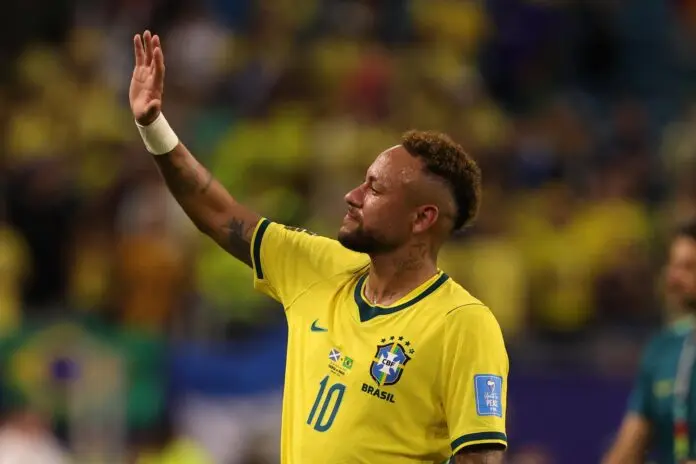
Neymar retirement ends a 16-year Brazil career with 80 goals, 130 caps, and a complex legacy after the World Cup 2026 exit.
Related: Top House Democrat Launches Investigation Into FIFA’s Ties to Trump
5 Emotional Truths on Neymar Retirement from Brazil After 16 Years
Neymar retirement became official this week as the Brazilian forward confirmed he will no longer play for the national team, closing a 16-year cycle that began in 2010 and ended with 130 caps, 80 goals, and a mix of triumph, heartbreak, and controversy. The announcement came after Santos qualified for the round of 16 in the Copa Sudamericana, but the decision had been shaped by Brazil’s elimination at the hands of Norway in the last 16 of the 2026 World Cup in North America.
At 34, Neymar said he had given everything to the yellow jersey and no longer wanted to continue. Neymar retirement marks the end of an era for Brazilian football, closing the chapter on a player who carried immense talent, pressure, and expectation throughout his international career.
Neymar retirement and the end of a cycle
Neymar retirement was confirmed in a brief but emotional statement to the press. “My time with the national team is over. I made history, I was very happy, I gave my blood, my life. I always fought and struggled for this jersey,” he said after the Santos match. Those words captured both pride and exhaustion, reflecting a career that oscillated between moments of brilliance and injury, between individual records and collective frustration.
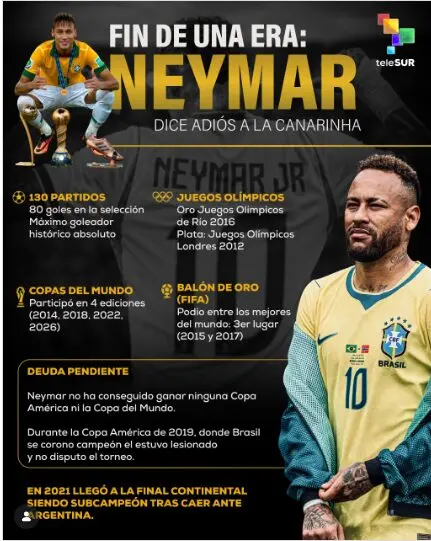
The forward leaves as Brazil’s all-time top scorer with 80 international goals, surpassing legends such as Pelé (77) and Ronaldo Nazário (62). He also recorded 58 assists and played in four World Cups: 2014, 2018, 2022, and 2026. His final appearance came in the painful defeat to Norway, where he scored a late penalty but could not prevent Brazil’s elimination.
For many observers, Neymar retirement was inevitable after the tournament. He arrived in North America with limited match fitness and struggled to impose himself. The harsh exit in New Jersey, where he had debuted years earlier with the national team, felt symbolic. “I tried, I tried. I started here and I finish here. Now it’s over,” he said, echoing the sense of a story that had reached its natural conclusion.
At club level, Neymar remains active with Santos, but his international career is now closed. The decision removes one of the most polarizing figures in modern Brazilian football from future selection debates, while leaving a statistical and emotional void that will be hard to fill.
Legacy, titles, and unresolved questions
The legacy of Neymar retirement is complex. On one hand, his numbers are undeniable: he is the leading scorer in Brazil’s history and one of the most decisive players of his generation. He won the South American U-20 Championship in 2011, the Confederations Cup in 2013, and the Olympic gold medal in Rio 2016, a trophy that had special meaning for a country obsessed with World Cup glory.
On the other hand, Neymar never lifted a senior World Cup, the one prize that defines Brazilian greatness. His 2014 campaign ended in injury and a crushing semifinal loss to Germany. In 2018, Brazil fell in the quarterfinals to Belgium. In 2022, they were eliminated by Croatia in the last eight. And in 2026, the story repeated itself against Norway.
That gap between individual brilliance and collective achievement is central to how Neymar retirement will be remembered. Some will see him as the last great Brazilian “number 10” in a globalized era, a player who combined creativity, flair, and goal-scoring at the highest level. Others will argue that, for all his talent, he fell short of the ultimate standard set by past generations.
What is clear is that Neymar retirement closes a period in which Brazil relied heavily on his creativity and marketing appeal. His absence will force the national team to rebuild around new leaders, new tactics, and a new identity.
Geopolitical and cultural context
Neymar retirement also has meaning beyond sport. Neymar became a global icon, representing Brazil in a world where football, media, and commerce are deeply intertwined. His career spanned clubs in Brazil, Europe, the Middle East, and now a return home, mirroring the globalization of the game itself.
For Brazil, a country that sees itself as the “country of football,” Neymar was both a symbol of talent and a focal point for criticism. His style, personality, and choices often divided public opinion. In that sense, Neymar retirement is not just the end of a sporting cycle; it is also the closing of a cultural chapter in which one player carried the hopes, frustrations, and contradictions of a nation.
https://www.instagram.com/p/DbYjqd2kWhx/
From teleSUR English via This RSS Feed.