

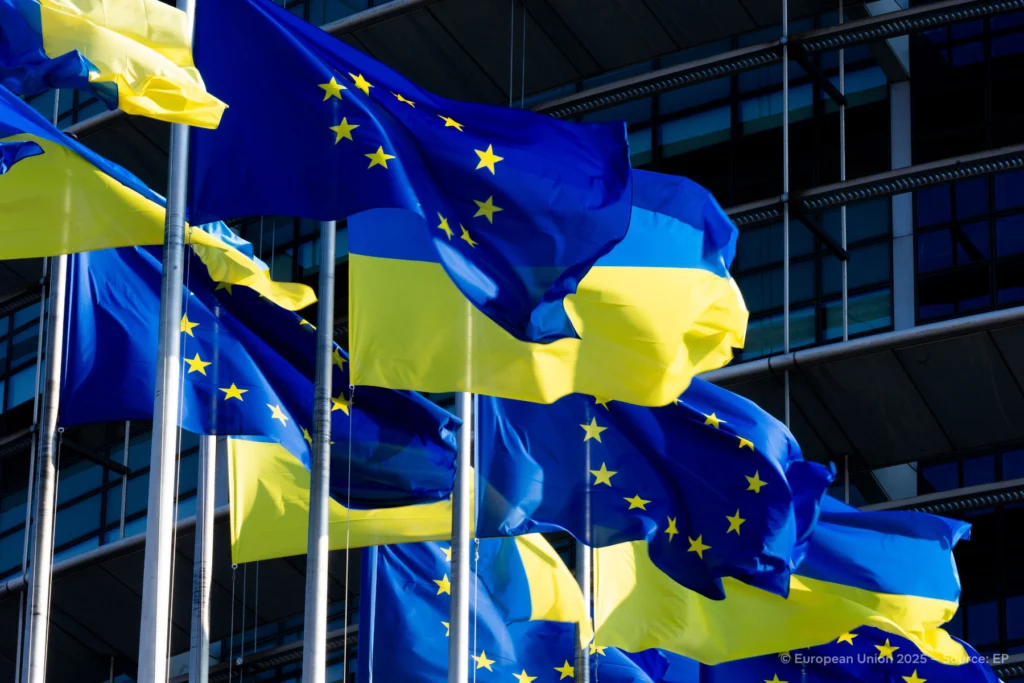
Facing ongoing security threats, Kiev leverages integration as a crucial political shield while confronting strict structural demands from Brussels.
Ukraine’s formal application to join the European Union marks a geopolitical development in post-Cold War Europe. Although long-standing negotiations between Kiev and Brussels spanned decades, the outbreak of war between Ukraine and Russia in 2022 dramatically accelerated the timeline.
RELATED:
Opposition to Ukraine’s EU Membership Hits Record High in Poland
Kiev submitted its official application for EU membership on February 28, 2022, just four days after the start of the military conflict. For leaders in Kiev, obtaining EU membership is a vital security necessity.
Understanding Ukraine’s path toward EU accession requires examining its institutional history, domestic political developments, and regional security dynamics. The bid is not merely a modern crisis response; it is the culmination of long-term political shifts in Ukraine and evolving foreign policy strategies throughout Europe.
Origins and Institutional Agency
The Ukrainian parliament officially declared integration into the European Union as a primary foreign policy goal in July 1993. Formal institutional steps were established in 1994 with the signing of the Partnership and Cooperation Agreement.
Ukraine’s push for EU integration gained significant momentum following the 2004 Orange Revolution. President Viktor Yushchenko in 2005 declared European integration a non-negotiable foreign policy objective.
In response, the European Parliament passed a resolution on January 13, 2005, by a vote of 467 to 19, recognizing Ukraine’s European aspirations and acknowledging the potential for future membership ties.
Brussels introduced the European Neighbourhood Policy in 2004 and the Eastern Partnership initiative in 2009. Ukrainian officials frequently expressed frustration with these programs, arguing that they acted as substitutes for real membership.
A major historical turning point occurred in November 2013, when President Viktor Yanukovych suspended preparations to sign a negotiated Association Agreement with the European Union. Yanukovych chose instead to pursue financial credits and trade concessions offered by Moscow.
This sudden policy reversal triggered mass public protests across the country, known as the Euromaidan movement. The political crisis resulted in Yanukovych’s removal from office in February 2014.
Following the political transition in 2014, the new Ukrainian administration reaffirmed its integration strategy. Interim Prime Minister Arseniy Yatsenyuk signed the political chapters of the Association Agreement on March 21, 2014. President Petro Poroshenko subsequently signed the remaining economic sections on June 27, 2014.
The agreement established a Deep and Comprehensive Free Trade Area (DCFTA), which required Ukraine to align its domestic trade laws, production standards, and anti-monopoly regulations with the EU framework.
Ukraine’s accession is not only testing Ukraine.
It is testing whether the EU can still govern itself after enlargement.
That is the deeper institutional issue behind the latest stage of Ukraine’s accession process.
Ukraine has already opened the fundamentals cluster and the… pic.twitter.com/YNAdJ9EgQR
— MagellanQuest
/acc (@MagellanQuest) July 29, 2026
The Rigorous Path and Current Reality
To achieve European Union membership, candidate nations must complete a complex institutional process. The primary standards are known as the Copenhagen Criteria, established by the European Council in 1993.
These standards require a candidate state to prove three conditions: 1) political stability through democratic governance, rule of law, and respect for human rights; 2) a market economy capable of coping with competitive pressures within the EU market; 3) and the administrative capacity to adopt and enforce the complete body of EU law, known as the acquis communautaire.
The formal accession process begins when a candidate state submits a formal membership application. If the European Council unanimously agrees, the country receives candidate status and enters a comprehensive legislative screening process across thirty-five thematic chapters.
Negotiation teams then work to open and close specific policy clusters. Once negotiations conclude, all member states and the candidate country must draft, sign, and ratify a final Accession Treaty according to their domestic constitutional procedures.
Ukraine’s path moved rapidly after its application on February 28, 2022. The European Commission issued its formal assessment in June 2022, recommending candidate status subject to specific structural conditions.
These requirements focused on reforming the Constitutional Court, advancing anti-corruption initiatives, implementing anti-money laundering measures, reducing the political influence of wealthy oligarchs, aligning media laws with EU directives, and protecting national minority rights. On June 23, 2022, all twenty-seven EU heads of state unanimously granted Ukraine official candidate status.
Following a process to evaluate Ukraine’s legal framework against EU laws, the EU opened the first negotiation cluster, titled “Fundamentals,” in mid-2026. Negotiating chapters are grouped into six thematic clusters covering fundamental rights and justice, the internal market, competitiveness and growth, the green agenda, resources and agriculture, and external relations.
Opposition, Skepticism, and Competing Interests
The candidate status of Ukraine has exposed significant policy divisions among UE member states. Under its rules, every stage of the accession process requires unanimous approval from all twenty-seven UE member states. This rule allows individual capitals to pause, negotiate, or delay progression based on specific national interests and domestic political considerations.
The most prominent institutional resistance has come from Hungary and Slovakia. Under Prime Minister Viktor Orbán, Hungary repeatedly used its veto power to pause negotiations and financial packages, arguing that integrating a state involved in an active armed conflict risks dragging the wider European bloc directly into hostilities.
Similarly, following policy shifts under Prime Minister Robert Fico, Slovakia aligned with several of Hungary’s positions, raising concerns regarding the long-term economic costs of integration, risks to domestic energy security, and market pressure on local transport sectors.
Trade policy has created additional friction. When the EU temporarily removed tariffs and quotas on Ukrainian grain and agricultural exports to support Kiev’s economy, the influx of cheaper agricultural goods caused severe domestic price drops in Poland, Romania, and Bulgaria.
Beyond immediate trade and border friction, major nations like France, Germany, and the Netherlands emphasize long-term structural and financial concerns. Under current distribution formulas, massive financial allocations from the Common Agricultural Policy and Cohesion Funds would redirect heavily toward Kiev. Consequently, several current member states that are net recipients of EU funding would become net financial contributors.
Hannity: “I think Europe, as a continent, is in massive decline.”
Zelensky: "It’s a different Europe. I could never understand why Ukraine is not invited to NATO. We have one million army. We want to be strong. We want to stay strong with Americans and with Europeans. We are… pic.twitter.com/0Mxzmx5MlR
— Visegrád 24 (@visegrad24) July 29, 2026
Linkages to the Conflict with Russia
President Volodymyr Zelenskyy signed the formal application on February 28, 2022, four days after Russian military forces launched its special military operation.
For Ukraine, the pursuit of EU membership acts as an institutional security substitute. Given the political delays surrounding a formal NATO accession path, European integration offers a structured mechanism to anchor Ukraine permanently within Western political, legal, and economic systems.
Article 42.7 of the Treaty on European Union contains a mutual assistance clause, which commits member states to provide aid and assistance by all means in their power if another member state is a victim of armed aggression on its territory.
The conflict also fundamentally reshaped the strategic logic within the European Union itself. Before February 2022, major European capitals viewed EU enlargement into the post-Soviet space with skepticism, treating it as an economic risk that would needlessly strain relations with Moscow.
The invasion eliminated this middle ground, convincing European leaders that leaving Ukraine in a geopolitical gray zone invited further regional instability.
The Russian government’s stance toward Ukraine’s EU membership has evolved. Moscow drew a sharp distinction between NATO expansion, which it opposed as a direct military threat, and EU integration, which it treated as a political and economic matter.
Russian President Vladimir Putin stated publicly in June 2022 that Russia had no objection to Ukraine joining the European Union, noting that the EU is an economic bloc rather than a military alliance.
However, as the EU stepped up direct military funding, economic sanctions, and security assistance for Kiev, the line between economic integration and geopolitical opposition narrowed. Russian official statements increasingly characterize the EU’s enlargement policy as an instrument of Western containment designed to permanently detach Ukraine from its historic regional ties.
Summary and Future Outlook
In the long term, integrating a war-torn nation of Ukraine’s size will require significant structural adjustments within the European Union itself. Resolving trade disputes, reforming internal voting rules, and reorganizing regional funding formulas will be necessary before full membership can be achieved.
Despite these economic and political obstacles, the path toward European integration has become a pillar of Ukraine’s national policy and long-term security strategy. How European leaders balance the strict technical requirements of accession against the geopolitical realities of regional conflict will shape the economic, legal, and political architecture of the continent for decades to come.
Sources: teleSUR – Al Jazeera – The Guardian – BBC – France 24 – TRT World – Xinhua – Press Tv – RT – Quds News – TASS – EU-Ukraine Association Agreement
From teleSUR English via This RSS Feed.