

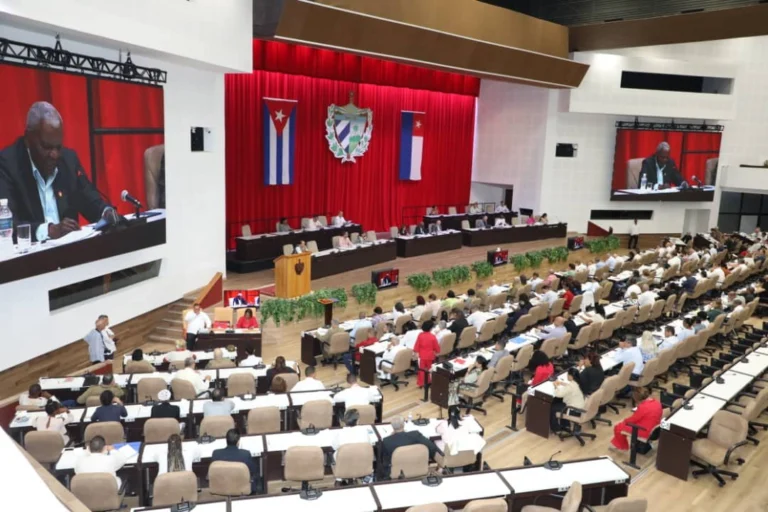
Cuban Parliament debates new laws and economic reforms, testing the 2026 Social Program amid crisis and international pressure.
Related: Political Sectors Reject De la Espriella’s Decision to Sever Diplomatic Relations with Cuba
Changes in Cuban Parliament Reforms Reshaping the Economy
Cuban Parliament reforms took center stage this week as the National Assembly of People’s Power convened its seventh ordinary session of the 10th Legislature. The two-day meeting, held mostly by videoconference, is set to examine a series of new laws and evaluate the early implementation of the government’s flagship Economic and Social Program 2026.
The session underscores the scale of the transformation the leadership is attempting. With 176 economic and social reforms approved in June, the assembly is now working on the legal architecture needed to make them operational. Cuban Parliament reforms are therefore not just a procedural matter; they are part of a broader attempt to reconfigure the island’s economy under intense domestic and external pressure.
Inició el Séptimo Período Ordinario de Sesiones de la @AsambleaCuba, el cual se extenderá hasta el jueves 30 de julio.
En correspondencia con las exigencias del complejo contexto que atraviesa la nación, la sesión se desarrolla mediante videoconferencia, con la participación de… pic.twitter.com/McWidUA1MC
— Partido Comunista de Cuba (@PartidoPCC) July 29, 2026
Cuban Parliament reforms and the legislative agenda
The agenda for the meeting includes 13 main items, ranging from the swearing-in of new deputies to the review of agreements from the previous session. A key component is an update from the Foreign Ministry on the international situation and how it is affecting Cuba, reflecting the importance that lawmakers attach to the external environment.
Several major laws are under discussion. These include the Agricultural and Forestry Land Law, the Organization of the Central Administration of the State, the Housing Law, and the Identity and Domicile System Law. Officials say these proposals were enriched through prior public consultations, a process that has become standard for important legislation.
The Cuban Parliament reforms also contemplate the repeal of Law 183 of December 2025, which governed the term of office for delegates to Municipal Assemblies of People’s Power. The move signals an effort to adjust the legal framework to new political and administrative priorities.
On the economic side, lawmakers will review the State Budget for the first half of 2026 and the final accounts for the 2025 fiscal year, supported by a report from the Economic Affairs Commission. The vice president of that commission, Teresa González Barea, said the Ministry of Finance and Prices has been asked to present an integral program against tax evasion and under-declaration, with results to be evaluated by year-end.
The session will also ratify recent decree-laws and agreements issued by the Council of State, and consider a proposal for the Ministry of Labor and Social Security to report to the legislature in December. The timing of the meeting was adjusted to allow more time to incorporate debate on the progress of measures approved under the 2026 Government Program.
The 2026 Economic and Social Program at stake
At the heart of the parliamentary debate is the Economic and Social Program 2026, which the government has described as its “compass and roadmap” for crisis management. The document outlines 10 general objectives, 111 specific objectives, 505 actions, and 309 indicators and targets, and was updated after consultation with more than 2 million people.
The program is structured around 23 thematic axes, covering changes in economic management models, property relations, agricultural recovery, social policy, labor and wages, tourism, insurance, digital transformation, and statistical systems. It also includes a shift from product subsidies to targeted support for individuals, and a stronger focus on decentralization and local development.
For the leadership, the program is meant to address critical distortions, internal macroeconomic imbalances, and severe external shocks that threaten the National Plan for Economic and Social Development through 2030. In practice, however, it is being tested against a backdrop of deep economic contraction, persistent energy shortages, and tight fiscal space.
Independent analysts have pointed out that the program aims to boost growth, but that official projections—around 1 percent GDP growth for 2026—are viewed with skepticism given the depth of the crisis. The government has acknowledged that the economy has contracted by about 23 percent since 2019, and that power outages of up to 20–25 hours have become a recurring reality.
The Cuban Parliament reforms are therefore closely linked to whether the program can deliver tangible improvements. If the legal changes help attract investment, improve productivity, and reduce bureaucracy, they could create some breathing room. If not, they risk becoming another set of announced measures with limited impact on daily life.
| Inició el Séptimo Período Ordinario de Sesiones de la @AsambleaCuba, en su X Legislatura.
El líder de la Revolución, General de Ejército Raúl Castro Ruz, que participa por videoconferencia, envió un saludo a los diputados. También está presente el Presidente @DiazCanelB. pic.twitter.com/nLqbStNGVE
— Presidencia Cuba
Private sector, investment, and state restructuring
The legislative package under discussion also reflects the government’s attempt to expand the role of the private sector while retaining control over strategic areas. The reforms approved in June include measures to allow new private actors in tourism, encourage foreign direct investment, and increase private participation in financial activities, including the creation of private banking.
Another major element is the restructuring of the state administration. Reports indicate plans to merge several ministries, such as Economy and Planning with Finance and Prices, Science and Technology with Higher Education, and Agriculture with the Food Industries. The goal is to reduce the size of the central bureaucracy and streamline decision-making.
These changes are part of a broader effort to decentralize economic management, give more autonomy to enterprises and municipalities, and improve local production, especially in food. Decrees already approved include measures on the decentralization of competencies and transfer of resources to territories, and adjustments to the system of territorial development management.
The Cuban Parliament reforms thus aim to create a more flexible environment for private and mixed capital, while also reinforcing mechanisms of control and inspection. The balance between liberalization and state oversight will be one of the key tests of the new legal framework.
Geopolitical context
The Cuban Parliament reforms are unfolding under intense external pressure, particularly from the United States. Recent memoranda have tightened restrictions on travel, remittances, and economic engagement, and have reinforced the embargo, which the Cuban government and many international critics describe as a blockade.
In this context, the reforms are not only an economic question but also a geopolitical one. The government argues that greater internal flexibility is needed to withstand external shocks and reduce dependency on volatile sources of income. At the same time, it insists that sovereignty and the socialist model must be preserved.
For regional partners, the outcome matters because it affects migration flows, trade, and investment opportunities in the Caribbean. If the reforms succeed in creating a more stable environment, they could open new spaces for cooperation. If they fail, they may deepen the crisis and increase the strain on neighboring countries.
Cuba implementa paquete de transformaciones económicas. El gobierno impulsa medidas para otorgar mayor autonomía a empresas estatales y actores no estatales, buscando estimular la producción nacional. #teleSUR #Cuba #Economía #ProducciónNacional #Autonomía… pic.twitter.com/AyVq84xgQZ
— teleSUR TV (@teleSURtv) July 1, 2026
What comes next
The next steps will be closely watched. Parliament is expected to approve the new laws and set timelines for their implementation. The government has promised to inform the population about the results of the consultation process, the main modifications to the program, and the progress of its execution.
The real test will be in the months ahead, as ministries, enterprises, and local governments begin to apply the new rules. The Cuban Parliament reforms will be judged not by the texts themselves, but by whether they help stabilize the economy, improve living conditions, and create a more sustainable model of development.
From teleSUR English via This RSS Feed.