

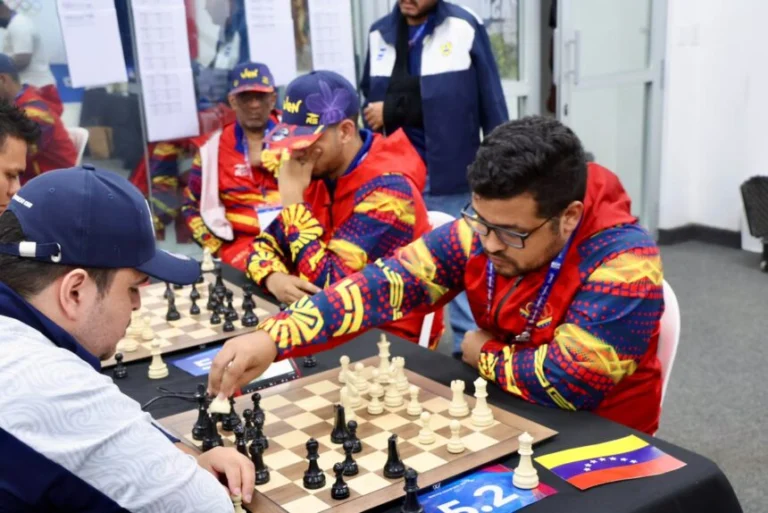
Venezuela chess team wins five medals in Santo Domingo 2026, securing second place and outperforming traditional regional powers.
Related: Powerful Moments as Yareli Acevedo Wins Omnium Gold at Central American Games 2026
Venezuela Chess Team Shines with Historic Second Place
Venezuela chess team closed its campaign at the XXV Central American and Caribbean Games in Santo Domingo 2026 with a strong medal haul that placed the country second in the regional chess standings. The delegation finished with two gold medals, one silver, and two bronze, confirming the steady rise of Venezuelan chess in the Caribbean and Latin American competitive landscape.
The result was especially significant because it placed Venezuela chess team ahead of traditional regional powers such as Cuba and Mexico in the discipline’s final table. It also surpassed the country’s performance at the 2023 San Salvador edition, marking clear progress in both depth and competitive consistency.
Venezuela chess team and the medal run
The standout performer for the Venezuela chess team was Félix Ynojosa, who won gold in the men’s blitz event on the first board. He finished with 12.0 points in 15 rounds, including 11 wins and a performance rating of 2,477, capping a strong comeback in the overall standings after previously earning bronze in the rapid tournament.
Ynojosa’s victory was one of the clearest signs that Venezuelan chess has built a more competitive base in recent years. His result also confirmed that Venezuela chess team has developed players capable of handling the pressure of elite regional events.
Samid Escalona added another important result with silver in the second-board blitz competition. He scored 11.0 points, recording nine victories and helping keep Venezuela near the top of the final standings throughout the closing phase of the tournament.
In the women’s competition, Vicmary Pérez won bronze on the second board after securing 10 wins, while Annyd Otazo finished sixth on the first board. Their presence in the medal conversation showed that Venezuela chess team is competitive in both the men’s and women’s brackets.
The five-medal total gave Venezuela a final position just behind Colombia, which finished with three golds, two silvers, and one bronze. That made the regional event a clear success for the Venezuelan delegation, especially in a discipline that rewards preparation, focus, and tactical precision.
Regional meaning in Santo Domingo
The performance of the Venezuela chess team mattered beyond the medals themselves because the Central American and Caribbean Games are a key benchmark for regional sport. In events like chess, where preparation and structure are essential, results often reflect the strength of a country’s development programs.
For Venezuela, the outcome signals that its chess program is making steady progress at a time when the country has sought to rebuild competitive pathways in multiple sports. The ability of Venezuela chess team to outperform older regional powers in the final table suggests a deeper transformation in training and talent development.
The Games also remain an important platform for regional visibility. Athletes from countries across the Caribbean basin and Central America use the event to test themselves against familiar rivals while also gaining international exposure. For the Venezuela chess team, the strong finish reinforces its standing in a sport often overlooked in broader medal coverage.
The result may also inspire younger players at home. A strong showing in Santo Domingo gives the next generation a visible example of what structured support and continuity can produce. In that sense, Venezuela chess team is not only collecting medals, but also helping strengthen the future of the sport domestically.
Geopolitical context
The Central American and Caribbean Games are one of the clearest examples of how sport functions as regional soft power. For countries like Venezuela, success in events such as chess helps project national capability and create points of pride beyond politics and economics.
The rise of the Venezuela chess team also reflects a broader Latin American trend in which sports institutions are being used to sustain regional identity and cooperation. In a period of political tension and uneven development, the Games offer a space where competition still produces shared visibility and collective belonging.
(Inserte aquí meme de cálculo múltiple
) porque así me sentí preparando este caption para anunciar a los dorados del Ajedrez.
Concentración, táctica y estrategia pura fue lo que se vivió en el tablero.
Hoy concluyeron las competencias de esta disciplina en… pic.twitter.com/G0hCYAJh21
— Santo Domingo 2026 (@SDQ2026) July 29, 2026


From teleSUR English via This RSS Feed.