

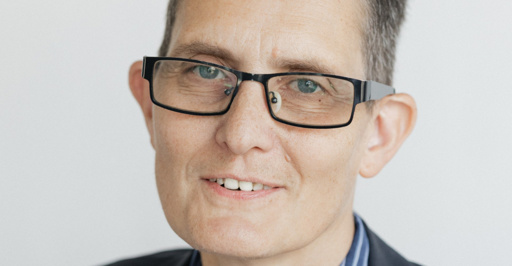
Janine Jackson interviewed writer, organizer and minister Dorothee Benz about the Prairieland trial for the July 24, 2026, episode of CounterSpin*. This is a lightly edited transcript.*
https://media.blubrry.com/counterspin/content.blubrry.com/counterspin/CounterSpin260724Benz.mp3
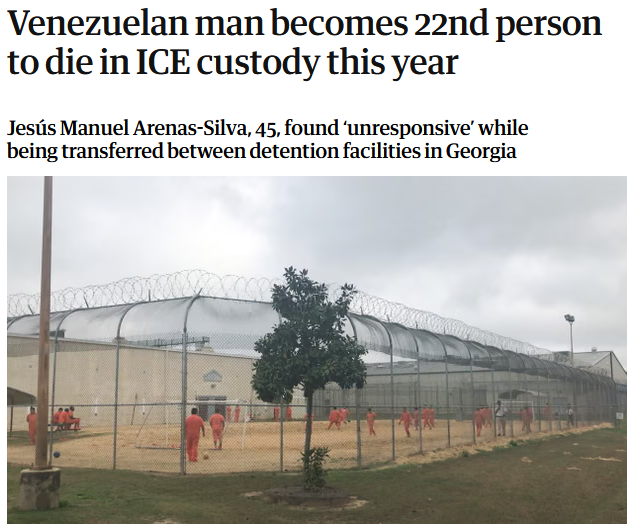
Guardian (7/15/26)
Janine Jackson: In addition to the visible, horrific murders in the streets by ICE agents, at least 52 people have died in Immigration and Customs Enforcement custody in the US, between Trump’s inauguration last January and June 4 of this year. Reasons include unsanitary facilities, inadequate food, substandard health infrastructure and delayed—which is to say, denied—medical care.
That would include Jesús Manuel Arenas-Silva, a Venezuelan man who died while being transferred between detention facilities in Georgia. ICE says it was cardiac arrest. His family says ICE refused to allow him to take medications with him when they snatched him up.
The people subjected to these lethal conditions have not all been charged, much less convicted, with any crime. But corporate news media are hard at work suggesting to us that somehow, for some reason, we shouldn’t seriously value their lives. And we shouldn’t seriously question their killings. And we should get ready for more.
A whole lot of people are not accepting that. And some of them gathered outside the ICE Prairieland Detention Center in Alvarado, Texas, last year to say “no,” and to show solidarity with the people detained, with a noise demonstration.
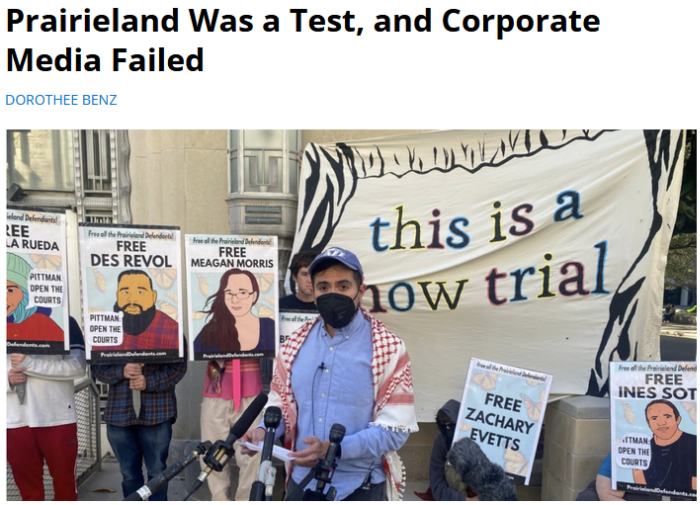
When one protester saw a police officer pulling his weapon, he fired his own rifle, wounding an officer. That man, Benjamin Song, has now been sentenced to 100 years in prison. And he was asked in court if he would deny being part of Antifa. According to NPR North Texas, Benjamin Song “defended anti-fascism as a belief.” “‘What kind of people are not against fascism?’ Song said.” Well, those eight defendants were sentenced to a combined 450 years in prison, including Daniel Sanchez Estrada, who wasn’t even there.
Prairieland is a test of this country’s aspirations toward democracy and, more immediately, a challenge to a press corps that insists that it is free. A new piece at FAIR.org looks at how the corporate press are meeting this moment. We’re joined now by its author.
Dorothee Benz is a social justice writer, organizer and an ordained minister dedicated to fighting white Christian nationalism. She joins us now by phone from Inwood. Welcome back to CounterSpin, Dorothee Benz.
Dorothee Benz: I’m delighted to be here.
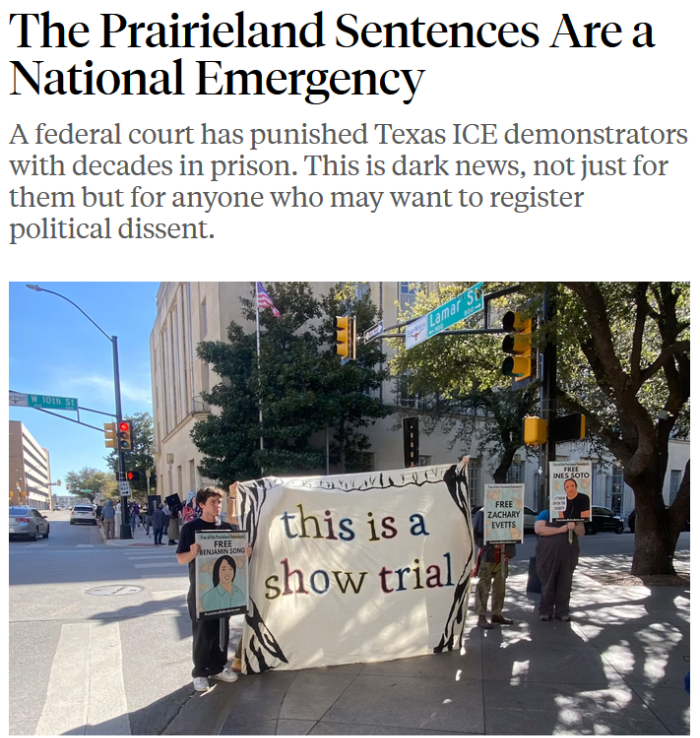
New Republic (6/25/26)
JJ: My planned first question was: I would hope that anyone paying attention could see how monumental this Prairieland case is—for free speech, for democratic participation, for fundamental human rights. Tell us what you found that the major media, that many of us still look to, what did that corporate media do with this case? And why does their emphasis, or their erasures, why does that matter?
DB: It actually took me quite a while of digging to figure out how bad the case was. I mean, the corporate coverage was so anemic and so missing a couple of really important points that I had to keep digging before I even understood the problem.
Because the case itself is deeply problematic. It’s built on a legal theory that relies on a made-up category that Antifa is a terrorist organization, and that people are guilty of material support of terrorism, that is not problematized in the media at all. And there were also tremendously significant procedural irregularities in the case that really made it pretty much a show trial in a lot of ways. And none of that is really apparent in the corporate coverage.
I would say that the corporate coverage came down to three big omissions. One is framing the issue at stake in the Prairieland trial as one of violence, and not protected First Amendment activity. All of the headlines and all of the leads were basically “violent protesters” and “part of an armed assault” and things like that, as opposed to a protected First Amendment right to protest, and a right to have political opinions. And therefore they missed the story, that what was being criminalized here is dissent and not terrorism.
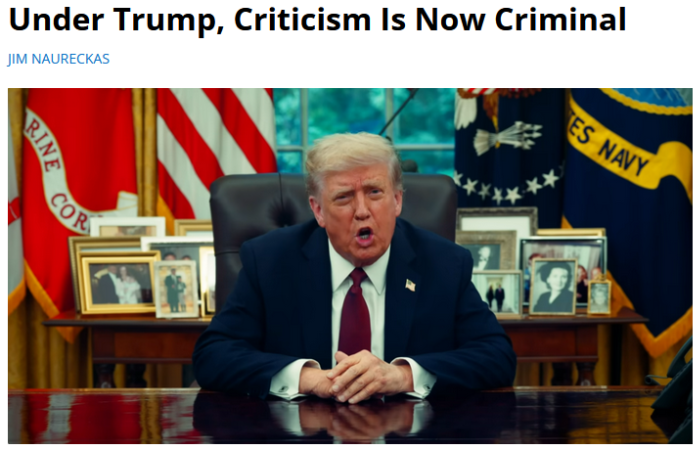
And then the second problem, really, and this is I think the deepest problem, was failing to understand and question the legal theory behind the case, which is built on the idea of “material support for terrorism,” whereby terrorism here is this made-up entity of Antifa.
And it’s one thing for Donald Trump to say Antifa is terrorist. It’s another thing for a judge to throw people in jail for decades on that same theory.
And then, lastly, I would say everything comes down to Antifa, understanding what Antifa is and isn’t, and how it is constructed for the purpose of criminalizing dissent. And the media missed that entirely.
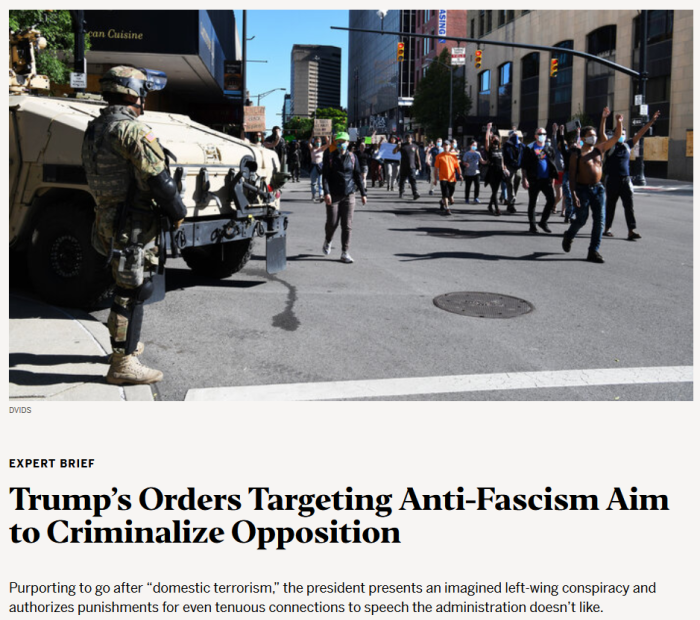
JJ: I just feel like we’re going to hear NSPM-7, and we can spell that out, but we’re going to hear it again and again invoked as if it was a real thing. And to me, I go back to when “war on terror” was taken out of quotation marks, because it used to be kind of a thing that like, what is this actually? And then, suddenly, media just said, “OK, it’s a thing.” And I’m concerned that this domestic terrorism definition is just going to be silently slid into the language that people are accepting that they hear. And it’s so dangerous.
Brennan Center (10/9/25)
DB: Absolutely. And I think Antifa is the symbol of that.
So all of the major news stories were quick to say Antifa is not a membership organization, which is kind of implied in the way Donald Trump talks about it. But then they went on to describe it as a “loose network” or an “ideology” or something like that. And none of them were able to say that it is a right-wing bogeyman that’s made up exactly for the purpose that it’s now being deployed to do, which is to take a whole bunch of people whose political opinions the right doesn’t like, lump them together, call them dangerous, call them violent, call them terrorist, and therefore make them vulnerable to these kinds of prosecutions. Nobody said that.
And they also attached the label “far left” to the name Antifa, as though being anti-fascist is somehow now beyond the pale. And in doing that, they inadvertently, I think, legitimize the government’s effort to take the First Amendment activities, to take political opinions that are anti-fascist, that are pro-democracy, that are pro-dissent, that are anti–ethnic cleansing, and make them suspect, and therefore make them vulnerable to prosecution in exactly this way.
JJ: And I wonder, why would not a press corps that is invested, presumably, in presenting a range of disparate views, how would you not see that as an alarm? How would you not be alarmed by, and get to work fighting, a declaration that says we’re going to call particular viewpoints “terrorism,” and we’re going to treat them like crimes? To me, that’s where a press corps would leap up. And that’s not what we’re seeing.
DB: No, it’s not. And I think it starts with the press being, I’ll just say “intimidated,” I don’t know if that’s really the right verb, by the call “terrorism.” Whenever the government shouts “terrorism,” rather than stick their necks out and maybe invite some backlash, they’re going to just take that pretty much at face value, and then sort of nibble around the edges, but not contest the central claim of it, right?
Because the central claim here was A) that Antifa exists, right, as opposed to being this entity that’s made up for the purpose of criminalizing dissent. And then B) that people who wear all-black clothing—as those of us in New York do every day—read anarchist books, have left-wing literature in their homes, that that makes them part of Antifa, which then in the equation means it must be violent, and therefore it must be terrorist. And that “terrorist” label just, I think, spooks the press, and then they back down. And that is not a good sign.
JJ: I think it spooks people, too. I think once you put that label “terrorist,” something shuts down, and somehow ‘under the jail’ isn’t bad enough. And I think interrogating that whole language has got to be part of what we’re doing.
And I guess that leads me to my question of what do you think a vital, independent, engaged, humanist, critical press corps would be doing right now? What would we be doing? Folks are in the streets, folks are working, but we could have media that support that work. And what do you think that kind of press corps would look like?
In These Times (3/26/26)
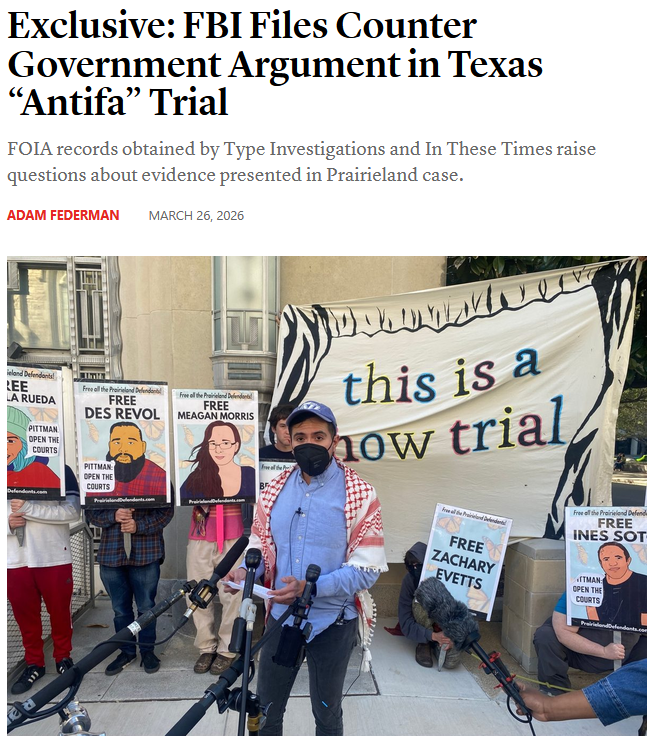
DB: Well, at first I think it would look like accurate and 360-degree reporting. So much of the work that I did in writing this piece was actually in finding out what the case itself was. Usually when I write a piece for FAIR, you can see what the facts of the case are, and then you can see the corporate spin on it. This was like, I had to dig well beyond corporate sources to even understand what the case was. And the more I dug, the more appalling it looked. So things that the Intercept or In These Times or other independent outlets reported are perfectly capable—like, the New York Times could report the same things. So these things just need to be reported.
And then, secondly, I would say corporate media, any media, needs to unpack terms and claims that are left intact and create a bias. In this case, the idea of “material support for terrorism.” There’s a whole body of law around “material support.” But no one ever explained that term, let alone that applying it to this idea of Antifa was creating an entire legal fiction on which people were then convicted.
That sentence that I just said is nowhere in the press. And that’s really the alarm bell that should have gone off. Police lie. Police lie all the time. And reporting “he said, she said,”—if that; there wasn’t a lot of the “she said” in these stories, even—is not the same as saying, “This is not true. This is a novel legal theory that is dangerous and is not based in existing law at all.”
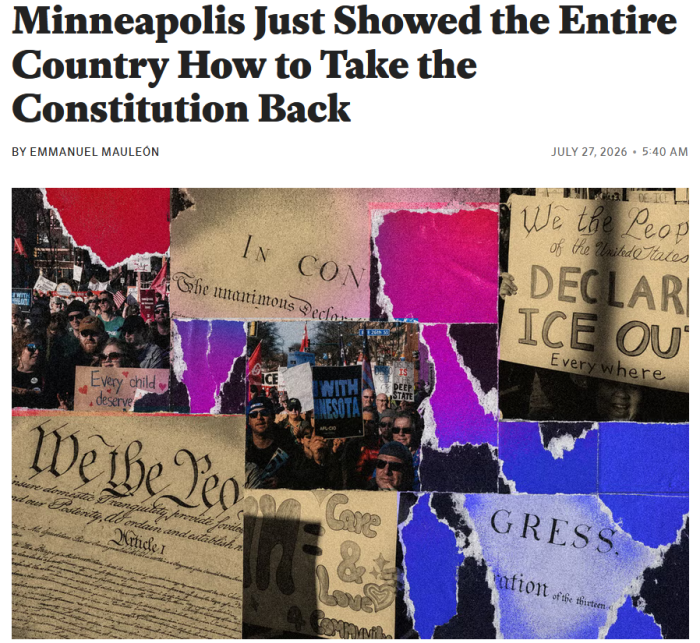
Pretending that these kinds of show trials and show prosecutions—Prairieland is one thing, but the folks that were just arrested in Minneapolis, the folks that were arrested in Ohio, this is not the first or the last. Pretending that these are something other than political prosecution is not serving us well.
And I’ll say that, in many ways, our elite institutions, in the last year and a half, have really failed us. The law firms that caved to the demands of the administration, the universities that caved—let’s not even talk about the Democratic Party, the corporate media. While ordinary and often extremely vulnerable people, who don’t have the resources or the lawyers that any of these institutions have, have stood up with incredible integrity and courage to challenge human rights violations and to challenge the narratives propping them up.
Slate (7/27/26)
We need our media to do the same thing, to defend the right to dissent along the way. Whether it was the student encampments or the detainees at Delaney Hall and their incredibly courageous hunger strike and labor strike, and the protesters outside. Everybody in Minneapolis. If 70-year-old Lutheran church ladies can be in the streets challenging ICE, then certainly corporate media can get it together to deconstruct these novel legal theories that are being used to criminalize dissent.
JJ: I’m going to bring you back to ways forward in just a second, but I’ll just hold you on media for a minute. I think a lot of the time, media criticism gets, maybe not bogged down, but misdirected by individual personalities: “Well, this person said this, but do they really believe it?” Or even by meta concerns: “Should we be consuming media at all? Why don’t we just touch grass?” But pretending that news media don’t shape our ideas and our understanding, not least our understanding of our political capacity, seems to me like whistling past the graveyard.
I remember a person from Radio for Peace International saying that people told him that if he didn’t like what was on the radio, he should just turn it off. And he said, “OK, I’ll turn it off. But my neighbor might not turn it off. And the radio might tell him to go kill the leftist next door.”
I believe in media hygiene; I don’t think we should soak ourselves in it. But I don’t think we can ignore journalism, and just pretend that it doesn’t affect us. So there has to be a way to integrate our media criticism into the other social justice work that we do.
DB: Absolutely. I mean, media literacy is important. Media criticism of corporate media, and understanding their interests and their structural location in the larger story of who this country is, is important, and holding them to account. And it’s not like everything that they do is always terrible, but their structural biases are, at this moment, really extremely dangerous.
JJ: Yeah, to gird ourselves against. And that’s just part of the work that we’re going to need to do if we plan to stay alive and fight.
Going forward, these are difficult and dark times. You are a hopeful person. And I just wonder, what do you say to folks who just want to lay down and pull up the covers, right? There’s a lot to do, and there’s a lot of reasons to do it.
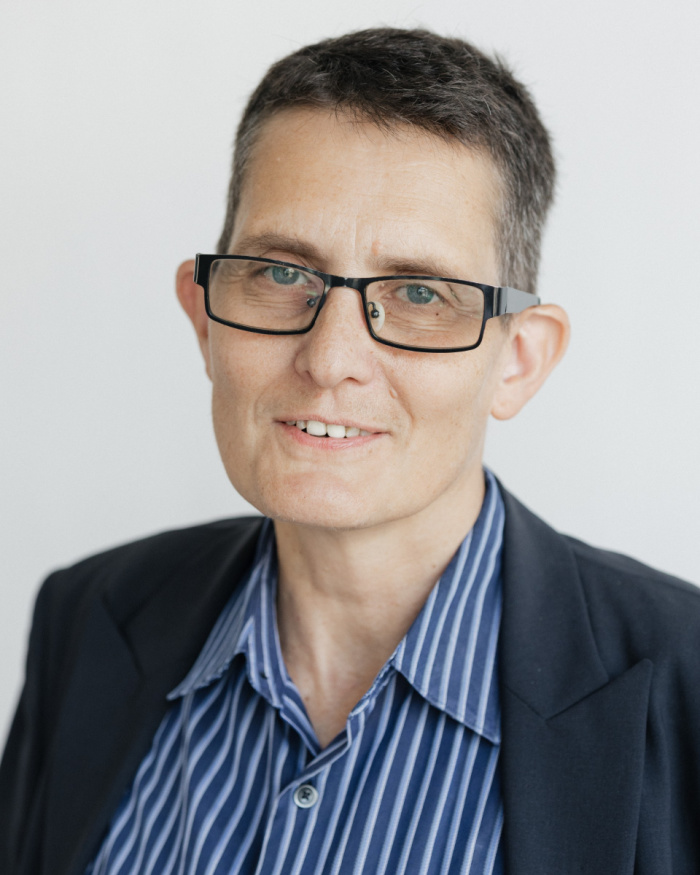
Dorothee Benz: “It’s up to us to connect with our neighbors, and build something collective that together, on scale, will change the world.”
DB: Yeah. Well, I certainly understand wanting to just pull the covers over my head. There’s a lot of days that start like that for me as well.
But I would say a couple things. One, what came to mind, as I was thinking about this conversation today, was Howard Zinn’s “You can’t be neutral on a moving train.” And I was thinking about it in the context of challenging the media to abandon their faux objectivity. The idea that there is such a thing as objectivity. That somehow reporting this trial as though it was something other than a sham is somehow doing a service to objective journalism. I was thinking of it in that context, but it really is in the context of what we’re all called to do every day. You’re on this train, and you’re either fighting fascism or you’re abetting it. So that’s the one thing I would say about that. Maybe that’s not too hopeful.
But the other thing is that we know that ordinary people can do extraordinary things, and that when we do them together collectively, the power of nonviolent noncooperation on scale has literally failed empires. It sent the British packing in India. It brought down the Berlin Wall. It ended apartheid in South Africa. We know we have that power. And it’s not up to any of us to bring down the Berlin Wall by ourselves, but it’s up to us to connect with our neighbors, and build something collective that together, on scale, will change the world.
JJ: That’s a beautiful place to end on. We’ve been speaking with Dorothee Benz. Her piece, “Prairieland Was a Test, and Corporate Media Failed,” is up right now at FAIR.org. Thank you so much, Dorothee Benz, for joining us this week on CounterSpin.
DB: Oh, my pleasure.
From FAIR via This RSS Feed.