

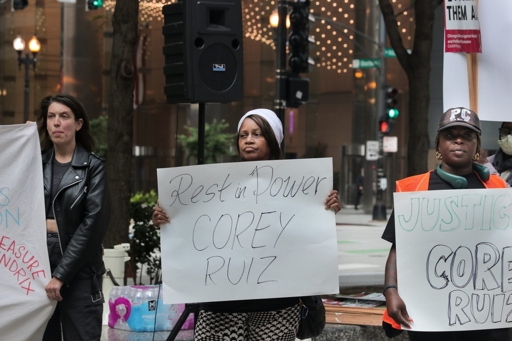

Protesters gather in Federal Plaza on July 28. Photo: Zoë Takaki
A small group of activists, community members and press gathered in Chicago’s Federal Plaza on Tuesday evening for a vigil honoring 38-year-old police shooting victim Corey Ruiz. A police officer in the Wisconsin capital of Madison—only a few hours northwest of Chicago—shot and killed Ruiz, a Black man, on Wednesday, July 22, after a chase and struggle that ended with police pulling him to the concrete.
The Chicago vigil featured speakers from multiple social justice and anti-police violence groups. As the sun hung low in the sky, they alternately mourned Ruiz, demanded justice for his killing and expressed support for impacted community members in Madison.
“We are standing in solidarity, demanding that those officers be fired,” Jasmine Smith, an organizer with the Chicago Alliance against Racist and Political Repression, told the crowd.
The gathering in Chicago was not the first of its kind. Since last week, hundreds of people in Madison have taken to the streets, establishing a memorial at the site of his killing and occupying an outdoor concert outside the Wisconsin capitol building in protest. In an act of solidarity across state lines, activists from Minneapolis, Minnesota transported the iconic raised Black fist from George Floyd square to Madison. The original street sign at the site of Ruiz’s killing now reads “Corey Street,” and community members have transformed the area around the intersection into an impromptu community hub.
A post shared by Humanizing Through Story (@humanizingthroughstory)
Ruiz’s family also voiced their grief during a press conference last Friday.
“They took my baby from me,” Corey Ruiz’s mother Elsa Ruiz told reporters with tears in her eyes. “I never thought I would have to bury my baby before he buried me.”
Per multiple videos available online [content warning: graphic police violence], four police officers wrestled with Ruiz at the intersection of Baldwin and Williamson Streets in central Madison after he fell off or was thrown from his bicycle. After cops deployed a taser and pulled Ruiz to the ground, one officer stepped forward and shot him at point blank range. Three shots can be heard in the videos—followed by the scream of a nearby witness.
According to the Madison Police Department (MPD), police initially chased and grappled with Ruiz because they suspected he was “stealing bicycles and checking vehicle doors” in the city’s Marquette neighborhood.
“He was executed based on speculation,” civil rights attorney Ben Crump said while standing next to Elsa Ruiz during the Friday press conference.
“They not only tackled him, not only tased him, not only kicked him, but then you saw they shot him three times… that is an execution,” Crump added.
Ruiz had multiple interactions with the criminal legal system in Wisconsin’s Dane County going back to 2007. But vigil attendees in Chicago, as well as community members and elected officials in Madison, stressed this in no way justified his death at the hands of police.
“There’s no justification to murder him… no matter what background he had, no matter what pleas he took from his criminal history or anything,” Smith said Tuesday. “That was somebody’s father. That was somebody’s son, that was somebody’s brother, that was somebody’s uncle.”
Speakers at the Chicago vigil also noted the link between Ruiz’s death at the hands of armed police and other forms of racialized, normalized state violence across the globe: how the ongoing occupation of Black and brown American communities by militarized local cops and federal immigration agents is linked to U.S. imperialism abroad and mirrored in the injustices enacted by Israel against Palestinians.
“It is a sad fact that this act of violence is nothing new,” an organizer named Chanel, with the Anti-War Committee Chicago, said of Ruiz’s killing. “It is a tactic in… a colonial system, and a systemic tactic that is working exactly as intended.”

Activists hold up a banner scrawled with the names of victims of police violence. Photo: Zoë Takaki
Madison Police Chief John Patterson said last Thursday that Ruiz initially fled from police, and during the subsequent struggle, produced a knife. Patterson said the officer who fatally shot Ruiz was injured by that knife, but had few details to offer on the alleged injuries. The office of Wisconsin Attorney General Josh Kaul said in a separate statement that two officers were injured while subduing Ruiz, but that both were treated at a local hospital and subsequently released.
In the videos of the shooting circulating online, the allegedly injured officer who shot Ruiz can be seen standing up and walking away seconds after firing his gun.
MPD further said last week that all officers involved in the shooting will be placed on administrative leave, which per department policy, includes pay. The Wisconsin Department of Justice, Division of Criminal Investigation “is now fully in charge” of investigating the shooting as a homicide, Patterson said. He added it would be the Division of Criminal Investigation that would identify the officer who fatally shot Ruiz. As of Tuesday afternoon, it had not yet done so.
Ruiz is not the first person that Madison police have shot and killed in recent years.
In March 2015, only about a block and a half west on Williamson Street from where police shot Ruiz, Officer Matthew Kenny fatally shot [content warning: graphic police violence] 19-year-old Tony Robinson. In November 2012, only about a block and half south on Baldwin Street from the site of Ruiz’s killing, Officer Stephen Heimsness fatally shot 30-year-old musician Paul Heenan. Neither Kenny nor Heimsness suffered criminal penalties for the shootings, and between 2015 and 2017, Madison paid over $5.6 million to settle lawsuits around Heenan’s and Robinson’s deaths.
Heimsness resigned from the Madison police force in 2013. A representative of the Madison Police Department told Unraveled that Kenny was still employed with the department, though not in a public facing role. Instead he is involved with training and teaches on topics like “wellness and first aid,” the MPD representative said. The city’s website also lists Kenny as a police “peer support officer.”
Robinson, Heenan and now Ruiz are among the thousands of people that have been killed by U.S. police forces. The Washington Post concluded at the end of December 2024 that U.S. police had shot and killed over 10,400 people since the start of 2015. The Police Data Archive, an independent research nonprofit which has tracked U.S. police killings back to 2013, found the number is even higher: over 1,000 people killed by police every year between 2013 and 2025.
Smith and other speakers at the vigil in Chicago concluded their remarks with a call to action, telling attendees to get involved and stay involved with efforts to hold police accountable and fight for a more equitable future.
“We out here, and we ain’t gonna stop until we get our full liberation,” Smith said.
From Unraveled via This RSS Feed.