

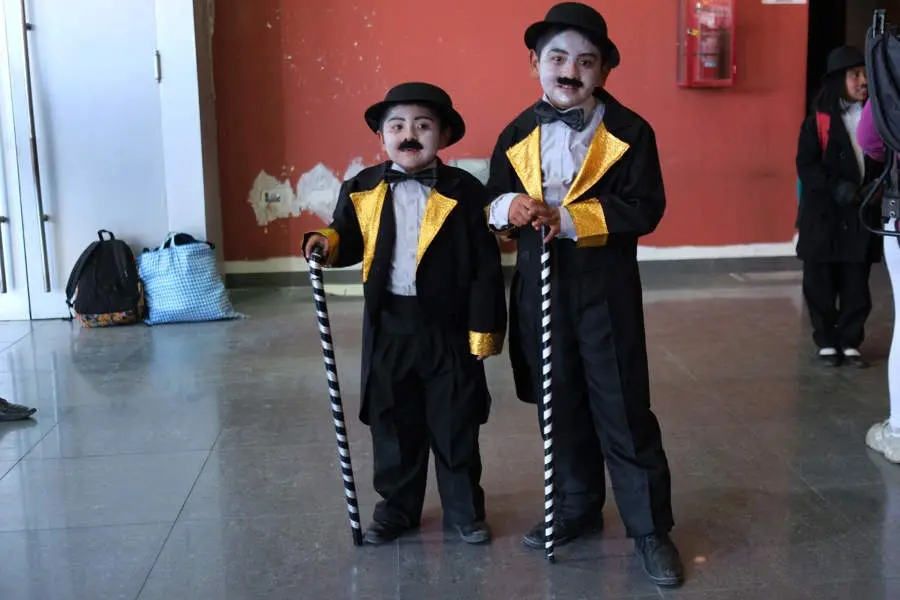
Children dressed as Chaplin pay tribute to the largest audiovisual archive in this Andean country.
On Tuesday, the Bolivian Film Archive marked its 50th anniversary with a colorful tribute that brought together dozens of children and adolescents dressed as Charlot, the iconic character created by Charlie Chaplin.
RELATED:
Bolivia Declares Disaster as Tarija Wildfires Spread
The event was held at the institution’s headquarters in La Paz and formed part of a broader program honoring the archive’s half-century of work preserving the country’s audiovisual memory.
With bowler hats, tailored suits, canes, umbrellas, and the unmistakable painted mustache, the young participants arrived with parents and teachers to join an homage that mixed cinema, theater, and education. Inside the archive’s screening rooms, a small theatrical performance introduced the tribute to Chaplin, followed by screenings of several of his short films, while each child received a piece of chocolate wrapped in a commemorative image celebrating Bolivian cinema.
The initiative sought to honor the symbol of Chaplin as a figure of cinema while also recognizing the people who helped build and sustain the archive over five decades. Cultural journalist Mabel Franco said the tribute also remembered key promoters of the institution, including critic and filmmaker Pedro Susz, priest Renzo Cotta, cultural organizer Amalia de Gallardo, former La Paz mayor Mario Mercado, and Argentine actress Norma Merlo.
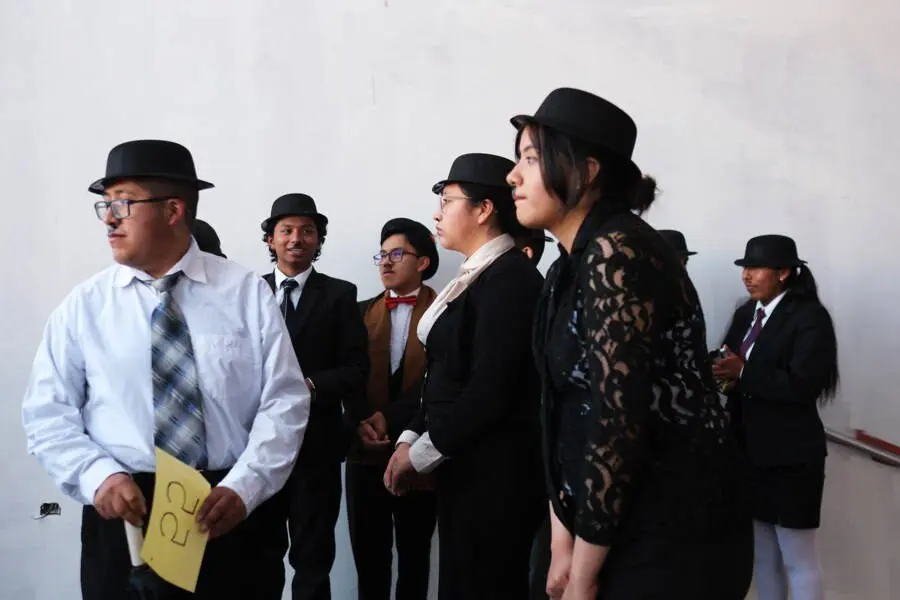
Franco recalled that Merlo used to dress as Chaplin to raise awareness in the streets about the need for a film law in Bolivia and later to help gather support for a permanent headquarters for the Bolivian Film Archive. That effort, she noted, was part of a broader campaign to defend the country’s cinematic heritage at a time when preservation was still a difficult and underfunded task.
The Bolivian Film Archive was founded in July 1976 and initially operated in a space inside the House of Culture in La Paz. It later moved in 1978 to a small property belonging to the Society of Jesus before finally opening its own building in 2007. Recognized by the state as the National Archive of Moving Images in June 1978, the institution today operates through a trustees’ council, a board of directors, and an executive office.
Alfonso Gumucio, president of the board of the Bolivian Film Archive Foundation, described the 50th anniversary as “a very important milestone” and said the institution has made major progress in reorganizing and cataloguing its holdings. Under the executive direction of filmmaker Mela Márquez, the archive now preserves around 8,000 reels of Bolivian films and another 33,000 reels of international cinema, making it one of the most significant repositories in the region.
Gumucio emphasized that part of the archive’s “magnificent” collection includes nitrate film, a highly flammable material that must be stored in a special vault. Among the treasures safeguarded by the Bolivian Film Archive is a copy of The Gold Rush, one of Chaplin’s most celebrated films. He said the archive is more than a storage site: it is a repository of national memory and a guardian of identity, history, and collective heritage.
The anniversary program will continue through the end of the year with exhibitions, talks, film cycles, tributes, a symphonic concert, and a major presence at the 30th La Paz International Book Fair, which opens this week.
For supporters of the Bolivian Film Archive, the celebration is not only a look back at the past but also a reaffirmation of the role archives play in protecting the cultural memory of a nation and keeping its film history alive for future generations.
From teleSUR English via This RSS Feed.