

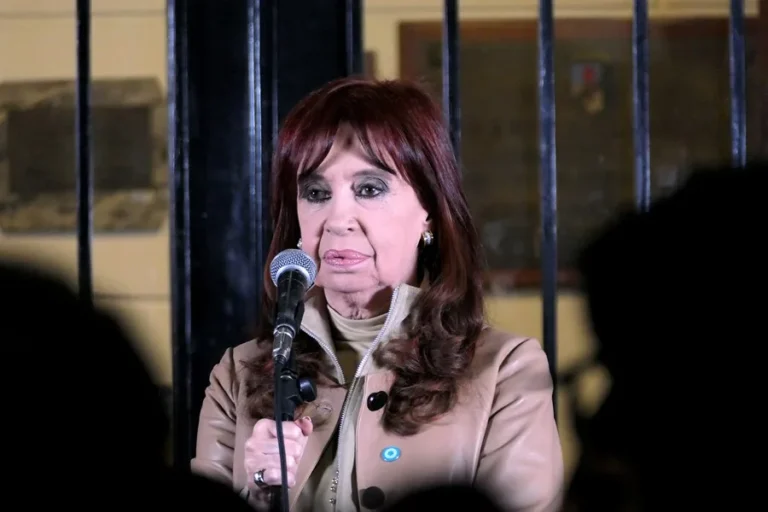
Cristina Kirchner UN complaint challenges her Vialidad conviction, raising due process, judicial independence, and political rights concerns in Argentina.
Related: Brazil Calls Its Ambassador in Argentina for Consultations After Milei Offenses
Cristina Kirchner UN Complaint and Argentina’s Legal Battle
Cristina Kirchner UN complaint has opened a new front in Argentina’s long-running battle over judicial independence, political rights, and the future of the former president’s conviction in the Vialidad corruption case. After exhausting domestic appeals, Cristina Fernández de Kirchner has taken her case to the UN Human Rights Committee, arguing that her trial violated due process and was shaped by political persecution.
The move marks a significant escalation in one of the most polarizing legal and political disputes in Latin America. Cristina Kirchner UN complaint now places Argentina’s judiciary under international scrutiny, while also reviving regional debates over lawfare, selective prosecution, and the boundaries between justice and politics.
What the UN complaint says
The complaint was filed as an individual communication before the UN Human Rights Committee, the body that monitors compliance with the International Covenant on Civil and Political Rights. Under the Optional Protocol, individuals who have exhausted domestic remedies may ask the committee to review alleged violations of rights protected by the covenant.
In this case, the former president argues that her conviction in the Vialidad case was the product of politicized justice, unequal treatment, and procedural irregularities. Her defense says the proceedings violated guarantees of impartiality, the right to defense, and the right to be tried fairly before an independent court.
According to the legal team, the complaint is aimed at challenging not only the six-year prison sentence, but also the permanent ban on holding public office. That disqualification is one of the most politically significant elements of the case because it bars her from future electoral participation.
Her lawyers say the international filing becomes possible only because local avenues have been exhausted. That procedural requirement is essential under the UN system, which generally allows individuals to submit complaints only after domestic remedies have been used.
The committee will first examine whether the case is admissible. If it is registered, the Argentine state will be asked to present formal observations before the committee later decides whether the complaint has merit.
Why the case matters in Argentina
The Cristina Kirchner UN complaint is not just about a legal sentence. It is also about the political meaning of a case that has shaped Argentina’s public life for years and remains deeply divisive across the country.
Cristina’s defense says the trial was influenced by bias among judges and prosecutors, including alleged ties to opposition sectors and business interests. They also argue that new accusatory evidence was introduced too late in the process, weakening her ability to defend herself properly.
The former president is currently serving house arrest with an electronic ankle monitor and strict limits on visits, after the court accepted her request to serve the sentence outside prison. Her lawyers say those conditions are unnecessarily harsh and amount to degrading treatment.
She has also denounced the restrictions on her movements and communications, arguing that they violate her fundamental rights. The defense says the combination of house arrest, the ankle monitor, and limits on visitors shows that the punishment is not only criminal, but also political in nature.
Her public statement, titled “The democratic cost of the politicization of justice,” frames the case as part of a broader pattern in which courts are used to weaken progressive leaders. That argument has become a recurring theme in Latin American political debates, especially in cases involving former presidents or popular leaders.
Related developments
The issue has recently been reinforced by another judicial setback for Kirchner: Argentina’s Supreme Court has upheld asset seizures linked to the Vialidad case, including a confiscation order that has generated wide controversy. That decision has added financial pressure to the political consequences already imposed by the conviction.
At the same time, her legal team says it is preparing to use the UN process to highlight the broader implications of the case for due process, judicial independence, and political rights. The lawyers are expected to present their arguments publicly as they seek to internationalize the dispute.
Carta Abierta: El costo democrático de la politización de la justicia.https://t.co/TlXxHOAgqr
— Cristina Kirchner (@CFKArgentina) July 29, 2026
Regional context and lawfare debate
The Cristina Kirchner UN complaint also resonates well beyond Argentina because it touches on one of the most disputed legal concepts in Latin America today: lawfare. Supporters of Cristina and other progressive leaders say courts are often used to target political adversaries under the appearance of legality.
The comparison with Lula da Silva’s Lava Jato case in Brazil is especially significant. Lula’s defense team, including Brazilian jurist Rafael Valim, has also worked on international legal strategies before human-rights bodies. That parallel has strengthened the argument that judicial systems in the region can be used selectively against political leaders.
This does not mean every corruption case is political. But it does mean that in highly polarized systems, courts can become arenas where institutional legitimacy, media narratives, and electoral power collide. That is why the UN filing matters: it moves the dispute from national tribunals to an international human-rights framework.
For Argentina, the case arrives at a moment when public trust in institutions is already strained. For the region, it reinforces the debate over whether judicial accountability can coexist with political neutrality in systems where courts are often accused of serving elites.
What happens next
If the Human Rights Committee accepts the filing, Argentina will need to respond formally to the allegations. The committee’s conclusions are not legally binding, but they carry political and moral weight and can influence international opinion.
A favorable ruling for Kirchner would not automatically reverse her conviction. However, it could strengthen her argument that her rights were violated and that the case undermined her political participation. It could also increase pressure on the Argentine state to review aspects of the trial and the penalties imposed.
Even if the case is rejected on admissibility grounds, the filing itself is already significant. It signals that Cristina and her lawyers intend to pursue every available international mechanism to challenge the legitimacy of the verdict.
Geopolitical context
The Cristina Kirchner UN complaint comes at a time when Latin American politics are increasingly shaped by battles over judicial power, electoral exclusions, and the internationalization of domestic disputes. Courts are no longer just legal institutions; they are also political actors in the public imagination.
That is why the case matters outside Argentina. It will likely be watched closely by governments, legal scholars, and human-rights organizations across the region, especially in countries where corruption cases overlap with political polarization. The outcome may not change the sentence immediately, but it could influence how future cases are framed, defended, and judged.
Corte Suprema argentina asesta un nuevo revés a Cristina Kirchner
En una nuevo episodio de la persecución judicial contra la expresidenta argentina, Cristina Fernandez, la Corte Suprema de Justicia del país suramericano ordenó el decomiso de sus bienes. pic.twitter.com/FTEmeKovkt
— teleSUR TV (@teleSURtv) July 3, 2026
From teleSUR English via This RSS Feed.