

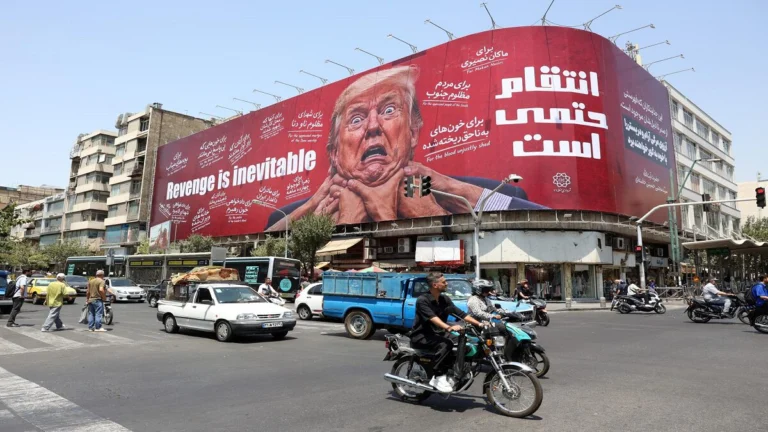
Iran retaliatory attack targeted a U.S. air base in Jordan, escalating regional tensions as Washington says missiles were intercepted.
Related: Iran Hormuz Ban Over Frozen Asset Payments
Iran Retaliatory Attack Against U.S. Base in Jordan
Iran retaliatory attack has intensified tensions in the Middle East after the Islamic Revolutionary Guard Corps said it launched ballistic missiles at a U.S. air base and command center in Jordan. Tehran described the strike as a response to American “aggressive actions,” while Washington said the missiles were intercepted.
The incident adds another layer to an already volatile confrontation between the two countries. Iran retaliatory attack is now part of a broader cycle of strikes, counterstrikes, and diplomatic warnings that has raised fears of wider regional escalation.
Iran retaliatory attack and the Jordan strike
In its statement, the IRGC said that “brave warriors” from its aerospace force had attacked the U.S. base in Jordan with several ballistic missiles. The message framed the operation as retaliation for what Tehran called the “massacre of children” and other unlawful actions by U.S. forces.
The strike was directed at a base and a command center in Jordan, placing the kingdom once again at the center of the regional conflict. Iran retaliatory attack follows a series of previous confrontations involving U.S. forces and Iranian-aligned groups across the Middle East.
U.S. Central Command said Iran launched what it called a “surprise attack” on U.S. military positions in the region, but that all incoming missiles were intercepted. At the time of the latest reports, Washington had not confirmed damage or casualties from this specific episode.
This was not the first time Jordan was pulled into the confrontation. Earlier rounds of attacks had already targeted U.S.-linked positions in the region, and Jordanian air defenses had intercepted missiles launched from Iranian territory. The repetition of these incidents has made the kingdom a strategic flashpoint.
The Iranian statement also warned that if threats against the Islamic Republic continue, “resistance will continue.” That language shows that Iran retaliatory attack was not presented as a one-off response, but as part of an open-ended message aimed at Washington and its allies.
Washington, negotiations, and regional escalation
The latest strike came after a period of heightened tension in which the United States and its allies had already exchanged attacks with Iran-linked forces. The move followed earlier U.S. strikes and occurred as negotiations were still unfolding, though the diplomatic process has repeatedly been interrupted by military escalation.
According to recent reports, the conflict has already led to multiple rounds of U.S. strikes on Iranian targets, Iranian missile launches at American bases, and retaliatory operations affecting Jordan, Kuwait, Bahrain, and other locations in the Gulf. Iran retaliatory attack is therefore part of a regional pattern rather than an isolated event.
The article also recalls that U.S. and Saudi forces had previously struck groups aligned with Iran in Iraq, following dozens of drone attacks attributed to the IRGC. That broader military campaign is one reason the region remains on edge.
International concern has grown because repeated attacks on bases, shipping lanes, and energy infrastructure could spill into global markets. The Strait of Hormuz remains one of the world’s most important transit corridors, and any serious disruption would affect oil prices, trade routes, and regional security.
The article highlights that Tehran has repeatedly framed its actions as a response to American aggression, while Washington presents its operations as defensive or preventive. That clash of narratives is central to understanding Iran retaliatory attack and the risks it carries.
Geopolitical context
Iran retaliatory attack matters well beyond Jordan because it sits inside a larger contest over power, deterrence, and influence in the Middle East. Every new strike makes it harder to return to diplomacy, especially when both sides view military pressure as a way to strengthen their bargaining position.
The conflict also draws in allies and partners across the region, including Jordan, Saudi Arabia, Kuwait, and Bahrain, all of which face the risk of being used as arenas for proxy confrontation. For the international system, Iran retaliatory attack is another reminder that the Middle East remains one of the world’s most fragile security theaters.
All Iranian missiles were successfully intercepted?
This is laundry fire? pic.twitter.com/rMLA6nc4xL
— Nemat Shaikh (@NematShaikh9) July 28, 2026
From teleSUR English via This RSS Feed.