

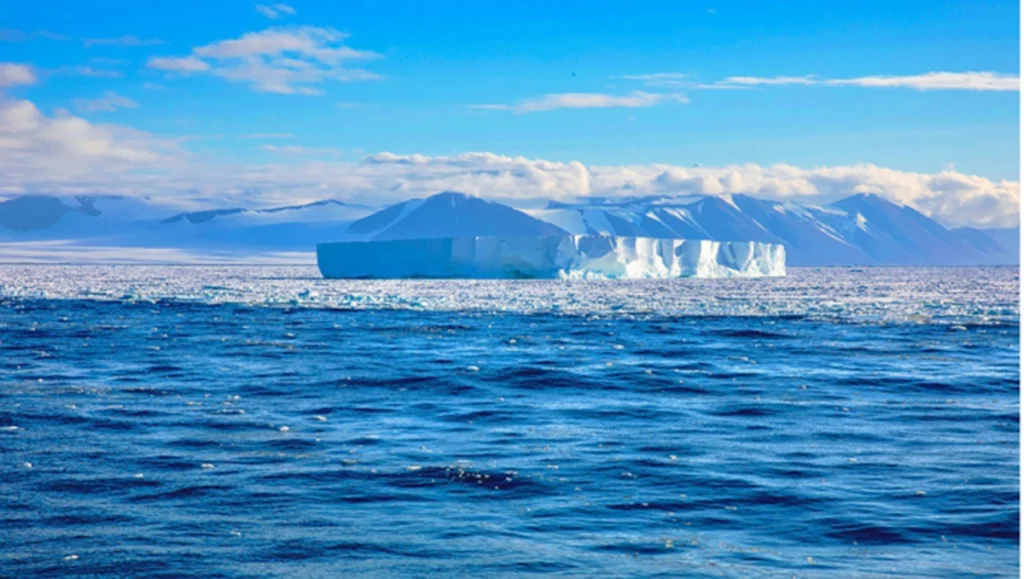
Chinese researchers link sharp increase to glacier melt and erosion driven by climate change.
On Monday, the journal Proceedings of the National Academy of Sciences (PNAS) published a study showing that the rate of mercury accumulation in the Antarctic Peninsula has increased by 160% since the Industrial Revolution, turning the region into a hotspot for this type of pollution. The increase is attributed to ice melt caused by climate change.
RELATED:
Extinction of Indigenous Languages and Climate Change Threaten the Amazon
Chinese scientists reconstructed the dynamics of mercury in the Antarctic Peninsula and its surrounding marine environment over the past 200 years using geochemical and isotopic records from 16 sediment cores collected at different locations across the region.
The analysis revealed that the continental shelf surrounding the Antarctic Peninsula is accumulating mercury at an increasing rate of about 93 additional micrograms per square meter per year despite its remote location.
The observed rate is approximately twice the average mercury accumulation rate measured on other continental shelves.
Antarctica’s Collapse May Have Already Begun
Antarctica is melting and one of its largest glaciers is collapsing from underneath. Thwaites could trigger a wider collapse of the full West Antarctic ice sheet, raising sea levels by 5 meters.
Credit: Russell Arnott ― New Scientist pic.twitter.com/MvnEkBZSWC
— David Ullrich (@DavidUllrich202) June 4, 2026
Causes of the Ice Melt
The PNAS study attributes the increase in mercury in Antarctica to two mechanisms. The primary one is the melting of ice and the resulting erosion affecting the peninsula because of global warming.
Historically, Antarctica’s vast ice reserves have served as a massive reservoir, storing large amounts of mercury deposited on land from the atmosphere. That mercury originates from both natural geological sources and industrial emissions caused by pollution.
As temperatures rise and glaciers retreat at an accelerated pace, this mercury, which had remained trapped for a long time, is being released into the environment through meltwater runoff and surface erosion.
The rate of mercury release associated with ice melt and erosion in Antarctica has increased by 550% since the Industrial Revolution. In addition, once the ice melts and releases mercury into the ocean, not all of the contaminant remains buried underwater. A significant portion is re-emitted into the atmosphere through the exchange of gases between the sea and the air.
Over the past 200 years, these mercury evaporation flows from the sea into the atmosphere have increased by 350%, driven jointly by ice melt and atmospheric deposition. The findings of the PNAS study underscore the need to consider ice melt as a key factor in the management of global pollutants.
teleSUR/ JF
Sources: EFE – PNAS
From teleSUR English via This RSS Feed.