

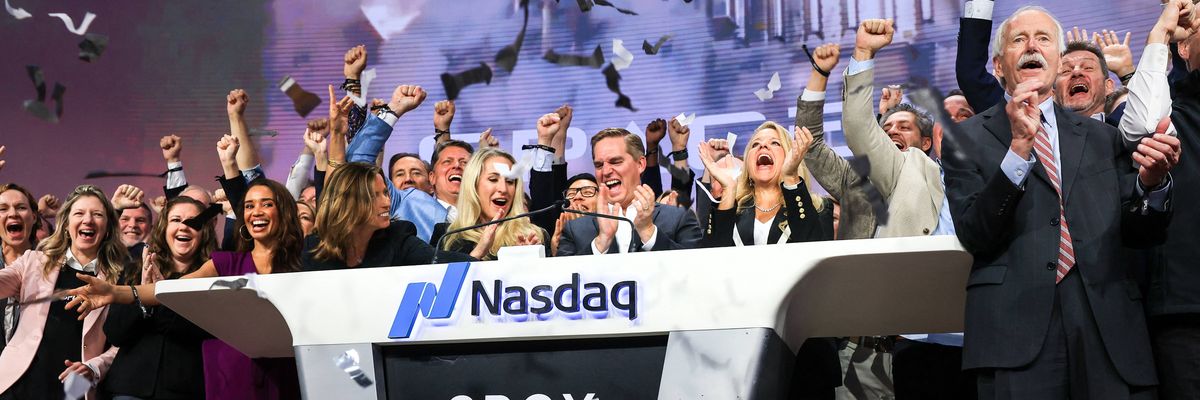
Congressional lawmakers from both major parties who have purchased stock in Elon Musk’s SpaceX—including some serving on committees whose work intersects with the company’s business—are facing increasing scrutiny over potential conflicts of interest, CNBC reported Tuesday.
According to CNBC’s Luke Fountain and Justin Papp, six lawmakers—Reps. William Timmons (R-SC), John McGuire (R-Va.), Dan Meuser (R-Pa.), Gil Cisneros (D-Calif.), Jared Moskowitz (D-Fla.), and John James (R-Mich.)—or members of their immediate families bought between roughly $83,000 and $245,000 in SpaceX shares combined. All of the purchases occurred within six days of SpaceX’s June 12 initial public offering.
Although all of the purchases were legal and there is no evidence of insider trading, Fountain and Papp noted that “five of the lawmakers serve on committees whose work intersects with SpaceX’s defense, satellite, [artificial intelligence], federal contracting, or securities businesses.”
Responding to the report, Rep. Pramila Jayapal (D-Wash.) took to social media to call for a full ban on congressional stock trading.
Members of Congress are continuing to buy and sell stocks as if they’re on Wall Street.They’re not doing it for the interest of their constituents — it’s in the interest of their pockets.We need a FULL ban on congressional stock trading.
[image or embed]
— Congresswoman Pramila Jayapal (@jayapal.house.gov) July 28, 2026 at 1:00 PM
Last week, the House of Representatives passed the Stop Insider Trading Act in a bipartisan vote; however, the current legal framework is primarily based on preventing self-dealing and boosting disclosure, not a trading ban.
Last year, Jayapal introduced the bipartisan Restore Trust in Congress Act, and Krishnamoorthi (D-Ill.) revived the ETHICS Act, both of which would “prohibit members of Congress, their spouses, and dependent children from owning or trading individual stocks, securities, commodities, or futures.”
Monday’s disclosure comes as SpaceX is already facing intense scrutiny over its growing influence in Washington, DC. In 2023, environmental groups sued the Federal Aviation Administration over approvals allowing expanded Starship launches in South Texas, arguing the agency violated federal environmental law by failing to adequately assess impacts on nearby wildlife refuges and endangered species amid a string of failed launches in which rockets exploded.
Earlier this year, tribal and conservation groups filed a lawsuit aiming to stop the US Fish and Wildlife Service from handing over 715 acres of the Lower Rio Grande Valley National Wildlife Refuge in South Texas to SpaceX in exchange for 683 acres elsewhere.
While conservationists contend that SpaceX launches and explosions threaten wildlife and sensitive habitats, astronomers have warned that the company’s rapidly expanding Starlink satellite constellation is cluttering near-Earth orbit, degrading dark skies, and interfering with astronomical observations.
Critics have also raised concerns about Musk’s relationship with federal regulators, with questions repeatedly raised surrounding the independence of agencies responsible for overseeing SpaceX as the company seeks further launch approvals.
While Musk’s short-lived stint as the de facto head of the so-called Department of Government Efficiency ended last year, a mix of former employees from Musk companies SpaceX, Tesla, and xAI were granted access or assigned to at least 15 executive branch agencies during 2025, according to reporting by The Washington Post, The New York Times, NPR, Wired, and other outlets.
From Common Dreams via This RSS Feed.