

Six years after the Ahunan Pumped-Storage Hydropower Project began in Pakil, the promised renewable energy has brought environmental degradation, displacement, dwindling water sources, and threats to the residents’ livelihood.
PAKIL, Laguna — “There was life. There was peace. Now, it’s covered in patches. Some areas are yellow, others have turned brown, and some are already barren. It’s crying out for help.”
This is how Priscila ‘Ela’ Regalado, a Pakil native and a member of Mamamayang Nagmamahal sa Pakil (MaNaPak) described Mt. Ping-As after the Ahunan Power Inc.’s Pumped-Storage Hydropower Project started its construction in 2020.
Ahunan Power Plant is a proposed 1,400-megawatt pumped-storage hydropower facility within the boundaries of Pakil above the mountain range of Sierra Madre. It is a joint venture by the billionaire Enrique Razon’s Prime Metro Power Holdings Corp. and JBD Water Power Inc., claiming to provide clean and renewable hydroelectric power to the Luzon grid.
But at what cost?
Six years after the Ahunan Pumped-Storage Hydropower Project began in Pakil, the promised renewable energy has brought environmental degradation, displacement, dwindling water sources, and threats to the residents’ livelihood.
On June 27 to 28, an Environmental and Socio-Cultural Impact Mission (ESCIM) led by Agham – Advocates of Science and Technology for the People (National and Southern Tagalog Chapter), Kalikasan Timog Katagalugan, and partner organizations was conducted in Pakil to look into what the project has gradually taken away.
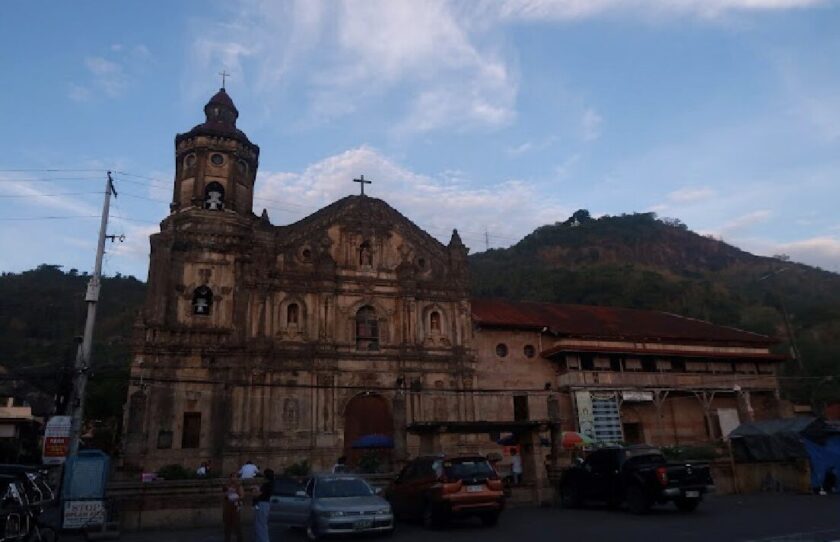
The view of Mt. Ping-as from Saint Peter of Alcantara Parish Church. Annually, devotees and pilgrims of the church hike Mt. Ping-as as part of the century-old tradition Ahunan sa Ping-as. (Photo by Shannia Cabuello/Bulatlat)
Not ‘ahunan’
Since the project started, residents have reportedly been asked to sell their own land in Mt. Ping-as area under the Republic Act No. 10752, also known as the Right-of-Way Act.
Mt. Ping-as is a sacred pilgrimage site known for its centuries-old-tradition called ‘Ahunan sa Ping-as’ and serves as a vital and natural irrigation of nearby agricultural lands.
Aida “Pasang” Ybardolaza, one of the residents who owns a property with significant size in the mountain, shared that she had no choice but to sell some of their land to pay for pending tax. Her family inherited the land from his late grandfather.
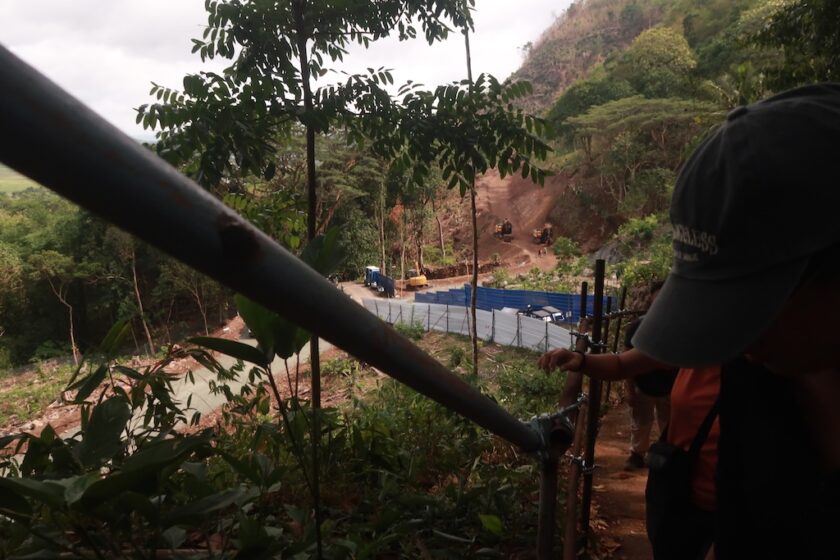
The foot of Mt. Ping-as where the Ahunan Power Plant construction site is located. (Photo by Shannia Cabuello/Bulatlat)
Similarly, Roberto Jimenez, a native and a member of Manapak, owns two lots and has been attending simultaneous hearings regarding proposals for land purchase. He recollected that his childhood years revolved around climbing the trees on the mountain.
They are only two of the residents who shared that their lands, holding years of life and culture, are being taken away from them. Most of them have no problem cooperating with the government as long as the project will only get what is needed.
“We have three lots (in the upper part of the land), they are taking it away. The size of the two lots is 6,000 square meters. The smallest is 2,000 square meters. Is that right of way? Imagine how big it is. That’s how they do it,” Regalado said in Filipino.
The Pakileños and environmental advocates have long been opposing the project due to its impacts on the environment, local livelihoods, communities’ way of living, and the culture of Pakil.
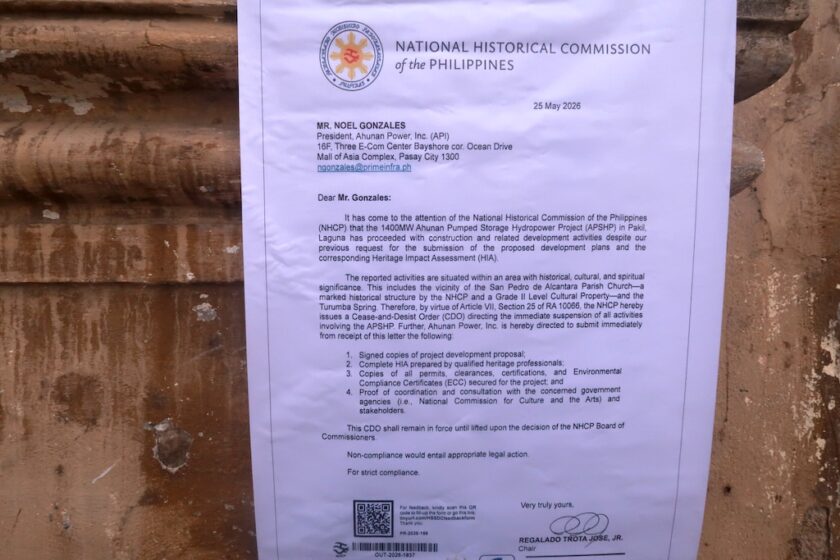
The National Historical Commission of the Philippines issued a cease-and-desist order on May 25, 2026. Before it was lifted on June 25, Mamamayang Nagmamahal sa Pakil (MANAPAK) posted it in front of the church during the silent protest. (Photo by Shannia Cabuello/Bulatlat)
More than its foreseen effects, residents shared in an interview with Bulatlat that the project has also consistently disregarded the community in the decision-making process.
“The Local Government Unit issued a ‘no objection’ (Certificate of No Objection for the Ahunan Powerplant). In 2022, a Facebook post surfaced stating that there is already a big pit above,” said a Pakil native Rosalia Naldo in Filipino.
They later found out that trees had been cut and the land atop the mountain had been dug, an act considered by Pakilenos as ‘disrespectful’ not just to the environment, but to their cultural heritage.
On May 25, 2026, the National Historical Commission of the Philippines (NHCP) issued a cease-and-desist order (CDO) which reads “suspension of all activities involving the Ahunan Pumped Storage Hydropower Project (APSHP).” The NCIP also requires Ahunan Power Inc. (API) to submit a proposed development plan with Heritage Impact Assessment (HIA).
However, the API did not comply.
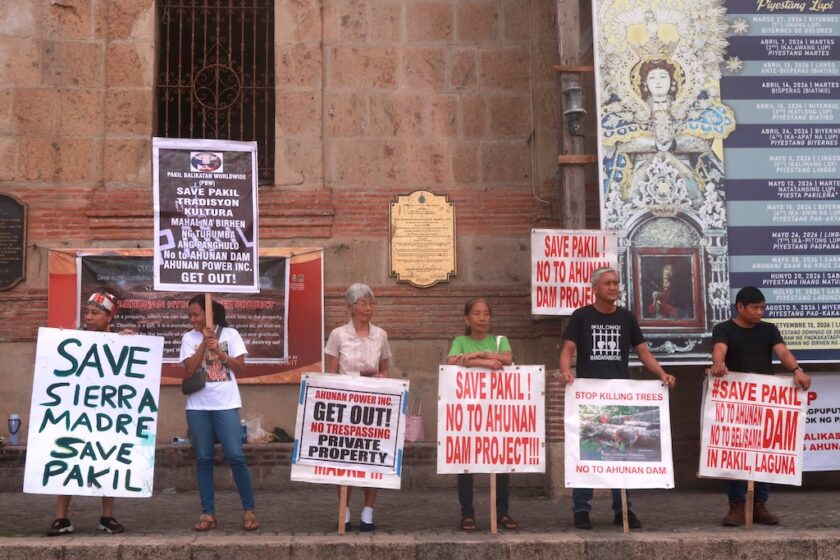
Manapak and the residents of Pakil held a silent protest in front of the Saint Peter of Alcantara Parish Church on June 28, condemning the Ahunan Power Inc. for its destructive project. (Photo by Shannia Cabuello/Bulatlat)
A month after, June 25, the NHCP lifted the CDO as the project “will not adversely affect the San Pedro de Alcantara Parish Church– outlining the dust mitigation and environmental monitoring measures being implemented.”
“The truth is, there is no CDO to be lifted because they never complied. The DOE (Department of Energy), the API (Ahunan Power Inc.) and the LGU (Local Government Unit) disregarded the order of NHCP,” emphasized Danilo Francisco, the Committee on Justice, Peace, and Integral Ecology for the Laguna Economical Movement of the Diocese of San Pablo Chairman in Filipino.
Regardless of NHCP’s indecision, the people of Pakil consistently emphasized how Mt. Ping-as looks like now, burned and barren.
“It is very obvious that Ahunan does not mean development but destruction. Destruction of our mountain,” Regalado underscored, rejecting development that costs livelihoods and natural resources.
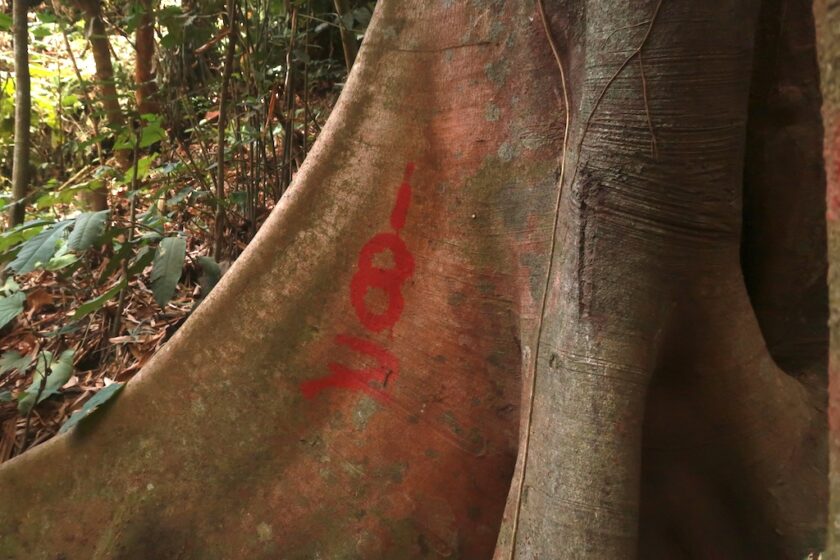
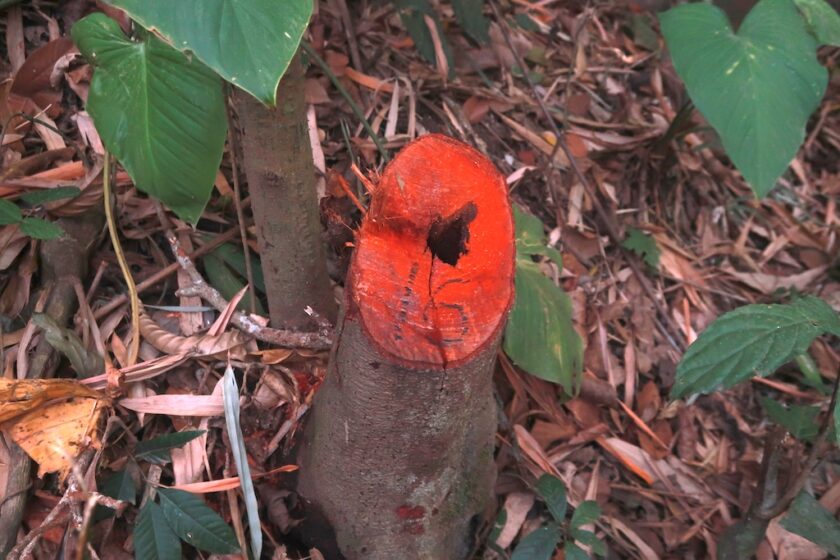
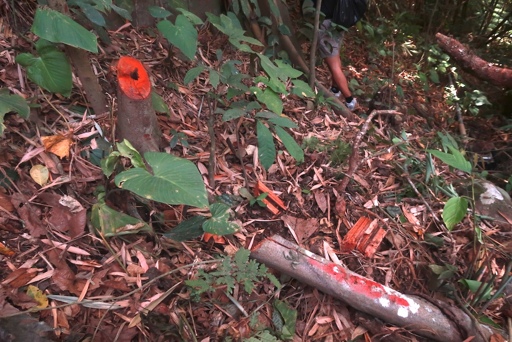
Some of the cut and numbered trees atop the mountain. Cut trees were identified as Bamboo, Narra, Santol, Lanzones, and Langka. (Photo by Shannia Cabuello/Bulatlat)
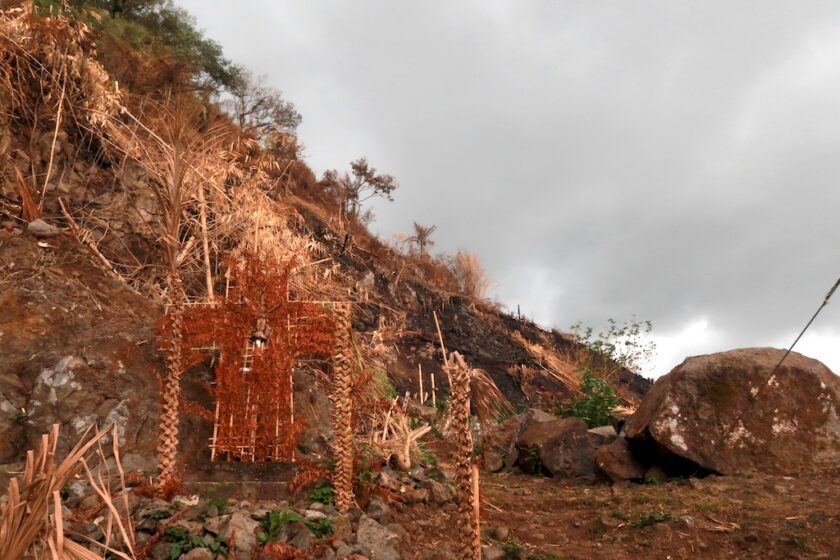
One of Ahunan sa Ping-as stations which a resident described as now burned and barren. (Photo by Shannia Cabuello/Bulatlat)
Pakil before
“People before really just depend on agriculture. For the entire year, we do not run out of something to pick,” recalled Rosalia Naldo, 79, who grew up in Pakil.
Before, Naldo shared that their town was abundant in fruits such as chico, star apple, coffee, cacao, lanzones, langka (jackfruit), santol, and mango. As a result, the community always has something to eat and sell, and celebrate during their festivals.
Now, the ESCIM’s rapid biodiversity assessments in the areas discovered bulldozers on the top of the mountain where trees were cut and some are already numbered. These trees include lanzones and langka.
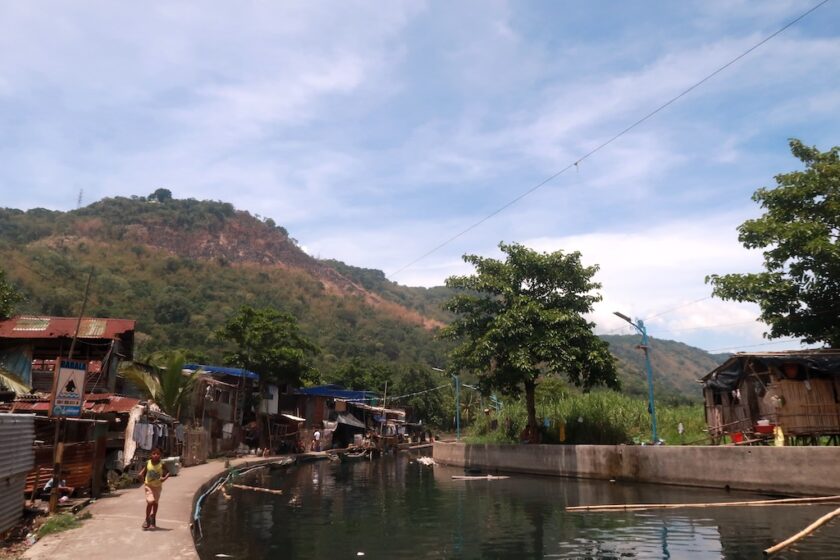
View of the deforested mountain from the farmers and fisherfolk community. (Photo by Shannia Cabuello/Bulatlat)
Agham Southern Tagalog and Kalikasan Timog Katagalugan also observed in the ESCIM a land cover change of approximately 255 hectares from vegetation to bare soil.
Naldo also said that fishes caught are not as plentiful as before, and some freshwater fish like ‘piton’ are gone now. She alleged that it is caused by the Caliraya Power Plant in Lumban, Laguna, and fears that worse could happen in Pakil if the Ahunan Power Plant remains operating.
Aside from its natural resources, Pakil is also known as the Pilgrimage Capital of Laguna, hosting the longest religious festival in the Philippines.
Every year, pilgrims celebrate Turumba Festival or Pistang Lupi which consists of seven novenas to honor the seven sorrows of the Virgin Mary, lasting for seven months.

A fabric that intricately symbolizes Pakil. The mountain-shaped cut at the top represents Mt. Ping-as, while the blue details flowing down its sides symbolize the natural irrigation towards the farm lands and forests. Our Lady of Sorrows of Turumba is placed in the middle, representing faith as the center of Pakil’s identity. (Photo by Shannia Cabuello/Bulatlat)
During this period, Naldo shared that devotees bathe in Panghulo or Turumba Spring which is believed to be healing and holy. It is also one of the main sources of the town’s income.
“Water is abundant here. That’s why we are afraid that if the trees were gone, we might lose it too,” she added.
As of ESCIM’s initial findings, almost all parameters of water in Pakil remain drinkable upon filtering and safe for leisure and livelihood. However, Agham ST and Kalikasan TK stated that the mechanisms of the dam could pollute, affect, and reduce the natural flow of water.
For hundreds of years, ‘Ahunan sa Ping-as’ has also been part of their tradition where Pakil people and visitors trek up the mountain every last Saturday of May.
“Pakil is very beautiful. We have mountain, downtown, farmlands, sea, lake. All of it sent me to school. Why won’t I return it to Pakil?” said Regalado, sharing that it serves as the fire in their fight for the preservation of Pakil.
According to Regalado, Ahunan Power Inc. conducted a forum for the proposed project in December 2022.
It is discussed that it will not affect Pakil’s water supply, the dam water will not come from the spring and river, the fields will not be dried, and it will not cause landslides.
Six years had passed, Pakileños now bore the impact of the powerplant.
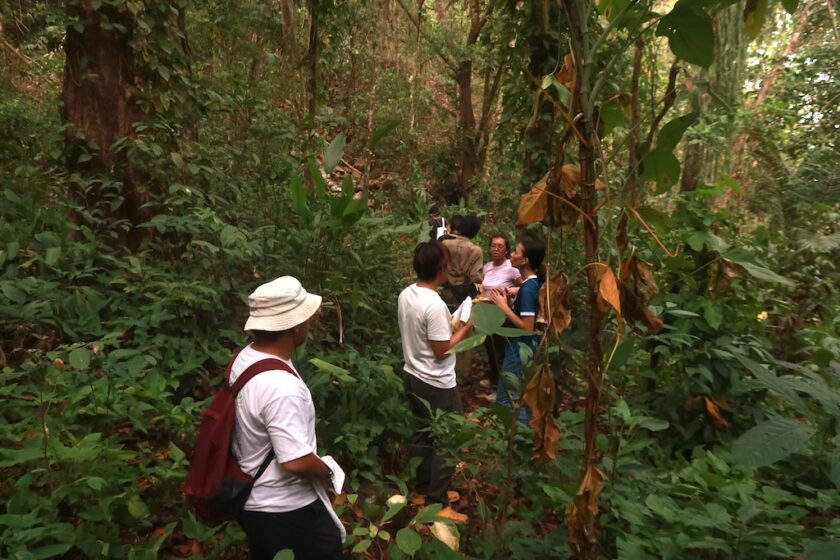
Volunteer scientists, engineers, and community researchers at Mt. Ping-as as they conduct an independent Environmental and Socio-cultural Impact Mission (ESCIM) to assess the effects of Ahunan Power Plant to communities in Pakil. (Photo by Shannia Cabuello/Bulatlat)
Pakil now
“It saddens me that all the water I saw is now dead,” said Jimenez after joining the impact mission’s biodiversity mapping and water quality monitoring.
Pakileños living on the mountain reported during ESCIM that they have been scrambling for water as their supply is being cut off. Above the mountain, several waterways have also dried up.
The forum in 2022 also stated the project’s benefits such as increase in income tax and funding of electrification, development, livelihood, reforestation, water management, health and environment enhancement.
In contrast, farmers and fisherfolk expressed in ESCIM’s focus group discussion that it is predictable that in five to 10 years, they will have no land to till and waters to fish in.
Their agricultural land has decreased in size now. They also shared that communities have also been displaced as some residential areas became the dump site of the powerplant construction.
“That’s the painful part. When they dumped there, even houses were dumped. Many people were wiped out. They have gone to different places,” farmer and fisherfolk John Ryan Salvador disclosed in Filipino.
Salvador jokingly added that in the next few years, researchers will not be able to interview Filipinos in Pakil anymore, as Chinese nationals proliferated in their municipality.
Ahunan Power Plant’s main Engineering, Procurement, and Construction (EPC) contractor is PowerChina, employing Chinese nationals who now live in the area.
These changes also caused fear and uncertainty to the people of Pakil.
Fear in own land
Project Noah classified Pakil as high to moderately susceptible to landslides. This has caused families to worry about their safety. The deep-rooted trees like Bamboo, Narra, and Santol can help in preventing this disaster, however these trees were also cut off.
Moreover, hiking the Mt. Ping-as is no longer peaceful. During the ESCIM, security guards were stationed at the foot of the mountain, while some individuals actively surveilled hikers throughout their ascent.
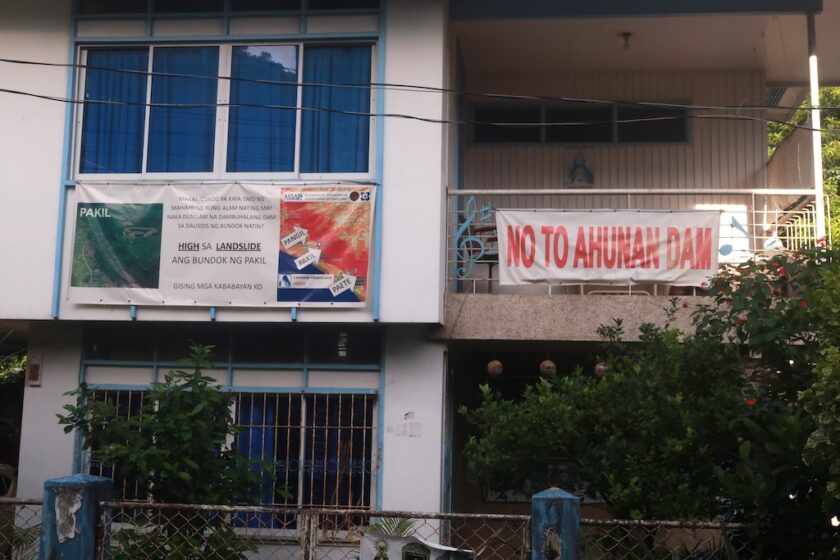
Banners opposing the Ahunan Power Plant are posted on the houses in Pakil, Laguna. It cites Project Noah’s classification of Pakil as high to moderately susceptible to landslides, aiming to awaken communities against the Ahunan Power Plant. (Photo by Shannia Cabuello/Bulatlat)
Teresa “Tessie” Saldaña Sanchez who has lived in Pakil since birth shared that in June 2025, they went to visit their land on the mountain with her children.
Along the way, they were confronted and questioned by personnel about the purpose of their hike.
“Since I was a child, climbing the mountain is allowed,” she recalled, now worrying that their mountain would soon be owned by the Ahunan Power Inc., restricting people from hiking.
Aside from surveillance, there have also been cases of threats and harassment to those who protest against the powerplant.
On June 11, 2022, an environmental defender, Vertrudez ‘Daisy’ Macapanpan was illegally arrested and redtagged for opposing the Ahunan Project.
Read: Arrest of environment activist linked to Ahunan dam project
Though she was out on bail two months after, the chilling effect is evident to residents who became hesitant to fight for their rights after the incident.
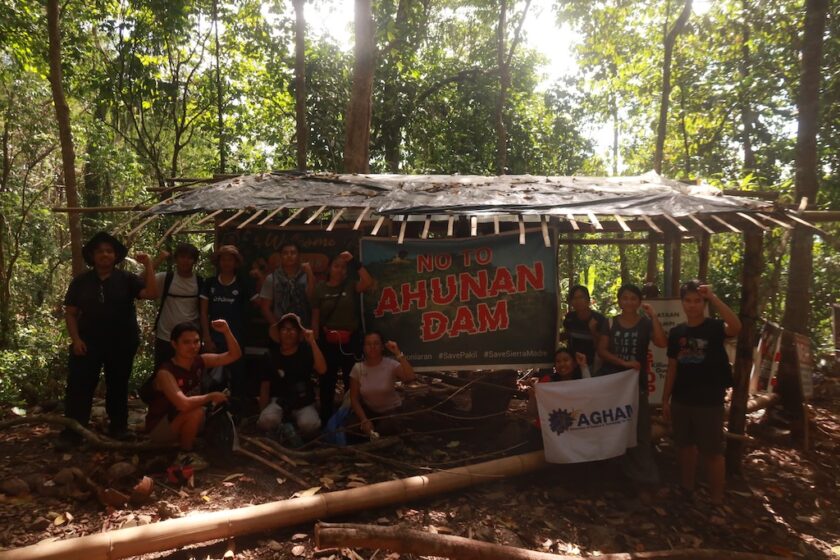
(Photo by Shannia Cabuello/Bulatlat)
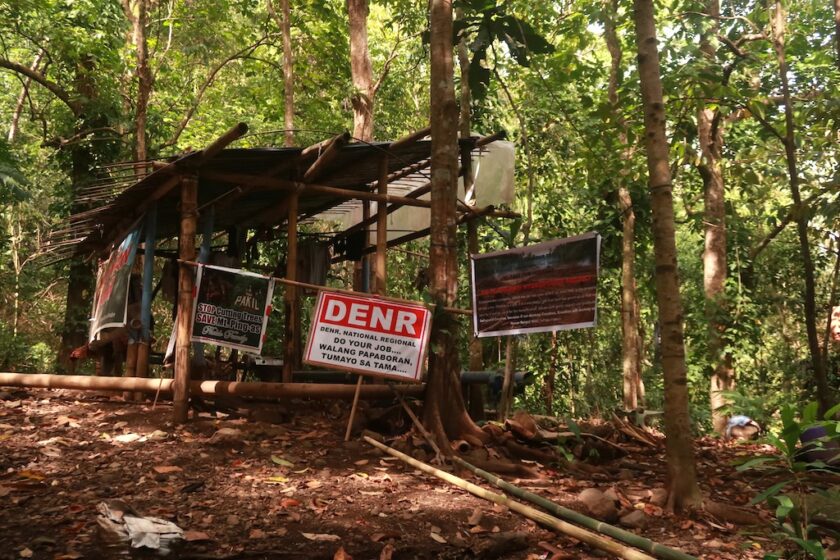
“We are the ones affected, of course we are against it. Pakil was abundant before. You can climb the mountain and harvest fruits and vegetables. Now, if you climb then get caught, you would be put to jail,” shared Salvador in the focus group discussion.
The farmers and fisherfolks also highlighted how the project divided the Pakileños to those who want development and those who oppose the destruction.
“A lot has changed since that (Ahunan Power Inc.) came. The people now are angry at each other,” added Salvador.
His father who is also a farmer and fisherfolk, Ruben Salvador stressed that even if they all united against the project, there would still be fear due to lack of support from their LGU.
“Many are objecting. However, some cannot take action because of fear. They are not supported by officials. If the higher ups go down here, then things will happen,” he said.
The Network Opposed to Ahunan Dam emphasized in a statement that if people know where they stand, there is no reason to be afraid.
“Energy development should genuinely serve the interests of the Filipino people,” reiterated by progressive scientists group, Agham, who are standing firm with Pakil in opposing this destructive project.
As the environmental defenders similarly state, progress must also mean protection of ecosystems, respecting communities’ rights and culture, and ensuring that the public mainly benefit from it.
For the love of Pakil, its people will continue defending their land with faith so future generations inherit its rich resources and heritage. (RVO)
The post What changed in Pakil after Ahunan Hydropower Project appeared first on Bulatlat.
From Bulatlat via This RSS Feed.