

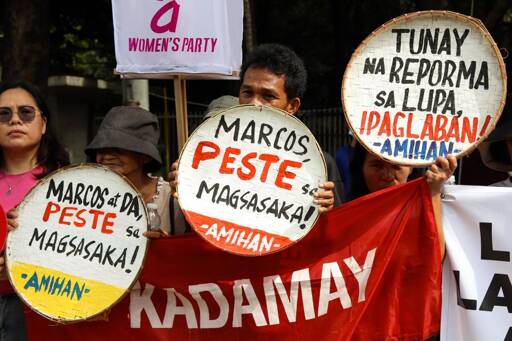
For decades, land ownership on Negros Island has remained concentrated in the hands of a small number of elite families.
By Trisha Nasam

MANILA — Negros farmer Allan* tills the land on borrowed time.
Every planting season, he returns to the 0.2-hectare field he has been cultivating for nearly five decades. Born to a family of farmers, Allan adopted the same livelihood, learning to farm as young as 12 years old.
Despite spending most of his life growing food in the same land, the 60-year-old is reminded that the land is never truly his.
Sometimes, Allan recalled, the landowner would visit and tell him that his stay was temporary, that one day he would have to vacate the field. This is why Allan, despite his low income, stays on “his” land while other farmers visit different barrios to take on more farm work.
“I haven’t tried [going away]. Because once you’re separated from the land you cultivate, everything changes. You don’t know what lies ahead,” he said.
Compared to neighboring farm workers whose land tenure was also under threat, he had an “okay” relationship with the land’s owner.
According to him, other hacienderos would beat up farmers who refused to leave their field. Usually, he said, converted farmlands become a space for “towering buildings, housing rentals and resorts.”
Allan tried applying to be a Comprehensive Agrarian Reform Program (CARP) beneficiary. It was not granted by the Department of Agrarian Reform (DAR).
When they asked the Department of Environment and Natural Resources (DENR) for proof of the landowners’ claim, he said that there was nothing they could provide. “That’s the difficult part. They want to drive us, farmers, off the land, yet they have no proof that it belongs to them,” Allan said.
He said that some farmers he knew who were CARP beneficiaries eventually had to sell their land to afford basic services like healthcare. “A neighboring farmer who also benefited from the CARP was forced to sell the family’s land after both parents were hospitalized. Unable to afford the medical bills, the family had no choice but to part with the property.”
Across Negros Island, generations of farmers continue to cultivate land they do not own, a legacy that peasant groups say has persisted despite decades of lobbying for agrarian reform.
Read: Bungkalan: Mga Aral mula sa Hacienda Luisita at Negros
“Negros is known as one of the country’s foremost strongholds of feudalism,” Defend Negros Network convenor Emmanuel Acosta said during the State of the Philippine Environment forum on July 10. “For decades, land ownership on Negros Island has remained concentrated in the hands of a small number of elite families, hacienderos, hacienderas, and landlords. While they reap the profits of agricultural production, the thousands of farm workers whose labor generates that wealth remain landless.”
Peasant and environmental rights advocates said that this landlessness is exacerbated by the Marcos Jr. administration’s push for development and renewable energy projects which the Center for Environmental Concerns (CEC) said allows for land grabbing and land use conversion.
“Every expansion of these projects further reduces the land available to grow food, undermining local food production,” Earlh Palacio of CEC said.
As elites and landlords retain control over farmlands and repurpose them for commercial ventures, farmers like Allan fear that food will soon be out of reach for those who grow it.
No way out/Mounting challenges
For Allan, the harvest first goes to his family’s table.
Only when there is enough left does he bring his produce to the market to earn money for daily expenses. Even then, the income is barely enough to survive. “Our income is meager because people from the market buy our produce at a very low price. It cannot meet our everyday needs,” he said.
His experience illustrates another challenge confronting farmers, which is producing food does not necessarily mean escaping poverty.
According to think tank Ibon Foundation, there is a 27% poverty incidence among farmers as agriculture workers remain among the lowest paid. They added that “the chronic neglect of agriculture has not only impoverished farmers but has also ingrained widespread hunger.”
Shrinking agricultural land does not only entail food insecurity at the national level, but even more among small-scale farmers. “Small farmers will go hungry. Living conditions will worsen further because the land they cultivate will be lost,” Allan said.
Larry Diego, a Bataan-based organic farmer from Magsasaka at Siyentipiko para sa Pag-unlad ng Agrikultura (MASIPAG), said, “Agricultural land keeps getting smaller, especially now with rampant land grabbing, development aggression, and mining. Nako po, it’s going to cause trouble. Solar [farms] would not benefit us either.”
He added that farmers remain trapped in rising production costs, low prices, and increasing competition from imported agricultural products.
As a trainer in MASIPAG, he seeks to bridge the gap between farmers’ low income and high production costs by introducing them to organic farming. However, he said that fellow farmers’ hands are tied. Since many still do not own the land they till, they do not have the freedom to pursue other farming techniques due to “regulations” of the landowner.
In organic farming, costs from expensive pesticides will no longer cut into a farmer’s earnings, Diego said, adding that this will also keep the produce nutritious as no chemicals were used in the process.
Beyond this, he stressed that organic farming would save farmers from the “exploitative” practices of middlemen as they will be allowed to set their own prices before sale. “The profit that would have gone to middlemen is instead shared by the farmers and the consumers… Without a middleman, farmers earn more.”
This direct access, he said, could be further improved by linkages and postharvest facilities that would make the entire production process efficient.
In January 2024, Agriculture Secretary Francisco Tiu Laurel Jr. reported that about 30% of harvest was wasted due to poor logistics. Laurel said that the department had a “three-year plan” to increase postharvest facilities which he claimed had not had “major” government investment in the last 40 years.
Bulatlat reached out to the Department of Agriculture (DA) to obtain data on the list of functional postharvest facilities and farm-to-market roads across the country as of June 2026. The DA acknowledged the request but has yet to provide the information.
Life tied to land
Food sovereignty advocate Lao Castillo said that while talks about food security are crucial, the government must also dismantle the deeply entrenched system that disempowers farmers’ ability to produce.
“The food we eat every day has to do with the food system that we have,” he said. “We need to really unpack and interrogate our longstanding problems in land and agriculture.”
“We are gifted with such abundance, and we should not take this abundance for granted,” he said.
As Negrense farmers stand to lose their land, Allan and his neighbors seek to appeal to their landlords to let them stay.
If the landowners evict them from their lands, Allan said that they will have nowhere else to go. Being a farmer for his entire life, he considers the essence of his being intertwined with the field and its soil.
Allan spends every day in the field with an agonizing fear that one day he will be parted from a piece of his soul. “My life is tied to the land I till. Now that they’re trying to take the land from us, it’s like they are killing me too.” (RTS, DAA)
*Allan’s real name is withheld for safety purposes.
The post ‘Philippines may lose ability to feed population’ appeared first on Bulatlat.
From Bulatlat via This RSS Feed.