

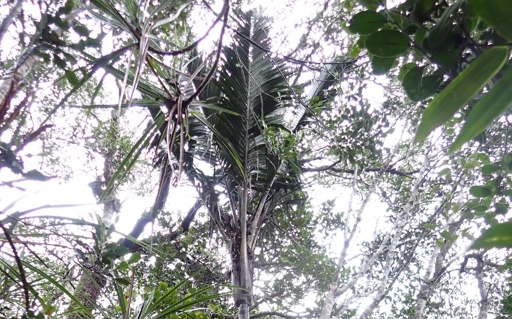
Researchers have tracked down 28 individuals of a palm tree species last recorded in Madagascar nearly 100 years ago. Nearly every tree of the species, Ravenea latisecta, was found within four protected areas in the Andasibe-Mantadia region of Madagascar, according to a recent study. “Andasibe–Mantadia is one of Madagascar’s best-explored botanical regions, and Ravenea latisecta is not an inconspicuous plant, it is a palm several metres tall,” Louis Aureglia, study lead author with Aix-Marseille University in France, told Mongabay by email. “Yet confirmed populations remained undocumented for almost a century. This is a good reminder that botanical exploration is far from complete.” There are around 20 known species of palm trees in the genus Ravenea. All are only found in Madagascar and the Comoros, and nearly all are endangered or critically endangered. For the study, Aureglia and his colleagues launched a survey in Andasibe–Mantadia in 2024 to document Ravenea palm trees in the wild. They also examined historical specimens kept in herbariums. Palm trees are usually large and difficult to miss, yet some Ravenea species can be tricky to tell apart with confidence if they’re not flowering, Aureglia said. The “real turning point” in their fieldwork, he added, was when they found “fertile” plants: male or female trees containing inflorescences, or branched structures with clusters of flowers. “Ravenea latisecta is dioecious, meaning that male and female flowers are produced on separate plants,” Aureglia said. “Once we found both male and female individuals, with inflorescences matching the original description, we could…This article was originally published on Mongabay
From Conservation news via This RSS Feed.